Andrew O’Hagan

Andrew O’Hagan is the LRB’s editor at large. He is the author of seven novels – Our Fathers, Personality, Be Near Me, The Life and Opinions of Maf the Dog, The Illuminations, Mayflies and Caledonian Road – and four books of non-fiction: The Missing, The Atlantic Ocean: Essays on Britain and America, The Secret Life: Three True Stories (which contains his LRB pieces on Julian Assange, creating a fake identity online and the search for Satoshi Nakamoto) and On Friendship.

His first piece for the LRB, a Diary about James Bulger’s murder and the cruelty of children to other children, appeared in 1993, when he was working as an editor at the paper (in 2010 he wrote about Jon Venables’s rearrest). He has written more than a hundred and fifty pieces for the LRB since then, on subjects including begging, the sinking of his grandfather’s ship, the murder of the Irish solicitor Rosemary Nelson, Marilyn Monroe and Arthur Miller, the end of British farming, Jonathan Franzen, hating football, Scotland’s sense of grievance, the Democratic and Republican National Conventions of 2004 and the Republican one of 2024, poetry anthologies, the 7/7 bombing outside the LRB’s old offices, the aftermath of Hurricane Katrina, what happens to our rubbish, a driving holiday with Seamus Heaney and the LRB’s first editor, Karl Miller, Jimmy Savile and the BBC, Norman Mailer, the Daily Mail, the Grenfell disaster, Robert Louis Stevenson in Bournemouth and in Edinburgh, old Soho, the New Romantics and Prince Harry.

Short Cuts: Clytemnestra du jour

Andrew O’Hagan, 21 February 2013

Where revenge ought to be slow, artful and elegant, payback is sudden and terribly crude. And when it comes to popular forms of personal justice, one is either Electra, swearing long and subtle revenge for her father’s death, or Clytemnestra, who started the whole thing off by killing Agamemnon in a moment of saliva-curdling jealousy. Some people argue that the king’s wife...

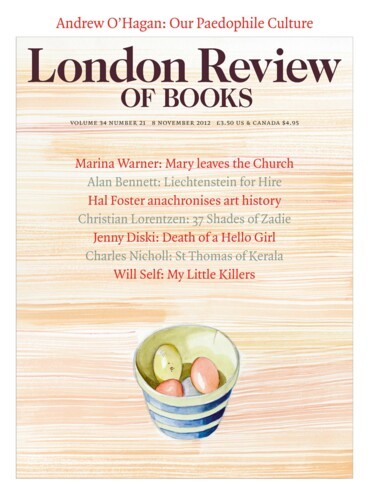
Light Entertainment: Our Paedophile Culture

Andrew O’Hagan, 8 November 2012

The BBC isn’t the Catholic Church, but it has its own ideals and traditions, which cause people to pause before naming the unwise acts that have been performed on its premises. Perhaps more than any church, the BBC continues to be a powerhouse of virtue, of intelligence and tolerance, but it is now suffering a kind of ecclesiastical terror at its own fallibility. One has to look further into the institution to see another, more obscure tradition, the one that leads to Savile and his liberty-taking. There was always an element of it waiting to be picked up. Many people I spoke to wished to make that clear, but – feeling the Chorus watching from above – they asked for anonymity.
When it comes to erotic writing, the more explicit it gets – the more heaving, the more panting – the more I want to laugh. Erotic writing is said to have a noble pedigree: the goings-on in Ovid, the whipping in Sade, the bare-arsed wrestling in Lawrence, the garter-snapping in Anaïs Nin, the wife-swapping in Updike, the arcs of semen hither and yon. But it’s so much sexier when people don’t have sex on the page.

Issues for His Prose Style: Hemingway

Andrew O’Hagan, 7 June 2012

Good reporters go hunting for nouns. They want the odd verb too, but the main thing is the nouns, especially the proper ones, the who, what and where. The thing British schoolchildren call a ‘naming word’ was, for Hemingway, a chance to reveal what he knew, an opportunity to be experienced, to discriminate, and his style depends on engorged nouns, not absent adjectives. But at times it strikes you that the cult of specificity in Hemingway is a drug you take in a cheap arcade: lights flash on the old machines and a piano plinks overhead.

Letter
David Thomson has high standards in film stars and he imposes rather firm rules about how they ought to twinkle, but he isn’t being fair to Marilyn Monroe (Letters, 24 May). The actress won’t be confused anytime soon with Abraham Lincoln or Abbie Hoffman, but in her own way she changed the situation, pre-1960s, by making the personal feel like something more political. Twentieth Century-Fox...

About a third of the way through his first book, The Missing, Andrew O’Hagan pauses over a perception he thinks his readers may find ‘a bit surprising’. It’s an intricate...

Read more reviews

Read anywhere with the London Review of Books app, available now from the App Store for Apple devices, Google Play for Android devices and Amazon for your Kindle Fire.

Sign up to our newsletters

For highlights from the latest issue, our archive and the blog, as well as news, events and exclusive promotions.

Newsletter Preferences