Andrew O’Hagan

Andrew O’Hagan is the LRB’s editor at large. He is the author of seven novels – Our FathersPersonalityBe Near MeThe Life and Opinions of Maf the Dog, The Illuminations, Mayflies and Caledonian Road – and four books of non-fiction: The MissingThe Atlantic Ocean: Essays on Britain and AmericaThe Secret Life: Three True Stories (which contains his LRB pieces on Julian Assange, creating a fake identity online and the search for Satoshi Nakamoto) and On Friendship.

His first piece for the LRB, a Diary about James Bulger’s murder and the cruelty of children to other children, appeared in 1993, when he was working as an editor at the paper (in 2010 he wrote about Jon Venables’s rearrest). He has written more than a hundred and fifty pieces for the LRB since then, on subjects including begging, the sinking of his grandfather’s ship, the murder of the Irish solicitor Rosemary NelsonMarilyn Monroe and Arthur Miller, the end of British farmingJonathan Franzen, hating footballScotland’s sense of grievance, the Democratic and Republican National Conventions of 2004 and the Republican one of 2024, poetry anthologies, the 7/7 bombing outside the LRB’s old offices, the aftermath of Hurricane Katrina, what happens to our rubbish, a driving holiday with Seamus Heaney and the LRB’s first editor, Karl Miller, Jimmy Savile and the BBC, Norman Mailer, the Daily Mail, the Grenfell disaster, Robert Louis Stevenson in Bournemouth and in Edinburgh, old Soho, the New Romantics and Prince Harry.

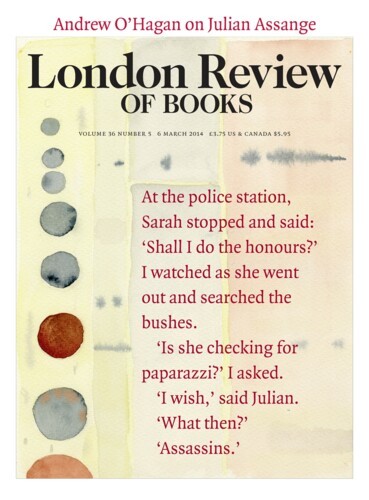
Ghosting: Julian Assange

Andrew O’Hagan, 6 March 2014

On 5 January 2011, at 8.30 p.m., I was messing about at home when the phone buzzed on the sofa. It was a text from Jamie Byng, the publisher of Canongate. ‘Are you about?’ it said. ‘I have a somewhat left-field idea. It’s potentially very exciting. But I need to discuss urgently.’ Canongate had bought, for £600,000, a memoir by the WikiLeaks founder, Julian Assange. The book had also been bought for a high sum by Sonny Mehta at Knopf in New York and Jamie had sold foreign rights to a slew of big houses. He said he expected it to be published in forty languages.
Kitty still pines for his dearest Dub: Gossip

Andrew O’Hagan, 6 February 2014

The much gossiped about George Eliot absolutely hated the idea of people talking behind their hands. The year she took up with a married man was also the year Ruskin’s wife revealed her husband’s impotence during court proceedings. ‘Gossip is a sort of smoke that comes from the dirty tobacco-pipes of those who diffuse it,’ Eliot wrote ironically in Daniel Deronda. But she also meant it. ‘It proves nothing but the bad taste of the smoker.’ Cough, cough, splutter. But surely a bit of relief lies in the notion that one doesn’t necessarily have the last (or even the first) say on how one appears.

The Reviewer’s Song: Mailer’s Last Punch

Andrew O’Hagan, 7 November 2013

Let me issue a warning. This is not a review. And it isn’t a memoir either: it’s a memoir-as-review, or perhaps an autobiographical review, or just a moderate piece of literary egotism masquerading as scholarship, or a shotgun marriage between the handsome remnants of personal history and the pretty stuff on the public record. Let’s take the spirit of J. Michael Lennon’s ‘double life’ of Norman Mailer and offer that doubleness back as subjective criticism. Mailer, after all, gave us the non-fiction novel, Lennon gives us the pseudo-objective biography, so why can’t I offer the confessional review?

Short Cuts: ‘The Trip to Echo Spring’

Andrew O’Hagan, 12 September 2013

There was a drawer in every room of our house and in every drawer there was a white pamphlet. On the cover it said: ‘Who, Me?’ My mother had placed the pamphlets there in the hope that when my father tried to find a corkscrew or a book of matches he would see the bold question and finally ask it of himself. I don’t know whether any of my brothers remember this, but I do, or...

Boys and Girls: With the Child Jihadis

Andrew O’Hagan, 8 August 2013

At the juvenile detention centre in Kandahar there are two sets of children. The first are riotous and loud, arrested for theft and other crimes of that sort. When you give them a piece of paper and ask them to write down the reason they are in prison they simply scratch lines into the paper or scrunch it up. They can’t write. The second group are silent. But when they take the sheet of paper they begin to write the most beautiful script, their sentences full of fire and argument. These are the child jihadis and their mothers tell them they will succeed next time.

About a third of the way through his first book, The Missing, Andrew O’Hagan pauses over a perception he thinks his readers may find ‘a bit surprising’. It’s an intricate...

Read more reviews

Read anywhere with the London Review of Books app, available now from the App Store for Apple devices, Google Play for Android devices and Amazon for your Kindle Fire.

Sign up to our newsletter

For highlights from the latest issue, our archive and the blog, as well as news, events and exclusive promotions.

Newsletter Preferences