Alan Bennett

Alan Bennett’s first play, Forty Years On, was produced in 1968; his most recent, Allelujah! in 2018. The Choral, for which he wrote the screenplay, was released in 2025. Bennett’s diary for 1983 appeared in the LRB, and we carried his diary every year after that until 2023. He now claims his life is so dull he won’t inflict it on LRB readers. The Lady in the Van was first published in the paper, and the LRB has also carried some of his Talking Heads monologues; short stories, such as ‘The Uncommon Reader’; pieces of memoir; and reviews, including ‘The Wrong Blond’, on W.H. Auden and Chester Kallman, and ‘Alas! Deceived’, on Philip Larkin.

Diary: Fresh Revelations

Alan Bennett, 20 October 1994

13 January. Having supper in the National Theatre restaurant are Lindsay Anderson and Gavin Lambert. ‘I suppose you like this place,’ says Lindsay. I do, actually, as the food is now very good. I say so and Lindsay, who judges all restaurants by the standard of the Cosmo in Finchley Road, smiles wearily, pleased to be reassured about one’s moral decline.
‘The Stringalongs’

Alan Bennett, 24 February 1994

Had Mark Boxer not been the first to acknowledge it I’d hesitate to claim the Stringalongs (I never hyphenated it) as my children but they did have a previous existence before they were adopted by Marc.

Diary: Where I was in 1993

Alan Bennett, 16 December 1993

4 January. On BBC’s Catchword this afternoon, one of the questions apparently consists of anagrams of playwrights. Mine is Annabel Tent. Nobody guesses it.

Alas! Deceived: Larkin the Librarian

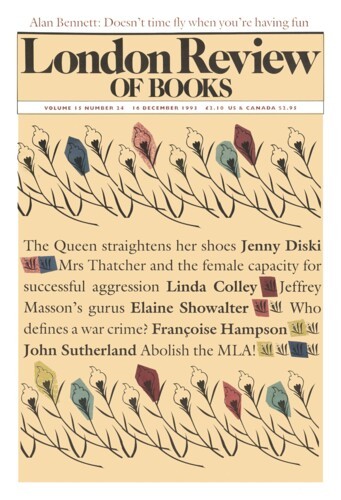
Alan Bennett, 25 March 1993

‘My mother is such a bloody rambling fool,’ wrote Philip Larkin in 1965, ‘that half the time I doubt her sanity. Two things she said today, for instance, were that she had “thought of getting a job in Woolworth’s” and that she wanted to win the football pools so that she could “give cocktail parties”.’ Eva Larkin was 79 at the time so that...

The King and I

Alan Bennett, 30 January 1992

I’ve always had a soft spot for George III, starting all of forty years ago when I was in the sixth form at Leeds Modern School and reading for a scholarship to Cambridge. The smart book around that time was Herbert Butterfield’s The Whig Interpretation of History, which took the 19th century to task for writing history with one eye on the future, and in particular for taking as the only path through the past the development of democratic institutions. On the Whig interpretation, historical characters got a tick if they were on the side of liberty (Cromwell, Chatham), a cross (Charles I, James II) if they held up the march of progress. Because he went in for active royalty and made some attempt to govern on his own account rather than leaving it to the Whig aristocracy, George III had been written up as a villain and a clumsy tyrant. This view Butterfield had helped to discredit, so a question on George III was thought likely to turn up in the Cambridge examination, which it duly did. Sitting in the freezing Senate House in December 1951, I trotted out my Butterfield and though I didn’t get a scholarship, counted myself lucky to be offered a place at Sydney Sussex, that Christmas when the college letter came the best Christmas of my life.’

Read anywhere with the London Review of Books app, available now from the App Store for Apple devices, Google Play for Android devices and Amazon for your Kindle Fire.

Sign up to our newsletters

For highlights from the latest issue, our archive and the blog, as well as news, events and exclusive promotions.

Newsletter Preferences