‘Nayatt School Redux’
Anna Aslanyan
The Cocktail Party by T.S. Eliot was first performed at the Edinburgh Festival in 1949. In 1966, Spalding Gray acted in it in upstate New York. He later spoke of being especially interested in Celia, a character who is ‘articulate about her “madness”. For me, she was a fantasy of what my mother might have been had she had the intellectual distance to articulate her nervous breakdown.’ Gray’s mother killed herself in 1967.
Gray and Elizabeth LeCompte intertwined his memories with Eliot’s play to devise the third part of Three Places in Rhode Island, a trilogy based on Gray’s life. Nayatt School was first performed by the Wooster Group at the Performing Garage in New York in 1978. ‘Autobiography gives way to farce,’ Jim O’Quinn wrote in his review for American Theatre. ‘But Gray’s personal history is the trilogy’s anchor.’
That history continued with Gray’s monologues – Monster in a Box, Sex and Death, Swimming to Cambodia – and ended when he jumped into New York Harbor in 2004. Depressed, he had talked of ‘creative suicide’. Oliver Sacks, who had treated him, recalled: ‘I was at pains to say that he could be much more creative alive than dead.’
The Wooster Group grew out of the Performance Group (TPG), an avant-garde collective founded by Richard Schechner in 1967. Gray later wrote that Schechner ‘emphasised the performer, making him more than, or as important as, the text’. The agent who helped TPG secure the building that became the Performing Garage, on Wooster Street, was George Maciunas, the co-ordinator of the Fluxus movement.
In Nayatt School, Gray played a ‘pedantic schoolteacher’ and the psychiatrist from The Cocktail Party, using a recording of its 1949 production. ‘It was also about my mother,’ Gray wrote, ‘and the victimisation of women in male-dominated social structures. It worked on many levels for us all.’
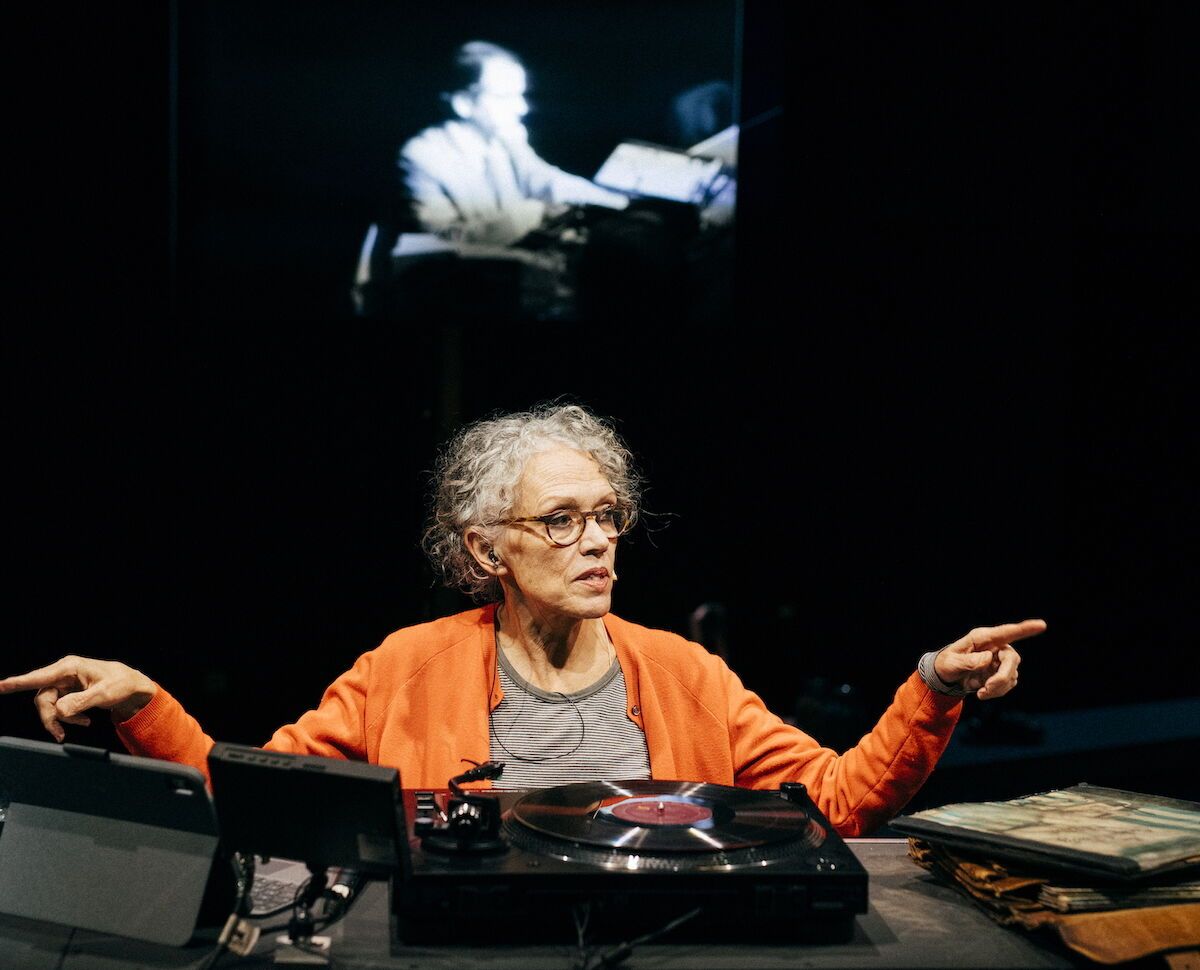
The play has now been remounted by The Wooster Group. Nayatt School Redux, directed by LeCompte, is on in London this week. The set at the Coronet Theatre comprises a black stage, a large screen and a few props, including a pink chair from the 1978 production. A projected photo of the Performing Garage forms the backdrop. A bar stretches along the front row, with turntables at one end and a laptop at the other. Sitting at the bar, face-to-face with the audience, Kate Valk narrates Gray’s and her own beginnings in experimental theatre.
Black-and-white footage of an early performance of Nayatt School appears on the screen: the image is poor quality, the sound even worse. Valk, consulting the transcript, deciphers the footage: now Gray cleans a record, now he puts it on … Turning my head, I noticed that the back of the auditorium also had a screen on it, showing the same images.
Gray grew up listening to the radio. His Christian Scientist mother forbade it, but he used a crystal set and earphones. When he plays the LP of The Cocktail Party in the footage, demented laughter is heard; he called it ‘infectious’. ‘I was concerned and thinking about a number of social themes,’ he wrote, ‘revolving around madness, anarchy, my particular socialisation process and the loss of innocence.’
Nayatt School Redux continues with a reading from The Cocktail Party. Scott Shepherd plays the psychiatrist while directing Maura Tierney as Celia. The young woman is heartbroken; the psychiatrist sends her to an institution. The scene is synced with the action in the footage. When Tierney asks for water, Shepherd pours a full glass back into the jug, then fills it again.
More drink is poured in the final scene from The Cocktail Party, acted out by the Nayatt School Redux cast: glasses are arranged, filled and knocked over. One character wears an acid green shirt and pink shoes; similar bright spots flash in the partly colourised footage, ‘the shadow of desires of desires’. Celia’s death is announced on stage, in a deliberately stagy manner – after becoming a missionary, ‘she was crucified very, very near an anthill’ – and shown on the screens.
Rehearsals of Nayatt School in 1978 included a workshop with boys aged between five and seven, where ‘all the adults involved would pull back and just play with the children’. The unruly boys never appeared in the show; instead, it had four eleven-year-olds lying still on the floor while Gray played his LP. ‘Then we’d do improvs around their reactions to the record … This made a wonderful juxtaposition of child and adult consciousness.’ In the finale the children were told to keep their eyes shut. What they didn’t see (and neither did we at the Coronet) was another performer, Ron Vawter, trying ‘to play a record with his penis’ and Gray, ‘with his bare ass to the audience’, drilling holes in vinyl.
Before joining TPG, Gray ‘had been working at becoming an “actor”’. ‘It was Richard Schechner’s method,’ he wrote, ‘that allowed me to drop the roles and come back to myself.’