Thomas Jones

Thomas Jones edits the LRB blog and presents the paper’s podcast. He has been writing for the LRB since 1999, when he was an editorial assistant. Many of his pieces have been Short Cuts. Most of the others have been on contemporary fiction, though he has also written on Romantic poetry, the ancient Greeks and Romans, the climate crisis and Italian politics. He has lived in Italy since 2006. Game Theory, a novel, was published in 2018.

Your life depends on it: Jonathan Raban

Thomas Jones, 19 October 2006

Jonathan Raban’s first work of fiction, Foreign Land, was published in 1985; his second, Waxwings, in 2003; Surveillance is his third. A gap of almost twenty years, and then two novels in fairly rapid succession. In the meantime, he has written a number of works of non-fiction: of memoir, reportage and – for want of a better way of putting it – travel writing. It may be tempting to...
Mr Down-by-the-Levee: Updike’s Terrorist

Thomas Jones, 7 September 2006

Ahmad Ashmawy Mulloy hates America. He is 18, and lives in a cramped apartment in the city of New Prospect, New Jersey, with his mother, Teresa Mulloy, an Irish-American painter and nurse’s aide. His father, Omar Ashmawy, came to the United States from Egypt to study business, and he and Teresa married soon after they met at the State University of New Jersey. He ‘decamped’...

Short Cuts: Blurbs and puffs

Thomas Jones, 20 July 2006

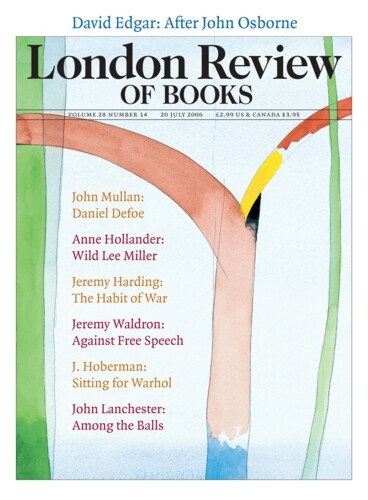
The dust-jacket was a late 19th-century invention; the notion that ‘you can’t judge a book by its cover’ must be a good deal older than that. It’s an expression that in an ideal world no one would ever say. But people do say it – often, oddly, when they’re talking about books. I say ‘oddly’ because once upon a time a book’s cover would...

Diary: My Life as a Geek

Thomas Jones, 22 June 2006

In 1979-80, a six-part documentary called The Mighty Micro was broadcast on ITV. Written and presented by the late Christopher Evans of the National Physical Laboratory, and based on his book of the same name, the series looked at the ways the world might be changed by the microcomputer revolution. The BBC responded with a more practically minded, educational series called The Computer Programme – a terrible if irresistible pun – which first aired on 11 January 1982. The aim was to give viewers lessons in computer literacy. When it went into development, a suitable machine for use in the series didn’t exist. So the BBC drew up a list of specifications, and went in search of someone to build them a computer.

Outfoxing Hangman: David Mitchell

Thomas Jones, 11 May 2006

David Mitchell’s first book, Ghostwritten (1999), which describes itself as ‘a novel in nine parts’, is a collection of loosely interconnected stories. The protagonist of one will have a walk-on role in the next; a minor character from someone else’s story will later reappear as the narrator of their own. The first narrator is a member of a Japanese doomsday cult, the...

Read anywhere with the London Review of Books app, available now from the App Store for Apple devices, Google Play for Android devices and Amazon for your Kindle Fire.

Sign up to our newsletters

For highlights from the latest issue, our archive and the blog, as well as news, events and exclusive promotions.

Newsletter Preferences