
Thomas Jones

Thomas Jones edits the LRB blog and presents the paper’s podcast. He has been writing for the LRB since 1999, when he was an editorial assistant. Many of his pieces have been Short Cuts. Most of the others have been on contemporary fiction, though he has also written on Romantic poetry, the ancient Greeks and Romans, the climate crisis and Italian politics. He has lived in Italy since 2006. Game Theory, a novel, was published in 2018.

From The Blog
15 September 2009

On the train to Rome the other afternoon, three bored young policemen were roaming the corridors. Maybe they'd been on since Trieste and were going all the way to Naples: who knows. In the compartment next to mine a young black woman, travelling by herself, was talking on her phone. One of the policemen stopped outside the door to her compartment and asked her to be quiet. She ended the call. The other two officers swaggered along to join their friend. The three of them stood in the corridor, in silence, staring at her. I thought I should go out and ask them what was going on, maybe tell them I was an English journalist, possibly one who was writing an article about racism, or about sexual harassment... Or maybe I should I just go and sit in her compartment.

From The Blog
11 September 2009

Craig T. Nelson, an actor (the Coach in Blades of Glory), explains to Glenn 'Obama is racist’ Beck of Fox News why he'd like to stop paying his taxes: 'I've been on foodstamps and welfare.

Letter

Compliments of Sorts

10 September 2009

I’m amused that where I wrote ‘people’, James Wood seems to have read ‘reviewers in the mainstream American press’ (Letters, 5 November). But to accept that narrow definition, and to answer his question (when has anyone complained that Pynchon’s characters aren’t proper, ‘sympathetic’ characters?): Michiko Kakutani said of Against the Day in the...

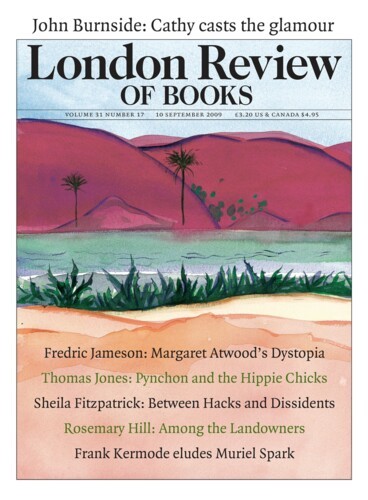
Call It Capitalism: Pynchon

Thomas Jones, 10 September 2009

The malign spirit hovering over Inherent Vice is Charles Manson, the white racist advocate of black power. He embodies the contradictions of the 1960s: he was into free love, getting stoned, the Beatles and the Beach Boys; he believed in the coming revolution; and he ordered his followers to go into other people’s homes and maim and kill in the service of a fugitive idea – just as Kennedy, Johnson and Nixon did.

Read anywhere with the London Review of Books app, available now from the App Store for Apple devices, Google Play for Android devices and Amazon for your Kindle Fire.

Sign up to our newsletters

For highlights from the latest issue, our archive and the blog, as well as news, events and exclusive promotions.

Newsletter Preferences