Stephen Sedley

Stephen Sedley is a former judge of the High Court and the Court of Appeal, and visiting professor at Oxford.

Big Lawyers and Little Lawyers

Stephen Sedley, 28 November 1996

It will soon be two hundred years since Napoleon, as First Consul, appointed four not especially distinguished lawyers to sit down and codify the entire heterogeneous mass of French civil law. They were appointed in August 1800 and by February 1801 had produced and published a complete draft of the Civil Code. After taking the views of the judges and the Tribunal, Napoleon chaired nearly half of the 123 subsequent redrafting sessions of the Conseil d’Etat, some lasting from noon to dawn, repeatedly insisting that detailed prescriptions would be self-defeating; that the right method was to set out the goals the courts were to achieve. By the spring of 1804 the whole project was law. The fresh codification now under way under the great conseiller Braibant is the task of a decade where Bonaparte’s commissioners took little more than four months. In Hong Kong yet worse has happened: an attempt in the best colonial tradition of demented heroism to codify the English common law in Chinese (something nobody has yet done in English) in time for the handover in 1997 has foundered on problems of translation. Initial worries about the Mandarin equivalent of issue estoppel and certiorari were overtaken by the catastrophic rendering of barrister and solicitor as ‘big lawyer’ and ‘little lawyer’ respectively, giving lasting offence to Hong Kong’s solicitors and bringing the project ultimately to a standstill.
Extra-Legal

Stephen Sedley, 19 October 1995

The sixth form at the boys’ boarding-school where I was educated was addressed on one occasion by an outside speaker, a sanctimonious pedagogue who announced to us that he and his wife – bootfaced on the platform beside him – had overcome sex. He counselled us to do the same. To an audience of overheated 17-year-olds whose only ambition was for sex to overcome them, the proposition was as mystifying as a book written by a judge and called Overcoming Law.’

Rights, Wrongs and Outcomes

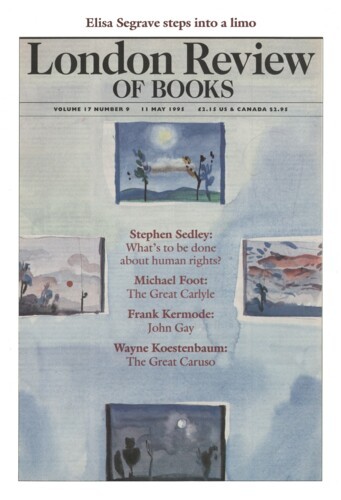
Stephen Sedley, 11 May 1995

The end of history seems a good moment to take stock. Fukuyama’s conceit (I mean it in both senses) that the triumph of Western liberalism has stopped the clock of change – has put an end to history – is already waning. We may reflect that human rights themselves have played a sacrificial role in this process, for the demise of the regimes of Eastern Europe was accelerated by a megaphone rhetoric about human rights from states, including our own, with an embarrassing capacity for overlooking human rights abuses among their own allies and clients and even within their own frontiers. The message between the lines has been that human rights are a commodity like any other, capable of being traded for political or economic advantage, and the rhetoric little more than the conduct of politics by other means.’

Doctor in the Dock

Stephen Sedley, 20 October 1994

I used occasionally to lecture to doctors at the Institute of Orthopaedics on giving expert evidence. With a hierarchical propriety that would have done the legal profession credit, the audience would arrange itself in order of seniority, consultants in the front row, registrars behind and so on. The occasion I enjoyed most was when I stayed to listen to the next lecture, ‘On Alleged Medical Negligence’, delivered by George Bonney, a laconic orthopaedic surgeon with long experience on the governing body of the Medical Defence Union. His tongue-in-cheek thesis was that the invention of penicillin had been a disaster for doctors, who until then had been unable to cure much other than malaria and syphilis (‘and nobody was going to get up in court and say: “That man failed to cure my clap.” ’) Where once the profession’s main therapeutic resource was the bedside manner, and the patient’s principal response gratitude, Bonney argued, people now expected to be cured and would sue if they were not.

Above it all

Stephen Sedley, 7 April 1994

For some reason the Mansion House was not struck by a thunderbolt on the night in 1936 when the Chief Justice, Lord Hewart, told the guests at the Lord Mayor’s Dinner: ‘His Majesty’s Judges are satisfied with the almost universal admiration in which they are held.’ Or, for that matter, on the same occasion in 1953 when the Lord Mayor told the diners: ‘Her Majesty’s judges have a greater understanding of human nature than any other body of men in the world.’ But who is to judge the judges? Well, there’s the Court of Appeal, and beyond it the judicial committee of the House of Lords, both of them capable of rapping judicial knuckles and occasionally drawing blood; but they’re just more judges. More fearsomely, there’s public opinion, stoked by a less than obsequious press – although the press can wound more easily than it can strike. And what if a judge’s indolence or spleen has cost someone their liberty or their job or their home? If the author of the disaster had been anybody else the victim might have expected to be able to sue for compensation: but nobody can sue a judge, however incompetent or even malicious, for anything which he or she has done as a judge. A doctor, an architect, a solicitor – certainly; a barrister – well, sometimes; a magistrate, rarely; a judge, never. In fact (though Abimbola Olowofoyeku has uncharacteristically missed this case) in 1746 the Chief Justice of the Common Pleas gave judgment for £1000 damages in favour of a Lieutenant Frye against the president of a court martial which had wronged him, and then encouraged Frye to sue the other members. When they protested through the Lords of the Admiralty to the King, the Chief Justice had the whole lot of them arrested for contempt and released them, when they apologised, with the warning: ‘Whosoever set themselves up in opposition to the law or think themselves above the law will find themselves mistaken.’’

At Sunday mass in my North London parish there was recently imposed a ‘New People’s Mass’. It came suddenly and without warning. One week, we were all enjoying versions of the...

Read more reviews

In a narrow pass

Derek Hirst, 19 November 1992

Stephen Sedley and Lawrence Kaplan seek to map a new course for the post-socialist Left, and to turn attention away from that beguiling but now exploded theme, egalitarianism. The long fixation...

Read more reviews

Read anywhere with the London Review of Books app, available now from the App Store for Apple devices, Google Play for Android devices and Amazon for your Kindle Fire.

Sign up to our newsletters

For highlights from the latest issue, our archive and the blog, as well as news, events and exclusive promotions.

Newsletter Preferences