
R.W. Johnson

R.W. Johnson was a fellow in politics at Magdalen College, Oxford for many years before returning to South Africa, where he was brought up, in 1995. His books include How Long Will South Africa Survive? and Look Back in Laughter: Oxford’s Postwar Golden Age.

From The Blog
20 August 2010

It was the 90th anniversary this week of the achievement of women's suffrage in the United States. On 18 August 1920 Tennessee became the 36th state to ratify the 19th Amendment – ‘The right of citizens of the United States to vote shall not be denied or abridged by the United States or by any State on account of sex’ – and it passed into law. For those who remember how the Equal Rights Amendment was defeated in the 1970s thanks to die-hard Republican opposition, it may come as a surprise to realise how much women's suffrage was a Republican achievement.
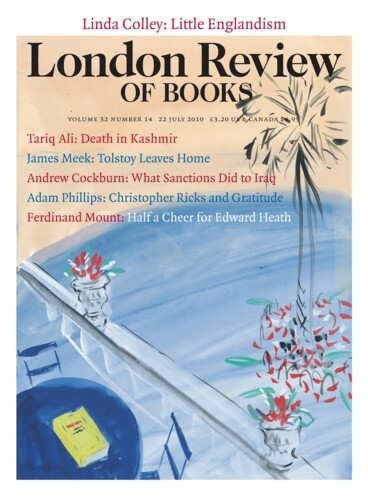

Diary: World Cup Diary

R.W. Johnson, 22 July 2010

R.W. Johnson’s article in this issue is taken from some of his blog posts during the South Africa 2010 World Cup. More of his posts, and those of some other LRB contributors, can be found at lrb.co.uk/blog/world-cup-2010/

6 June. South Africa is being worked up by an endless media barrage into a state of great excitement and expectancy about the World Cup. The advertising tends to stress...

From The Blog
12 July 2010

My sympathies were with the Dutch. Rather endearingly, the Dutch team only booked its hotel accommodation for the World Cup to last until 5 July and thus had to find themselves a new hotel once they did better than they expected. The Sunnyside Park Hotel, to which they moved, is an extremely pleasant but middle market establishment which almost certainly never expected to house any of the overpaid footballers in South Africa for the tournament. All the other teams, and the celebrities, stayed in Sandton, Johannesburg's most affluent and whitest suburb. The Dutch alone moved out of Sandton. I know their hotel well, and hotels well known to me are not usually the sort of places frequented by celebrities and could, indeed, be termed WAG-free zones.

From The Blog
11 July 2010

Several people have asked about fascism and football. The key figure here was Mussolini, who saw soccer as a key tool for creating national unity and international prestige. He created the Serie A as the first national league in 1929 and, once the World Cup had been launched in 1930, he made Fifa an offer it couldn't refuse to hold the 1934 Cup in Italy. It was, of course, essential that Italy should win (they had already won the first European Cup), so Mussolini himself invited a favoured Swedish referee to run the semi-final between Italy and Austria, in which the Italians were allowed to barge the Austrian goalkeeper into his net from three metres out. The ref duly gave a goal. Mussolini naturally selected the same ref for the final, Italy v. Czechoslovakia, and the ref again failed to notice a rather prominent Italian handball, so Italy won.

From The Blog
9 July 2010

The press here seems flummoxed by the failure of the players who were much-vaunted pre-tournament to shine – Mssrs Ronaldo, Rooney, Messi and Kaka – so somewhat half-hearted attempts are being made to promote Miroslav Klose and Arjen Robben into the vacancies. Football fans seem to demand stars to personalise their dreams and attachments, though most fans choose their team first and then who to idolise within it, roles which naturally change down the years as players come and go. This makes the objective assessment of players very difficult. If you ask the average manager who was the best player he ever saw, he will normally choose either someone he played alongside when young or someone in the team he manages, or seek refuge in saying that there are so many good players it’s hard to choose. I once heard Bill Shankly asked that quest­ion and, quick as a shot, he replied ‘Dennis Law’, the sort of remarkably honest choice you might have expected from Shanks: he had never played with him or managed him, on top of which Law was a thorn in Liverpool’s side.

Bristling Ermine: R.W. Johnson

Jeremy Harding, 4 May 2017

R.W. Johnson​ is a long-standing contributor to the LRB. His first appearance was on the letters page in 1981, where he took ‘mild issue’ with a review of his most celebrated book,

Read more reviews

Anyone in South Africa, white or black, rich or poor, who reads R.W. Johnson’s new book could be forgiven for rushing to the airport. It’s a familiar tale of African hopelessness,...

Read more reviews

Making things happen

Ross McKibbin, 26 July 1990

This Johnson is an energetic essayist. His energy is not simply physical, though he has plenty of that: it is mental too. He seems to write quickly – how else the productivity? – but...

Read more reviews

The scandal that never was

Paul Foot, 24 July 1986

Profound embarrassment has greeted the publication of R.W. Johnson’s book on the shooting-down of a Korean airliner over Russian airspace. Even its serialisation in the Sunday Telegraph...

Read more reviews

Downhill

David Marquand, 19 September 1985

As late as 1951, the British economy was the strongest in Western Europe. Only the wartime neutrals, Sweden and Switzerland, surpassed us in income per head. In his magisterial new history of the...

Read more reviews

Althusser’s Fate

Douglas Johnson, 16 April 1981

‘Is it easy to be a Marxist?’ Louis Althusser put this question to a crowded audience at the University of Picardy in 1975. Is it possible to be an Althusserian? The question has to...

Read more reviews

Read anywhere with the London Review of Books app, available now from the App Store for Apple devices, Google Play for Android devices and Amazon for your Kindle Fire.

Sign up to our newsletter

For highlights from the latest issue, our archive and the blog, as well as news, events and exclusive promotions.

Newsletter Preferences