R.W. Johnson

R.W. Johnson was a fellow in politics at Magdalen College, Oxford for many years before returning to South Africa, where he was brought up, in 1995. His books include The Long March of the French Left, How Long Will South Africa Survive? and Look Back in Laughter: Oxford’s Postwar Golden Age. He died in July 2026 at the age of 82.

Peter Wright, Judges and Journalists

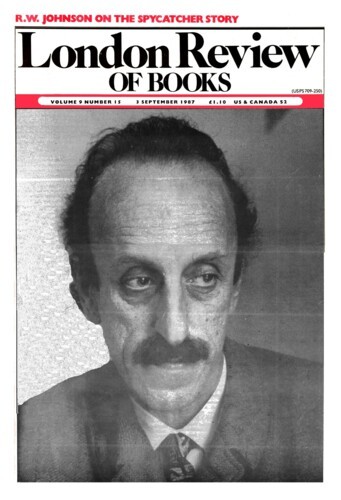
R.W. Johnson, 3 September 1987

Let us first dispose of Spycatcher – a well-written book which eschews a sensationalist style even when dealing with sensational matters. The widespread impression that the book is mainly about MI5 attempts to destabilise the Wilson Government is quite wrong – there are just a few pages about this. Most of the book is an account of the endless mole-hunting undertaken in the aftermath of the Burgess/ Maclean/ Philby affairs and the construction of Wright’s case that the MI5 chief, Roger Hollis, was a Soviet spy. This latter question is, for Wright, very much the heart of the book, but I doubt whether readers will be universally convinced by his case or even that they will be chiefly interested in it. Most, one suspects, will savour more the chillingly casual way in which Wright details how even friendly embassies were bugged and assassination schemes plotted, and also the sheer Le Carré-like richness of the bureaucratic and diplomatic intrigues, particularly when they involve characters as colourful as Edgar Hoover or James Angleton. Wright describes how Angleton ingeniously contrived to enjoy simultaneously his three main hobbies of drinking, smoking and fishing. Having bought a stretch of river, he buried bottles of Jack Daniels at regular intervals in the river bed, so that he could always fish with a whisky and a cigarette in hand.’
Letter

Oxford and Labour

23 July 1987

SIR: Mr Xavier asserts that I ‘call for Labour to start selecting Oxford graduates as Parliamentary candidates’ (Letters, 15 October). I’m afraid this is quite untrue. The trends in Labour élite recruitment are a sociological phenomenon one could hardly influence by issuing ‘calls’ of any kind, and personally I have no ambition to change the way in which either...

Going for Gould

R.W. Johnson, 23 July 1987

Election post-mortems concentrate, reasonably enough, on how the electorate actually behaved – which class, which region or which sex swung most. In 1987 the most striking finding was surely the highly differential way in which the sexes behaved. Among men the pro-Labour swing from the Tories was a mere 0.5 per cent, but among women it was nine times greater, at 4.5 per cent. (All figures here are based on the vast MORI sample of 23,396 voters interviewed in the course of the campaign, weighted to the actual outcome.) Further analysis of that swing shows a peculiar age distribution among women: among the 35-54 age-group women moved only 2 per cent towards Labour; the 25-34s swung 6.5 per cent; and the 18-24s a massive 11 per cent. (The shift among men aged 18-24 was only 1.5 per cent to Labour.) The real peculiarity is that women aged 55-65 also moved 4.5 per cent to Labour and women over 65 showed a 7 per cent Labour swing. That is to say, it was the middle-aged who were the odd women out: not only did far more younger women swing to Labour, but so did many more older women. Without doubt, most of these middle-aged women who stuck with the Tories lived in the South: Southern women showed a pro-Labour swing only one-third as great as that of Northern women. Even so, women in the South did show a pro-Labour swing, while the men swung clearly towards the Tories.

In the first few pages of Walter Laqueur’s The Age of Terrorism (largely a reworking and updating of his 1977 work, Terrorism), the author attempts to confront the old adage that ‘one man’s terrorist is another man’s freedom fighter.’ Laqueur will have none of it:

Letter

Subversions

4 June 1987

R.W. Johnson writes: Regan illustrates many of the habits of mind which seem to have led many of our mole-hunters down false trails. In particular, he repeatedly accuses me of saying things I did not say. Thus when I speak of Joe McCarthy’s allegations against Alger Hiss and Harry Dexter White, he answers that McCarthy was not responsible for the investigation of either man. True, but then I...

Bristling Ermine: R.W. Johnson

Jeremy Harding, 4 May 2017

R .W. Johnson​ is a long-standing contributor to the LRB. His first appearance was on the letters page in 1981, where he took ‘mild issue’ with a review of his most celebrated book,

Read more reviews

Anyone in South Africa, white or black, rich or poor, who reads R.W. Johnson’s new book could be forgiven for rushing to the airport. It’s a familiar tale of African hopelessness,...

Read more reviews

Making things happen

Ross McKibbin, 26 July 1990

This Johnson is an energetic essayist. His energy is not simply physical, though he has plenty of that: it is mental too. He seems to write quickly – how else the productivity? – but...

Read more reviews

The scandal that never was

Paul Foot, 24 July 1986

Profound embarrassment has greeted the publication of R.W. Johnson’s book on the shooting-down of a Korean airliner over Russian airspace. Even its serialisation in the Sunday Telegraph...

Read more reviews

Downhill

David Marquand, 19 September 1985

As late as 1951, the British economy was the strongest in Western Europe. Only the wartime neutrals, Sweden and Switzerland, surpassed us in income per head. In his magisterial new history of the...

Read more reviews

Althusser’s Fate

Douglas Johnson, 16 April 1981

‘Is it easy to be a Marxist?’ Louis Althusser put this question to a crowded audience at the University of Picardy in 1975. Is it possible to be an Althusserian? The question has to...

Read more reviews

Read anywhere with the London Review of Books app, available now from the App Store for Apple devices, Google Play for Android devices and Amazon for your Kindle Fire.

Sign up to our newsletters

For highlights from the latest issue, our archive and the blog, as well as news, events and exclusive promotions.

Newsletter Preferences