R.W. Johnson

R.W. Johnson was a fellow in politics at Magdalen College, Oxford for many years before returning to South Africa, where he was brought up, in 1995. His books include The Long March of the French Left, How Long Will South Africa Survive? and Look Back in Laughter: Oxford’s Postwar Golden Age. He died in July 2026 at the age of 82.

The Last Days of Bhambayi

R.W. Johnson, 6 January 1994

Just outside Durban lies the vast black squatter camp of Inanda, whose huddling shacks house half a million people or more – the only way to perform a census is to take an aerial photograph and allow for six people per shack. On Inanda’s eastern edge lies the historic Gandhi Settlement, founded by the Mahatma before he set off to lead the struggle against the British in India. Ninety per cent of South Africa’s one million Indians live in Natal, more than half of them in Durban, and the community is intensely proud of having produced the man who launched India’s independence. The Settlement itself became a focus of the Gandhian movement and a place of pilgrimage. It was also a place of reflection and refuge: during the hardest apartheid years this was where radicals of every stripe would retire for workshops and seminars or, on occasion, for Gandhian fasts of protest against the apartheid laws. Rick Turner and Steve Biko used to hold weekend retreats there, as did many of the activists who later built the trade union movement.’


Schadenfreude

R.W. Johnson, 2 December 1993

‘What Tory MPs really wanted,’ Margaret Thatcher writes of the Westland affair, ‘was leadership, frankness and a touch of humility, all of which I tried to provide.’ A great deal of indignant energy has fired the reviews of this book, many of them by Mrs Thatcher’s former Cabinet colleagues, largely because of the sheer outrageousness of those claims to frankness and humility. And there has, of course, been no difficulty in showing that, in these memoirs as in her career, Thatcher has been neither frank nor humble.

Stitched up

R.W. Johnson, 21 October 1993

At one point in this book, except that it’s not so much a book as a series of sharp-eyed digressions, Breyten Breytenbach tells the story of his friend Tobe. We’ve already got used to Tobe’s name cropping up in unlikely places in French Africa, or as a character in the dreams, the take-offs into magical realism or the one long drinking bout that make up this book. The notion of a famous literary figure on an inebriated progress across a continent has a certain raffish hilarity to it and once produced a study called Dylan Thomas in America. This book is a sort of ‘Dylan Thomas in Africa’, with the difference that Breytenbach has written this one himself and cares about the continent he’s travelling through and getting drunk in. As he says, to be African is not a choice but a condition and he’s got it. Even worse he’s an Afrikaner: ‘I am of a people who are the mortification of Africa, a people of colonists without a metropolis, with whom nobody wants to share history.’

Letter
R.W. Johnson writes: Messrs Legum and Bernstein both reproach me, in effect, for being too gloomy about South Africa. In a sense I sympathise with them. They both belong to a South African generation which, having followed the country’s evolution form abroad for thirty years, has now, like the rest of us, to face the possibility that the ending of apartheid may not usher in the liberal, Communist...

Magical Socialism

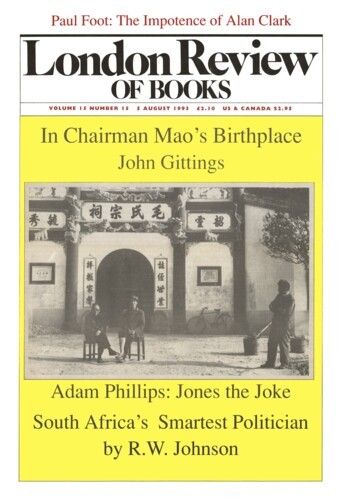
R.W. Johnson, 5 August 1993

According to the New Nation (the nearest thing there is to an ANC newspaper until Tiny Rowland sets up an official one), what really drove Janusz Waluz and Clive and Gaye Derby-Lewis to plot the assassination of the South African Communist Party leader Chris Hani was the belief that Hani was the most likely successor to Nelson Mandela as head of the ANC – and thus the next-President-but-one of South Africa. It’s an interesting thought partly because its airing in an ANC paper signals both that the matter of the succession is in the air and that it is now publicly thinkable that a Communist could succeed Mandela.’

Bristling Ermine: R.W. Johnson

Jeremy Harding, 4 May 2017

R .W. Johnson​ is a long-standing contributor to the LRB. His first appearance was on the letters page in 1981, where he took ‘mild issue’ with a review of his most celebrated book,

Read more reviews

Anyone in South Africa, white or black, rich or poor, who reads R.W. Johnson’s new book could be forgiven for rushing to the airport. It’s a familiar tale of African hopelessness,...

Read more reviews

Making things happen

Ross McKibbin, 26 July 1990

This Johnson is an energetic essayist. His energy is not simply physical, though he has plenty of that: it is mental too. He seems to write quickly – how else the productivity? – but...

Read more reviews

The scandal that never was

Paul Foot, 24 July 1986

Profound embarrassment has greeted the publication of R.W. Johnson’s book on the shooting-down of a Korean airliner over Russian airspace. Even its serialisation in the Sunday Telegraph...

Read more reviews

Downhill

David Marquand, 19 September 1985

As late as 1951, the British economy was the strongest in Western Europe. Only the wartime neutrals, Sweden and Switzerland, surpassed us in income per head. In his magisterial new history of the...

Read more reviews

Althusser’s Fate

Douglas Johnson, 16 April 1981

‘Is it easy to be a Marxist?’ Louis Althusser put this question to a crowded audience at the University of Picardy in 1975. Is it possible to be an Althusserian? The question has to...

Read more reviews

Read anywhere with the London Review of Books app, available now from the App Store for Apple devices, Google Play for Android devices and Amazon for your Kindle Fire.

Sign up to our newsletters

For highlights from the latest issue, our archive and the blog, as well as news, events and exclusive promotions.

Newsletter Preferences