R.W. Johnson

R.W. Johnson was a fellow in politics at Magdalen College, Oxford for many years before returning to South Africa, where he was brought up, in 1995. His books include The Long March of the French Left, How Long Will South Africa Survive? and Look Back in Laughter: Oxford’s Postwar Golden Age. He died in July 2026 at the age of 82.

The Presidents’ Man

R.W. Johnson, 25 May 1995

Throughout the Sixties rumours circulated in Paris political circles about the awesome powers of de Gaulle’s adviser, Jacques Foccart. Foccart had no elected position and was seldom seen, but he was said to have an exclusive hold over France’s African policy, the intelligence services and the whole shadowy world of covert action. Every now and again a coup would occur in West or Central Africa or there would be a kidnapping in Switzerland, or some OAS jackal would be run to earth in Latin America. There would be no official comment but those in the know would invariably say: ‘C’est Foccart.’ Foccart himself was never available to the press. Insiders would tell you, incredulously (and, it now seems, correctly), that while a cabinet minister might see de Gaulle every few weeks and the Prime Minister once a week, Foccart had access to him every day and whenever he wanted. For de Gaulle was fascinated by Intelligence, and as a military man, knew its worth.
Megalo

R.W. Johnson, 9 March 1995

Will Hutton, the Guardian’s economics editor, has produced a book which is part show-biz – it carries a passionate puff from Ian McEwan on the front cover and leapt straight into the bestseller list – and part political event: it clearly aims to provide a sweeping economic and political platform for Labour, has been elaborated with the help of Tony Blair’s adviser, David Miliband, and sees Blair’s election as leader as an epochal event, finally settling Labour’s commitment to social democracy. All of which sounds very much as if Hutton hopes to become a key adviser in a future Blair administration, though the Tories may well want to know how much of the book really represents Labour policy. The State We’re In will almost certainly be a powerfully influential book among Labour’s élite, but many of its positions – particularly its out-and-out republicanism – are considerably bolder than any Labour’s leadership is likely to own up to.’’

At the Skunk Works

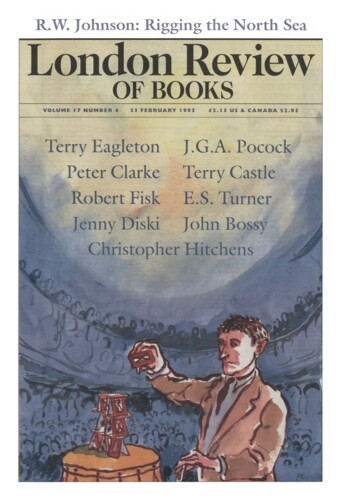
R.W. Johnson, 23 February 1995

In 1937 a small gas field was discovered near Whitby in Yorkshire. In 1943 in Nazi-occupied Holland drilling began in a search for gas which met success only in July 1959 when the Groningen field was discovered in Friesland. It became clear that Groningen, the world’s second largest gas field, stretched far out into the North Sea and geologists noticed that the strata in which the Dutch deposits were found were actually an undersea extension of a formation which began in Yorkshire. Oil companies began to search the sea and quickly found several sedimentary basins of the sort likely to contain gas and oil. BP rather perilously converted a barge into a makeshift rig, the Sea Gem, which in November 1965 discovered the West Sole gas field off the Norfolk coast. Six days later the Sea Gem capsized with the loss of 13 lives. The search for hydrocarbons in the North Sea led the oil companies into the deepest water and toughest conditions they had ever encountered. In 1964 it was reckoned that North Sea waves never got higher than forty feet, winds never higher than 53 mph. Gradually, bitter experience taught that nothing was ever quite tough enough for the North Sea, that you had to be ready for waveheights of 65-100 feet and wind speeds of 70 mph. The technology became more and more awesome, the rigs huger, the entire scenario more and more futuristic. It was, in Alvarez’s phrase, ‘outer space with bad weather’.

This Sporting Life

R.W. Johnson, 8 December 1994

It was one of the most attractive aspects of Iain Macleod that he was not easily taken for a professional politician. After depressing his hard-working doctor father by getting a lower second at Cambridge, he was quickly sacked from his first job at De la Rue’s, mainly because he found it an almost impossible struggle to get to work in the morning after staying up into the wee hours playing bridge and poker at Crockfords. Sometimes he would have to write his father urgent letters asking him to bail him out of his card debts; but more often he won. He was earning £3 a week but sometimes won £100 at a sitting. After he got the sack he became a full-time card-player and, until war broke out, earned up to £2500 a year tax free (at a time when average male earnings were about £200 per annum). An international player, he and his friends sat up late into the night at a club in Acol Road in Hampstead, devising the Acol system – still the most widely used in the bridge world.

Letter

Enrichissez-Vous!

20 October 1994

The tone of Kader Asmal’s letter (Letters, 26 January) is eerily similar to a missive I once received from one of his predecessors under the old apartheid regime when it banned one of my books. The oddity is that I suspect that I am in agreement on many points with Mr Asmal, a man for whom I have a deal of liking and respect.1. My praise of Mr Mandela was not patronising. I greatly admire him...

Bristling Ermine: R.W. Johnson

Jeremy Harding, 4 May 2017

R .W. Johnson​ is a long-standing contributor to the LRB. His first appearance was on the letters page in 1981, where he took ‘mild issue’ with a review of his most celebrated book,

Read more reviews

Anyone in South Africa, white or black, rich or poor, who reads R.W. Johnson’s new book could be forgiven for rushing to the airport. It’s a familiar tale of African hopelessness,...

Read more reviews

Making things happen

Ross McKibbin, 26 July 1990

This Johnson is an energetic essayist. His energy is not simply physical, though he has plenty of that: it is mental too. He seems to write quickly – how else the productivity? – but...

Read more reviews

The scandal that never was

Paul Foot, 24 July 1986

Profound embarrassment has greeted the publication of R.W. Johnson’s book on the shooting-down of a Korean airliner over Russian airspace. Even its serialisation in the Sunday Telegraph...

Read more reviews

Downhill

David Marquand, 19 September 1985

As late as 1951, the British economy was the strongest in Western Europe. Only the wartime neutrals, Sweden and Switzerland, surpassed us in income per head. In his magisterial new history of the...

Read more reviews

Althusser’s Fate

Douglas Johnson, 16 April 1981

‘Is it easy to be a Marxist?’ Louis Althusser put this question to a crowded audience at the University of Picardy in 1975. Is it possible to be an Althusserian? The question has to...

Read more reviews

Read anywhere with the London Review of Books app, available now from the App Store for Apple devices, Google Play for Android devices and Amazon for your Kindle Fire.

Sign up to our newsletters

For highlights from the latest issue, our archive and the blog, as well as news, events and exclusive promotions.

Newsletter Preferences