R.W. Johnson

R.W. Johnson was a fellow in politics at Magdalen College, Oxford for many years before returning to South Africa, where he was brought up, in 1995. His books include The Long March of the French Left, How Long Will South Africa Survive? and Look Back in Laughter: Oxford’s Postwar Golden Age. He died in July 2026 at the age of 82.

An Unreliable Friend: Nelson Mandela

R.W. Johnson, 19 August 1999

One of the oddities about living in South Africa is that a whole lot of people who have left the country still believe that they know better than those of us who live here what goes on. The reason for this is that South Africa is seen as the supreme paradigm both of colonial exploitation and of black-white relations – what Nadine Gordimer called ‘the last great colonial extravaganza’. Having seen apartheid crumble and the ANC come to power, such folk know that good has triumphed over evil and that if any problems persist, they can only be due to the legacy of apartheid. Any suggestion that the truth is actually a lot more complicated is often met with rage and moral disapproval.’‘
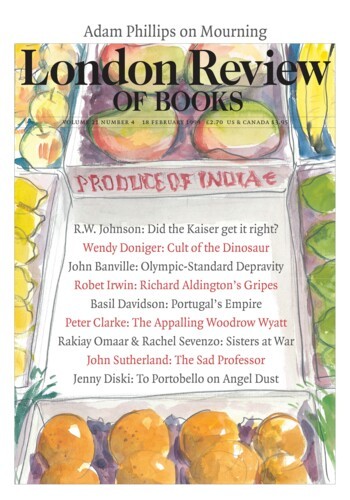
Diary: Goodbye Zimbabwe

R.W. Johnson, 4 March 1999

Harare is morose under the rains, more drenching this year even than last year, and longer than most can remember; five or seven centimetres, day after day. It’s made the water table too high and water lies permanently on the surface, sewage floating in it, for the city’s long-neglected sewage system is on the point of collapse. This wouldn’t be easy for anyone to bear, but it’s particularly hard for the residents of Harare, who point to the colossal mansion which the mayor, Solomon Tawengwa, is building for himself and the Mercedes cars which he and his municipal colleagues have awarded themselves. Most angry of all are the council workers whose pay cheques bounced. They went on strike despite a ban on strikes decreed last year by President Mugabe, in the wake of a second round of urban riots caused first by food and then by fuel price hikes, themselves the result of a 60 per cent devaluation of the Zim dollar (which, having started life at two to the US dollar, is now 67 to the US dollar). Mugabe wasn’t bothered by the council workers’ strike any more than he has been by the recent teachers’, doctors’ and telephone-workers’ strikes. It is ZCTU, the Zimbabwe Congress of Trade Unions, that he fears.

Both The Pity of War and the reception it has enjoyed illustrate aspects of British culture about which one can only feel ambivalent. Anyone who has been a victim, let alone a perpetrator, of the Oxbridge system will recognise Niall Ferguson’s book for what it is: an extended and argumentative tutorial from a selfconsciously clever, confrontational young don, determined to stand everything on its head and argue with vehemence against whatever he sees as the conventional wisdom – or, worse still, the fashion – of the time. The idea is to teach the young to think and argue, and the real past masters at it (Harry Weldon was always held up as an example to me) were those who first argued undergraduates out of their received opinions, then turned around after a time and argued them out of their new-found radicalism, leaving them mystified as to what they believed and suspended in a free-floating state of cleverness.’

‘I am wholly preoccupied with the war between England and the Transvaal,’ Tsar Nicholas wrote to his sister at the outbreak of the Boer War. ‘Every day I read the news in the British newspapers from the first to the last line … I cannot conceal my joy at … yesterday’s news that during General White’s sally two full British battalions and a mountain battery were captured by the Boers!’‘

Ross McKibbin’s remarkable study of the way the cultures of class shaped English society has, at a stroke, changed the historiographical landscape. One learns more about almost any aspect of English society by reading this book than one would by reading, for example, A.J.P. Taylor’s English History 1914-45 – which makes it indispensable for anyone studying the politics, sociology or history of English society. Only once, while discussing the impact of The Goon Show, does McKibbin’s guard slip enough to reveal that, despite his sure touch for the niceties of English society, he is Australian.’

Bristling Ermine: R.W. Johnson

Jeremy Harding, 4 May 2017

R .W. Johnson​ is a long-standing contributor to the LRB. His first appearance was on the letters page in 1981, where he took ‘mild issue’ with a review of his most celebrated book,

Read more reviews

Anyone in South Africa, white or black, rich or poor, who reads R.W. Johnson’s new book could be forgiven for rushing to the airport. It’s a familiar tale of African hopelessness,...

Read more reviews

Making things happen

Ross McKibbin, 26 July 1990

This Johnson is an energetic essayist. His energy is not simply physical, though he has plenty of that: it is mental too. He seems to write quickly – how else the productivity? – but...

Read more reviews

The scandal that never was

Paul Foot, 24 July 1986

Profound embarrassment has greeted the publication of R.W. Johnson’s book on the shooting-down of a Korean airliner over Russian airspace. Even its serialisation in the Sunday Telegraph...

Read more reviews

Downhill

David Marquand, 19 September 1985

As late as 1951, the British economy was the strongest in Western Europe. Only the wartime neutrals, Sweden and Switzerland, surpassed us in income per head. In his magisterial new history of the...

Read more reviews

Althusser’s Fate

Douglas Johnson, 16 April 1981

‘Is it easy to be a Marxist?’ Louis Althusser put this question to a crowded audience at the University of Picardy in 1975. Is it possible to be an Althusserian? The question has to...

Read more reviews

Read anywhere with the London Review of Books app, available now from the App Store for Apple devices, Google Play for Android devices and Amazon for your Kindle Fire.

Sign up to our newsletters

For highlights from the latest issue, our archive and the blog, as well as news, events and exclusive promotions.

Newsletter Preferences