Perry Anderson

Perry Anderson’s books include Lineages of the Absolutist State, The Origins of Postmodernity, Passages from Antiquity to Feudalism and Ever Closer Union? Europe in the West. He is a professor of history and sociology at UCLA and sits on the editorial board of New Left Review. He has written more than fifty pieces for the LRB, on subjects including his father’s career in the Chinese Customs Service, Lula’s Brazil, Michael Oakeshott, Anthony Powell, Dmitri Furman, the modern political histories of Italy, Turkey, France, and India and the failings of the EU.

The Dark Side of Brazilian Conviviality

Perry Anderson, 24 November 1994

Brazil today has a larger population and gross national product than Yeltsin’s Russia. Yet, against all reason, it continues to occupy a curiously marginal position in the contemporary historical consciousness. In 15 years it has left virtually no trace in these pages. Popular images, despite increasing tourism, remain scanty: folk-villains on the run, seasonal parades in fancy-dress, periodic football triumphs. In cultural influence, while the music and literature of Latin America have swept round the world, Brazil has receded. The rhythms of salsa have long eclipsed those of the samba, and the list of headline novelists conspicuously omits any name from the land of Machado de Assis, the most ingenious 19th-century practitioner of the form outside Europe. Today Northern readers are more likely to get an impression of Brazil from Peruvian bombast than from any native fiction.
Maurice Thomson’s War

Perry Anderson, 4 November 1993

The English Civil War occupies a strange niche in contemporary memory. To all official appearances, no episode of the country’s modern past is so parenthetical. Leaving no reputable trace in common traditions or public institutions, it looks in established retrospect like a temporary black-out in the growth of the national psyche. Our only republic remains under ban, a historical freak. Rosebery could raise a statue to Cromwell outside Parliament: eighty years later, Benn could not even get him onto a postage-stamp, at a time when Rosa Luxemburg adorned West German mail.

Diary: On E.P. Thompson

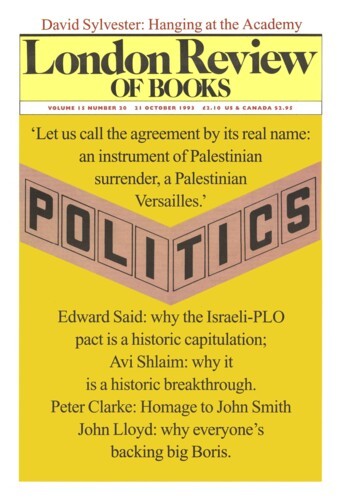
Perry Anderson, 21 October 1993

Coming home one evening in the last weeks of 1962, I found a bottle of wine in the vacated room, with a note underneath. Edward Thompson had been completing The Making of the English Working-Class. He lived in Halifax, and needed a final couple of weeks in the British Museum. In those days I lived in Talbot Road, newly wed to Juliet Mitchell. She was teaching in Leeds, while I was working for New Left Review in London. After hours Edward and I would exchange notes on our day, and fence amiably about history and sociology. ‘Do you really think Weber is more important than Marc Bloch?’ he would ask me with an air of mischievous puzzlement. If we were more circumspect about politics, this was partly a question of tact – he didn’t want to lean on me too heavily, as a cub editor of the journal of which he was a founder. But there was also a trick of perception to which I was subject.’

High Jinks at the Plaza

Perry Anderson, 22 October 1992

‘Constitutional theorists who wish to hold our attention must charm as well as instruct; this is not so, I think, in other countries,’ writes Ferdinand Mount. Who better to illustrate the claim? Few figures in the world of English letters possess such a combination of credentials. Author of a number of novels; columnist or leader-writer for half of the nation’s press, with a record of service from the Sketch to the Spectator; champion of family values; political counsellor at Downing Street: the editor of the Times Literary Supplement seems the ideal candidate for the task in hand. Nor is the success of The British Constitution Now in fulfilling the first part of the requirement in doubt. Mount’s account of the framework of the United Kingdom, and what repair it may call for, has already beguiled readers across the political spectrum. Commentators on right and left alike have praised its wit and acumen. If few have seen eye to eye with every proposal it makes, virtually all have agreed that this is the work of an enlightened reformer, of liberal temper, within the party of tradition. Here, so it would appear, is a rare conservative who might even be regarded as an ally, in his own fashion, of the franc-tireurs around Charter 88.

Letter

Peccavit

24 September 1992

William Lamont points to Ernest Barker’s Oliver Cromwell and the English People as a peccant moment of his liberalism (Letters, 22 October). Touché. Still, if Lamont’s own work on William Prynne and Richard Baxter teaches us to distinguish between different kinds of 17th-century Puritan, not to smooth out their paradoxes, and to set each in the collective context of the time, the lesson is valid...

The Murmur of Engines: A Historian's Historians

Christopher Clark, 5 December 2024

Perry Anderson brings a peculiar gift to the work of criticism: he can step into a book and inspect it closely, even sympathetically, scrutinising its structures, immersing himself in its style and atmosphere;...

Read more reviews

You need a gun: The A-Word

Wolfgang Streeck, 14 December 2017

What​ is the relationship between coercion and consent? Under what circumstances does power turn into authority, brute force into legitimate leadership? Can coercion work without consent? Can...

Read more reviews

‘It is a sign​ of true political power when a great people can determine, of its own will, the vocabulary, the terminology and the words, the very way of speaking, even the way of...

Read more reviews

What We Have: Tarantinisation

David Bromwich, 4 February 1999

Post-Modernism entered the public mind as a fast-value currency in the late Seventies and early Eighties, in the field of architecture, where its association with gimmicky tropes of visual play...

Read more reviews

Post-Nationalism

Geoffrey Hawthorn, 3 December 1992

For the past thirty years, New Left Review has been the most consistently interesting political journal in the country. And Perry Anderson, who used to edit it and still helps direct it, has been...

Read more reviews

What would socialism be like?

Geoffrey Hawthorn, 1 March 1984

Joseph Schumpeter had a refreshing sense of socialism. For him, it had almost no fixed sense at all. ‘A society may be fully and truly socialist and yet be led by an absolute ruler or be...

Read more reviews

English Marxists in dispute

Roy Porter, 17 July 1980

The Englishness of English historians lies in their eclecticism. Few would admit to being unswerving Marxists, Freudians, Structuralists, Cliometricians, Namierites, or even Whigs. Most believe...

Read more reviews

Read anywhere with the London Review of Books app, available now from the App Store for Apple devices, Google Play for Android devices and Amazon for your Kindle Fire.

Sign up to our newsletter

For highlights from the latest issue, our archive and the blog, as well as news, events and exclusive promotions.

Newsletter Preferences