Nicholas Penny

Nicholas Penny is a former director of the National Gallery. He is cataloguing the earlier Italian paintings at the Norton Simon Museum in Pasadena, with Imogen Tedbury.

In the centre of the most beautiful painting by Correggio in the Louvre there is a knot of flesh as intricate and lively as a swimming octopus. It consists of the left hand of the Virgin Mary delicately supporting the slightly smaller right hand of Saint Catharine, while the much smaller hand of the infant Christ tenderly picks out the Saint’s ring finger. This is a miniature example of an effect at which Correggio excelled: actions inspired by a sentiment of breathless intensity are somehow endowed both with angelic grace and with a formal complexity which is delightfully difficult to disentangle.
Lost in the Woods: Victorian fairy painting

Nicholas Penny, 1 January 1998

The exhibition of Victorian Fairy Painting, which can be seen in the Sackler Galleries at the Royal Academy until 8 February (after which it will travel, first to Iowa, then to Toronto), may sound like safe family entertainment designed to appease the Friends and Academicians dismayed by Sensation in the rooms below. It is in fact an original and valuable exhibition devoted to a curious and often daring development in British painting in the 1840s and to a taste which survived well into this century in Arthur Rackham’s book illustrations, with their tangled roots and wrinkled goblins, and in the misty lakes and moonlit forests which were the essential settings for so many pantomimes and ballets.

Vertiginous

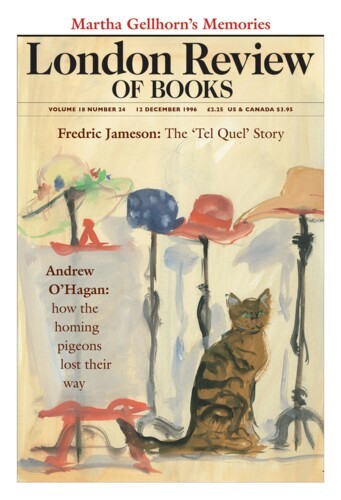
Nicholas Penny, 12 December 1996

The rococo style transformed the character of the domestic interior. First in France, where the style originated in the late 17th century, and then in the rest of Europe, rooms were created which were lighter and more elegant and charming than those of any previous period. They were also audacious, often astonishingly so, in their treatment of space and their denial of solidity or stability. It is easy to forget this because these rooms are more easily reconciled with modern ideas of luxury and comfort than those decorated in any other historical style. De Troy’s famous painting, The Reading from Molière illustrated on the dust-jacket of Katie Scott’s study of the rococo interior, seems to epitomise an ideal of polite but informal and mixed society which is still current. However, those who feel at ease with rococo furniture today do so because it is old and familiar. Originally it seemed novel and fantastic.

Hollow-Headed Angels

Nicholas Penny, 4 January 1996

The Romantic Spirit in German Art, an exhibition shown at the Royal Scottish Academy in Edinburgh in the summer of 1994 and at the Hayward Gallery last winter, included a small group of paintings by artists popular during the Third Reich – the type of painting which was excluded in 1985 from the Royal Academy’s survey of German art in the 20th century. The labels that accompanied these pictures at the Hayward warned that they could have no claim to the true lineage traced from Friedrich to Beuys, while the catalogue briskly dismissed them as distasteful banalities. However, Adolf Wissels’s puzzled and frightened farming family from Kalenberg, which was shown at the exhibition, are self-reliant, plain-living, God-fearing folk of a kind especially popular in North American art and literature. Looking at pictures such as this, we should ask ourselves whether, or rather to what extent, the character of the painting was determined by the regime which approved of it.’

Giorgio Mio

Nicholas Penny, 16 November 1995

We would know very much less about Italian Renaissance Art, and indeed very much less would have been made of the very concept of the Italian Renaissance, had Vasari not published his Lives of the Artists in 1550 (and again, revised and enlarged, in 1567), providing us with biographies of more than two hundred Italian artists. A good place to reflect on the nature of Vasari’s achievement is the Uffizi in Florence. Many of the Renaissance pictures in the gallery there were first described by him. The niches outside are occupied by statues of great Tuscan artists, placed there in the 19th century – Vasari would have approved of such a commemorative initiative, and indeed he may have inspired it. Vasari was also the architect of the building itself. The lucid elevations, the combination of solemn grandeur and ceremony with rational order which they suggest, masked the stealthy despotism and expressed the new bureaucratic regularity imposed on the city by Cosimo de’ Medici, Duke of Florence and then first Grand-Duke of Tuscany, whom Vasari served, and to whom the Lives was dedicated.’

School of Hard Knocks

Peter Campbell, 2 December 1993

There are two forces at work in sculpture. One pushes it towards the waxwork, where materials suggest something quite contrary to their native qualities – marble flesh, wooden flowers,...

Read more reviews

The Raphael Question

Lawrence Gowing, 15 March 1984

When I used to give a survey course for first-year students, I dreaded December. That was when I reached the High Renaissance and my audience fell away. It was not only the alternative seasonable...

Read more reviews

Priapus Knight

Marilyn Butler, 18 March 1982

Richard Payne Knight was an important English intellectual of the era of the French Revolution. He flourished from the 1770s until his death, perhaps by suicide, in 1824. Most of that time he...

Read more reviews

Perfection’s Progress

E.H. Gombrich, 5 November 1981

Here, at last, is a book of which we can sincerely say in the old phrase that it meets a long-felt want. It offers, in the modest words of the Preface, ‘a series of illustrations (which are...

Read more reviews

Read anywhere with the London Review of Books app, available now from the App Store for Apple devices, Google Play for Android devices and Amazon for your Kindle Fire.

Sign up to our newsletter

For highlights from the latest issue, our archive and the blog, as well as news, events and exclusive promotions.

Newsletter Preferences