Gestures of Embrace
Nicholas Penny, 27 October 1988
In the first chapter of Rembrandt’s Enterprise. Professor Alpers devotes much attention to a small etching of 1655. This, she says,
Nicholas Penny is a former director of the National Gallery. He is cataloguing the earlier Italian paintings at the Norton Simon Museum in Pasadena, with Imogen Tedbury.
In the first chapter of Rembrandt’s Enterprise. Professor Alpers devotes much attention to a small etching of 1655. This, she says,
Arianna Stassinopoulos Huffington, author of After Reason and The Female Woman, took up the task of writing about Picasso because she had been ‘seduced by his magnetism, his intensity, that mysterious quality of inexhaustibility bursting forth from the transfixing stare of his black marble eyes as much as from his work’, but had come to be ‘chilled’ by him. Huffington, who is also the author of The Gods of Greece, felt that in order to explain Picasso’s demonic attraction, she had to go ‘back to the original Spanish tales of Don Juan and the Indian myths of Krishna’. But she had to think about the modern world as well, for she ‘suddenly saw that Picasso’s life was not just the life of one of the most gifted artists who ever lived … it was in a very real sense, the 20th century’s own autobiography.’
The exhibition of Lucian Freud’s paintings which has already been shown in Washington and Paris, and which moves on to Berlin in the spring, has been amplified at its current London showing with some works on paper – a foretaste of an exhibition devoted to Freud prints and drawings which will open in May at the Ashmolean Museum in Oxford and will then travel to four other British venues and on to three museums in the United States of America. Much of this article arises from conversations which I have had with the artist whilst writing on the early drawings and since seeing the Hay ward exhibition.’
In the Preface to his new book Richard Wollheim tells how he ‘evolved a way of looking at paintings which was massively time-consuming and deeply rewarding’. He looked at them for a very long time – longer than us – and then they told him what they were all about.’
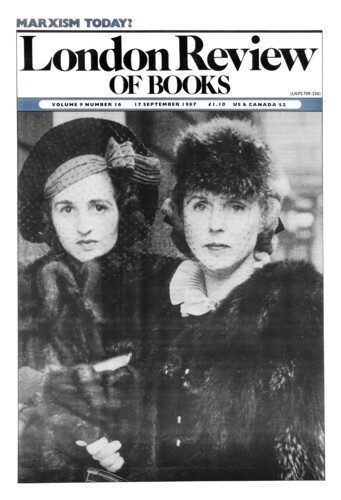
Bernard – originally Bernhard – Berenson was a Lithuanian Jewish refugee rescued from poverty by the charity of Bostonian plutocrats who sent him to Harvard and then to Europe. During the 1890s he established himself as an expert on Italian Renaissance art and simultaneously made his knowledge indispensable to the booming international art trade, which made him a very rich man by the time the second volume of his biography by Ernest Samuels opens in 1903. These relations with dealers, which were either discreet or secret, deepened in subsequent decades, and it should have come as no surprise to Berenson when he returned from holiday in October 1922, to his luxurious Florentine villa, I Tatti, to discover that the Internal Revenue Service had questioned his tax return.
Nicholas Penny looks through the letters of Prince Hermann von Pückler-Muskau, who visited England in the late 1820s.
Nicholas Penny, former director of the National Gallery, explains how Kenneth Clark transformed the National Gallery as director from 1934 to 1945, with a look at the Myra Hess concerts and Clark's wide-ranging...
There are two forces at work in sculpture. One pushes it towards the waxwork, where materials suggest something quite contrary to their native qualities – marble flesh, wooden flowers,...
W hen I used to give a survey course for first-year students, I dreaded December. That was when I reached the High Renaissance and my audience fell away. It was not only the alternative seasonable...
Richard Payne Knight was an important English intellectual of the era of the French Revolution. He flourished from the 1770s until his death, perhaps by suicide, in 1824. Most of that time he...
Here, at last, is a book of which we can sincerely say in the old phrase that it meets a long-felt want. It offers, in the modest words of the Preface, ‘a series of illustrations (which are...

Read anywhere with the London Review of Books app, available now from the App Store for Apple devices, Google Play for Android devices and Amazon for your Kindle Fire.
For highlights from the latest issue, our archive and the blog, as well as news, events and exclusive promotions.