Nicholas Penny

Nicholas Penny is a former director of the National Gallery. He is cataloguing the earlier Italian paintings at the Norton Simon Museum in Pasadena, with Imogen Tedbury.

Bidding for favours

Nicholas Penny, 19 December 1991

Today the Roman Catholic priest celebrating Mass stands on the far side of the altar, facing the congregation, in accordance with the prescription of the Second Vatican Council of 1963. In doing so he is adopting the position which was normal before the 13th century. On the modern altar an altarpiece is an impossibility: it would get in the way. It was the same in 1200. Much else has, however, changed since then. The altar is now, emphatically, a table, the mensa of the primitive Church, whereas in 1200 it was, and had long been, a solid structure more like a tomb chest. Its frontal or antependium was often as lavish in materials and in workmanship as a shrine or reliquary. Indeed, altars were a type of shrine or reliquary, for relics had to be kept in them and were often exhibited above them or in crypts beneath them – relics which might be merely a toe or a tooth but which were, not unusually, the mortal remains of a martyr.
Letter

Off the point

21 November 1991

Henry James in The Tragic Muse described an English family at an exhibition as ‘finished productions … ranged there motionless … almost as much on exhibition as if they had been hung on the line’. Philip Horne (LRB, 21 November 1991) finds this deflationary, leaving the family ‘high and dry’ as on a washing-line. But James’s public, on the rare occasions when they heard that domestic...

Myths of the Artist’s Youth

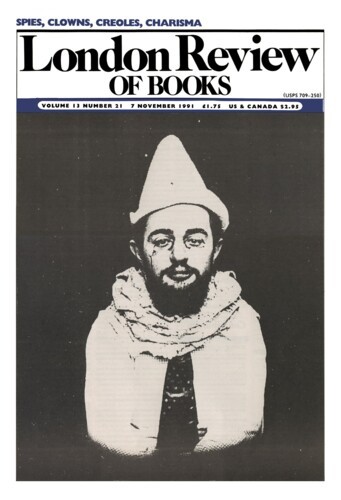
Nicholas Penny, 7 November 1991

Picasso was no lover of truth: his own accounts of his childhood in Andalusia and his youth in Barcelona, as recorded by pious biographers in his own lifetime, notably Sabartes and Penrose, are riddled with hyperbole which Richardson, in the first volume of his biography, is careful to question and is sometimes able to correct – thanks to the scrupulous record-keeping of the Spanish state schools. He is also able to reveal some things which Picasso either forgot or concealed. The census of 1885 records a younger brother, Jose, then aged one, never, it seems, mentioned by the painter. Jose may be a clerical error, but more probably he lived only for a short time. In any case, no male sibling survived as a rival for the love of Picasso’s mother, on whose support he could always count. Little is known about her, and Richardson, while acknowledging the importance of Picasso’s relationship with her, cannot expand on it with authority.

Measuring up

Nicholas Penny, 4 April 1991

Opposite the first page of Lorne Campbell’s Renaissance Portraits is a large colour plate of a pair of young female hands emerging from crisp and translucent white cuffs with black borders. The hands, which clasp soft buff kid gloves against a black satin gown, belong to Christina of Denmark, Duchess of Milan – or rather to the arresting full-length portrait of her by Holbein reproduced nearby. We learn from one of the unusually informative captions that King Henry VIII was taken with the idea of making Christina, a teenage widow, his fourth wife. He dispatched Holbein, his court painter, to Brussels to record her likeness. She sat to Holbein between 1 and 4 p.m. on 12 March 1538. The artist left Brussels that night and within a few days the King was able to study her picture. It put him into a ‘much better humour’. Musicians were ordered to ‘play on their instruments all day long’. Luckily for Christina, the scheme came to nothing; Holbein, however, was able to use he drawings he had made in Brussels to paint he great full-length portrait.

Diary: Columns and Pilasters

Nicholas Penny, 8 November 1990

Last year I travelled frequently on the early-morning coach from London to Oxford which passes Sir Edwin Cooper’s pair of Classical municipal buildings in Marylebone. The first of these is the Town Hall of 1914: proudly alert like the lions which guard its portal; perhaps ostentatious like the swollen waistcoats paraded by its original occupants; ‘massive and effusive,’ Pevsner puts it. I couldn’t decide how much to like it. But the library beside it is a different matter. Its elevations are tighter, its detail sharper and less showy. I began to look forward to its disciplined and exalted harmonies as keenly as I did to the great Classical architecture awaiting me in Oxford. It was built in 1939.

School of Hard Knocks

Peter Campbell, 2 December 1993

There are two forces at work in sculpture. One pushes it towards the waxwork, where materials suggest something quite contrary to their native qualities – marble flesh, wooden flowers,...

Read more reviews

The Raphael Question

Lawrence Gowing, 15 March 1984

When I used to give a survey course for first-year students, I dreaded December. That was when I reached the High Renaissance and my audience fell away. It was not only the alternative seasonable...

Read more reviews

Priapus Knight

Marilyn Butler, 18 March 1982

Richard Payne Knight was an important English intellectual of the era of the French Revolution. He flourished from the 1770s until his death, perhaps by suicide, in 1824. Most of that time he...

Read more reviews

Perfection’s Progress

E.H. Gombrich, 5 November 1981

Here, at last, is a book of which we can sincerely say in the old phrase that it meets a long-felt want. It offers, in the modest words of the Preface, ‘a series of illustrations (which are...

Read more reviews

Read anywhere with the London Review of Books app, available now from the App Store for Apple devices, Google Play for Android devices and Amazon for your Kindle Fire.

Sign up to our newsletter

For highlights from the latest issue, our archive and the blog, as well as news, events and exclusive promotions.

Newsletter Preferences