Marina Warner

Marina Warner is the author, most recently, of Sanctuary: Ways of Telling, Ways of Dwelling.

From The Blog
30 August 2013

The Museum of Islamic art is closed on Tuesdays, the taxi driver tells us. En route to the Melbourne Writers Festival, Mary-Kay Wilmers, Jacqueline Rose and I, soon to be joined by Andrew O’Hagan, have stopped for the night in Doha for this collection, to see the medieval lamps, the carpets, the emeralds, the Kaaba curtains, the manuscripts of the Quran, the maps of the world – maybe the map of Qatar when it was a pearl fishing port and an infamous haven for pirates. After all my browsing on the museum’s site, how could I have missed the opening times? We resolve to find a way: personnel must be on duty even during closing hours. Guards present. Temperature controls purring. Lighting on to protect against stealthy intruders. We email and text anyone who might have an entrée. I am a little embarrassed.
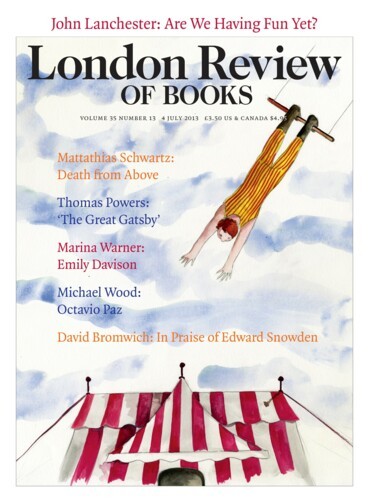
Emily Wilding Davison was born in 1872 in a substantial house in Greenwich, the middle daughter of her speculator father’s second marriage. She was red-haired and liked sweets; her pet name at home was Weet Weet. At the age of 19 she won a scholarship to Royal Holloway, where she could read for the Oxford degree in English. But during her second year her father died and, in a Dickensian twist, he left the family skint; Davison’s mother took her children north and opened a shop. Davison became a governess and worked on her books at night.

From The Blog
26 June 2013

The Wilding Festival, organised by mostly young artists, teachers and activists, took place earlier this month in St George’s Bloombury, the Hawksmoor church which is crowned by a ziggurat and backs on to Little Russell Street, opposite the offices of the LRB. Emily Wilding Davison’s funeral took place there a hundred years ago, the magazine was collaborating with the festival, and I was asked to give a talk about female heroism.

At the V&A: ‘Hollywood Costume’

Marina Warner, 20 December 2012

Dressmakers’ dummies are favourites with photographers of haunting; Eugène Atget, who rarely shows the inhabitants of a Parisian street or room, dwells on the smiling mannequins in shop windows, wearing aprons and housemaids’ caps, or on an effigy of madame in a string of pearls and a tilted trilby. Fixed expressions and rigid bodies give the images an uncanny aura –...

Letter

Our Joan

6 December 2012

Andrew McCullough, in his response to my piece about Joan of Arc, ends by saying, ‘If the right want her they can surely have her’; R.W. Johnson seems to be tarring her with the same brush, recalling a dim heroine of colonial propaganda from the French war in Indochina (Letters, 20 December 2012 and Letters, 3 January). Both show startling complacency about mythical and political symbols...

There can be no new reader, and therefore perhaps no wholly new reading of the collection of stories known as The Arabian Nights. Not because they have been exhausted by retelling and...

Read more reviews

A memorable image in Robert Musil’s Man without Qualities likens the impact of a certain character to that of a powdery avalanche. The effect of reading Marina Warner’s magisterial...

Read more reviews

Some Evil Thing

James Davidson, 18 February 1999

Marina Warner’s No Go the Bogeyman: Scaring, Lulling and Making Mock is an impossible book. It circles around monsters and the frightening of children, but it also has chapters on the...

Read more reviews

Once upon a Real Time

Wendy Doniger, 23 March 1995

If women are the ones who tell fairy tales, why do fairy tales paint such ugly pictures of women? Or, as Marina Warner puts it, ‘If and when women are narrating, why are the female...

Read more reviews

Fear of Rabid Dogs

Margaret Anne Doody, 18 August 1994

In his last days, the exiled and ageing Aristotle wrote to a friend: ‘The lonelier and the more isolated I am, the more I have come to love myths.’ We may puzzle over what Aristotle meant....

Read more reviews

Sea Changes

Patrick Parrinder, 27 February 1992

The British, a nation of Sancho Panzas, like to dream of governing an island. The majority of ideal states both ancient and modern have been imaginary cities rather than sea-girt lumps of rock,...

Read more reviews

Making and Breaking

Rosalind Mitchison, 21 December 1989

Nobody could call Frank Honigsbaum’s book ‘user friendly’. Some reasons for its indigestibility are inherent in the topic: the moves, some effective, most frustrated, by civil...

Read more reviews

Let’s get the hell out of here

Patrick Parrinder, 29 September 1988

Here, in these three novels, are three representations of the state of the art. In The Satanic Verses the narrator, who may or may not be the Devil, confides that ‘what follows is tragedy....

Read more reviews

The nude strikes back

John Bayley, 7 November 1985

The psychologist John Layard – ‘Loony Layard’, as he is affectionately termed in one of Auden’s early poems – is said to have told a submarine officer that he had...

Read more reviews

Nationalities

John Sutherland, 6 May 1982

A new novel by Günter Grass invites comparisons of a national kind. If a British writer of fiction wished to engage with the big stories of the day – the kind of thing Brian Walden...

Read more reviews

Joan and Jill

V.G. Kiernan, 15 October 1981

In 1870, Daumier drew a cartoon of soldiers filing past a monument of the fatherland, with the caption: ‘Ceux qui vont mourir te saluent.’ Wandering about quiet French churches, one...

Read more reviews

Read anywhere with the London Review of Books app, available now from the App Store for Apple devices, Google Play for Android devices and Amazon for your Kindle Fire.

Sign up to our newsletters

For highlights from the latest issue, our archive and the blog, as well as news, events and exclusive promotions.

Newsletter Preferences