
Marina Warner

Marina Warner is the author, most recently, of Sanctuary: Ways of Telling, Ways of Dwelling.

You must not ask

Marina Warner, 4 January 1996

Bachelor uncles can be popinjays who wear moustache trainers in bed in order to cut a dash the next day, as in Fellini’s Amarcord; or they might take the children aside at Christmas and show them how to trumpet a tune in farts, as in Bergman’s Fanny and Alexander. In stories like that of Freud’s ‘Katharina’, they interfere with little girls, though for many reasons Freud substituted Katharina’s uncle for her father. Perhaps an uncle seemed a more plausible or even acceptable perpetrator. But the kind of bachelor uncle formed in England over the decades by the university ruling that dons should not be married offers a study in psychological and national identity that has no counterpart abroad. He lingered on – still does – though the rambling houses of North Oxford built to accommodate the new families of married fellows stand as monuments to the social changes that inaugurated his decline. His love objects were not usually girls, though John Betjeman, sighing over thighs, caught the authentic tone of enraptured and impotent yearning.’

Harmoniously Arranged Livers

Marina Warner, 8 June 1995

When a djinn appears in one of A.S. Byatt’s fairy tales and grants the fifty-ish academic heroine any wish her heart desires, she asks for her body ‘as it was the last time she really liked it’. And lo, she finds herself once more housed in the ‘serviceable and agreeable’ form she possessed some fifteen years earlier, bearing some marks of experience (an appendix scar), but otherwise compact, neat, strong. She feels wonderful. ‘I can go in the streets, she said to herself, and still be recognisably who I am … only I shall feel better, I shall like myself more.’ She proceeds to great adventures of an earthly variety with the djinn himself.…

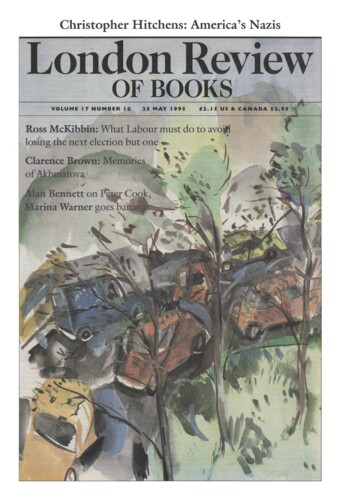
Diary: Gone Bananas

Marina Warner, 25 May 1995

The frond of the banana has straight seams, as a good pair of nylons used to have, so it’s easy to tear along them and make squares of bright luminous green, nature’s own shot silk. Which is what Adam and Eve probably did when they made shift with ‘aprons’ to hide their shame from God in the garden. In some countries where Spanish and Portuguese are spoken – which means parts of the Caribbean as well as Latin America – the word for fig is used of the banana, so this may be another example of those inspired clerical slips which result in widespread conventions. That the figleaf is hard to fix to the body every child confronted with a Renaissance statue has noticed. Banana leaves, on the other hand, can be draped and threaded – like cloth.’

Letter

Mistake

6 April 1995

I regret that in my review of Love’s Work (LRB, 6 April) I gave the wrong surname for Gillian Rose’s sister Diana; I should have written Diana Stone.

Fierceness

Marina Warner, 6 April 1995

This small book contains multitudes. It fits to the hand like one of those knobbed hoops that do concise duty for the rosary, each knob giving the mind pause to open up to vistas of meditation on mysteries and passions; in the compass of a scant 135 pages it provokes, inspires and illuminates more profoundly than many a bulky volume, and confronts the great subjects – death, illness, reason and unreason, family strife and family bonds, friendship and betrayal, today’s political abdication and philosophical cowardice, the limits of feminism, of happiness – and it delivers what its title promises, a new allegory about love.’

There can be no new reader, and therefore perhaps no wholly new reading of the collection of stories known as The Arabian Nights. Not because they have been exhausted by retelling and...

Read more reviews

A memorable image in Robert Musil’s Man without Qualities likens the impact of a certain character to that of a powdery avalanche. The effect of reading Marina Warner’s magisterial...

Read more reviews

Some Evil Thing

James Davidson, 18 February 1999

Marina Warner’s No Go the Bogeyman: Scaring, Lulling and Making Mock is an impossible book. It circles around monsters and the frightening of children, but it also has chapters on the...

Read more reviews

Once upon a Real Time

Wendy Doniger, 23 March 1995

If women are the ones who tell fairy tales, why do fairy tales paint such ugly pictures of women? Or, as Marina Warner puts it, ‘If and when women are narrating, why are the female...

Read more reviews

Fear of Rabid Dogs

Margaret Anne Doody, 18 August 1994

In his last days, the exiled and ageing Aristotle wrote to a friend: ‘The lonelier and the more isolated I am, the more I have come to love myths.’ We may puzzle over what Aristotle meant....

Read more reviews

Sea Changes

Patrick Parrinder, 27 February 1992

The British, a nation of Sancho Panzas, like to dream of governing an island. The majority of ideal states both ancient and modern have been imaginary cities rather than sea-girt lumps of rock,...

Read more reviews

Making and Breaking

Rosalind Mitchison, 21 December 1989

Nobody could call Frank Honigsbaum’s book ‘user friendly’. Some reasons for its indigestibility are inherent in the topic: the moves, some effective, most frustrated, by civil...

Read more reviews

Let’s get the hell out of here

Patrick Parrinder, 29 September 1988

Here, in these three novels, are three representations of the state of the art. In The Satanic Verses the narrator, who may or may not be the Devil, confides that ‘what follows is tragedy....

Read more reviews

The nude strikes back

John Bayley, 7 November 1985

The psychologist John Layard – ‘Loony Layard’, as he is affectionately termed in one of Auden’s early poems – is said to have told a submarine officer that he had...

Read more reviews

Nationalities

John Sutherland, 6 May 1982

A new novel by Günter Grass invites comparisons of a national kind. If a British writer of fiction wished to engage with the big stories of the day – the kind of thing Brian Walden...

Read more reviews

Joan and Jill

V.G. Kiernan, 15 October 1981

In 1870, Daumier drew a cartoon of soldiers filing past a monument of the fatherland, with the caption: ‘Ceux qui vont mourir te saluent.’ Wandering about quiet French churches, one...

Read more reviews

Read anywhere with the London Review of Books app, available now from the App Store for Apple devices, Google Play for Android devices and Amazon for your Kindle Fire.

Sign up to our newsletters

For highlights from the latest issue, our archive and the blog, as well as news, events and exclusive promotions.

Newsletter Preferences