Jonathan Coe

Jonathan Coe’s new novel, Lessons in Harmony, is due in November.

Calvinoism

Jonathan Coe, 26 March 1992

‘What tends to emerge from the great novels of the 20th century is the idea of an open encyclopedia,’ wrote Calvino in 1985, the year of his death. Tracing the lineage of the encyclopedic novel through Perec, Mann, Proust and Flaubert, he homes in on the figures of Carlo Emilio Gadda and Robert Musil, two ‘engineer-writers’ who have one quality in common: ‘their inability to find an ending’. Despite his own love of arcana and encyclopedic forms, Calvino’s relationship to this tradition was always tangential, for the simple reason that, in his own words, ‘my temperament prompts me to “keep it short” ’: but now we have two volumes which, because unfinished, are more defiantly, maddeningly ‘open’ than anything else in his canon, and which can therefore scarcely avoid taking on something of the glamour which in Gadda’s novels was an intrinsic quality – their sense of being ‘left as fragments, like the ruins of ambitious projects that nevertheless retain traces of the splendour and meticulous care with which they were conceived’.’
Something else

Jonathan Coe, 5 December 1991

The traditional self-contained, sensibly-proportioned novel, still very much the dominant influence on today’s literary scene, is called gently into question by each of these writers. Carey Harrison, with ostensibly the second (although in fact the first) volume of what looks set to become a monumental tetralogy, puts pressure on the boundaries of the form by insisting that it absorb a near-infinity of characters, events and incidental detail. Less ambitious, but more subversive, Christopher Stevenson and Hugh Nissenson seek to dismantle the system from within by producing novels which look like something else altogether: a form of experimentation which often has rather puritanical motives behind it – the assumption being either that existing literary forms have played themselves out or that it’s somehow possible to get closer to an uncorrupted version of the truth if the trappings of novelistic convention are done away with.’

Australian Circles

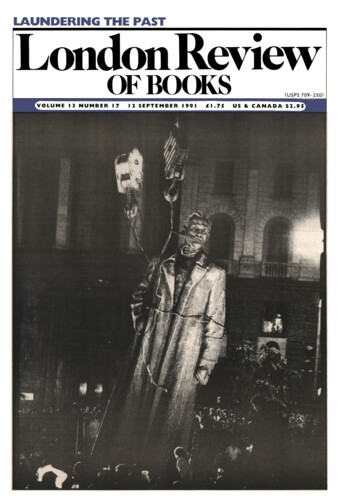
Jonathan Coe, 12 September 1991

Both of these Australian novels describe circles. Carey, forsaking the confident historical sweep of Oscar and Lucinda and Illywhacker to focus once again on the horrors of modern suburbia, traces the vicious circles of a family history in which successive generations are debilitated by a legacy of abuse. Rodney Hall tells of a convict at large in New South Wales in 1838, caught up in larger, even more powerful cycles of captivity and exploitation, until he finds temporary sanctuary with an Aboriginal tribe and becomes ‘the very centre of their circle’. Both novels end with violence: but only Carey’s has the nervous optimism to suggest that this might provide a means, however damaging, of breaking loose from an imprisoning pattern.

There was and there was not

Jonathan Coe, 4 April 1991

Amos Oz and David Grossman are both political writers. This might seem an obvious statement, given that they are well-known for being politically vocal and have both written political (non-fiction) books consisting of interviews with their Palestinian and Israeli countrymen. But the main thing is that they also write intensely and truthfully political novels of the sort which tend to he thin on the ground in Britain. Partly, no doubt, this is a question of Israel’s history, and of the urgency of the material which it offers, hut there’s also the possibility that when a writer decides to leap boldly into the area where ideology leaves off and action begins, significant analogies between political and literary activity start to emerge. One of them has to do with the nature of lies, because the fundamentalist Platonic position that ‘telling stories is telling lies’ has haunted the conscience of the imaginative writer for centuries. Even Sidney’s attempt to brush it off by claiming that the poet ‘nothing affirms, and therefore never lieth’ seems more than a little shifty: a real politician’s manoeuvre, in fact. It doesn’t deflect attention from the central link between politics and literature, which is that they both boil down to the art of lying in the name (supposedly) of a higher truth.

Conversions

Jonathan Coe, 13 September 1990

The terms ‘Catholic writers’ and ‘women writers’ were invented by critics to make their own lives easier, at the cost, no doubt, of making the lives of certain authors more exasperating. They are dangerous terms because they tempt us to lump writers like Muriel Spark and Alice Thomas Ellis together, especially when there are other alluring points of comparison, such as a characteristic tone which at first can seem no more than coolly ironic, and even – in these latest books – some clear similarities of plot (both novels touch on the predicaments of women who know they are about to be murdered). As it turns out, though, just about the only thing which Symposium and The Inn at the Edge of the World have in common is a readiness to be ceaselessly entertaining even when absorbed in the treatment of issues which are, for both authors, of the most deadly seriousness. If the contrasts in temperament and narrative method are what strike us first, it seems likely that these will finally boil down to a fundamental difference in the sense of what it means to be a Catholic: so this has to be addressed, however much we may feel – in Muriel Spark’s case, anyway – that the field has already been ploughed pretty thoroughly.’

One​ of the inhabitants of Middle England, the title and the setting of Jonathan Coe’s last novel, part of a location that is also called ‘merrie’, ‘deep’ and...

Read more reviews

Nate of the Station: Jonathan Coe

Nick Richardson, 3 March 2016

On 18 July​ 2003, the body of the weapons inspector David Kelly was found in the woods on Harrowdown Hill in Oxfordshire, two months after he’d revealed that the Blair administration had...

Read more reviews

Fetch the Scissors: B.S. Johnson

Colin Burrow, 11 April 2013

Until very recently I had never read any B.S. Johnson. I had a staticky reminiscence of what he might have been, which could be represented, using his own idiosyncratic conventions for marking the...

Read more reviews

Beatrix and Rosamond: Jonathan Coe

Daniel Soar, 18 October 2007

People think they like reading Jonathan Coe’s novels for any number of reasons. For their satirical sharpness, for instance: What a Carve Up! (1994) – the carve-up in question...

Read more reviews

Hindsight Tickling: disappointing sequels

Christopher Tayler, 21 October 2004

In Like a Fiery Elephant, his recent biography of B.S. Johnson,* Jonathan Coe writes feelingfully about the perils of too much Eng. Lit. He ‘emerged from the experience of reading English...

Read more reviews

Retripotent: B. S. Johnson

Frank Kermode, 5 August 2004

B.S. Johnson died by his own hand in 1973. He was 40, and the author of seven novels, all of them rather odd in ways that put publishers off because their oddities made them expensive to produce...

Read more reviews

There are those who like to mortise a plot, carefully and neatly, and there are those who are content simply to bang it together with panel pins and a tube or two of Gripfill. Jonathan Coe is...

Read more reviews

You see stars

Michael Wood, 19 June 1997

In the early Eighties, British novelists worried a lot about history. Where had it gone, why had it left so few traces, why did it still hurt? How could it simultaneously seem so irrelevant and...

Read more reviews

Theydunnit

Terry Eagleton, 28 April 1994

Gothic horror tale, detective mystery, autobiography, political history: Jonathan Coe’s appealingly ambitious new novel involves a promiscuous intermingling of literary genres, as a potted...

Read more reviews

Deep down

Julian Symons, 28 June 1990

What is it really about, and why was it written like this? The questions are never unreasonable when confronted with works that suggest the possibility of other meanings present beneath the...

Read more reviews

Strong Meat

John Lanchester, 11 January 1990

Harry Fonstein, one of the four main characters in The Bellarosa Connection, is a now-prosperous American-Jewish businessman who was saved from a Fascist prison and smuggled to America by Mafia...

Read more reviews

Read anywhere with the London Review of Books app, available now from the App Store for Apple devices, Google Play for Android devices and Amazon for your Kindle Fire.

Sign up to our newsletter

For highlights from the latest issue, our archive and the blog, as well as news, events and exclusive promotions.

Newsletter Preferences