John Bayley

John Bayley, who died in 2015, was the first holder of the Warton chair in English literature at Oxford. He wrote 153 pieces for the LRB, some of which were collected in The Power to Delight: A Lifetime in Literature. His other books include The Romantic Survival, The Characters of Love and studies of Shakespeare, Hardy, Pushkin and Tolstoy.

Just off Lexham Gardens

John Bayley, 9 January 1992

Towards the end of his life (he died aged 58) Patrick Hamilton was taking the cure in some Metroland establishment while Malcolm Lowry was being dried out in another not far off. That was around l960, and the two writers never met; but both had become something of a cult. Hamilton died two years later in more than averagely gloomy circumstances, back on the bottle again; and most of his reputation went with him; but there were always the faithful who remembered and read him, and a few years ago his young man’s trilogy from the early Thirties, Twenty Thousand Streets under the Sky, was republished.
Dry Eyes

John Bayley, 5 December 1991

A Jane Austen of today is barely imaginable: but it one nonetheless imagines her, and locates her in South Africa, how would she be exercising her art? Could she find any subject other than the one Nadine Gordimer writes about? A great, even a good writer does not find his subject, it lakes him over: he becomes it, and the world it has brought with it. But there exist situations in which this is necessarily not the case. Not only the subject but the way to treat it is handed to the talented South African writer in the most unambiguous terms. His success must be measured, not in terms of the world he has made by his art, but by what his art reveals of a particular world.

Out of Ottawa

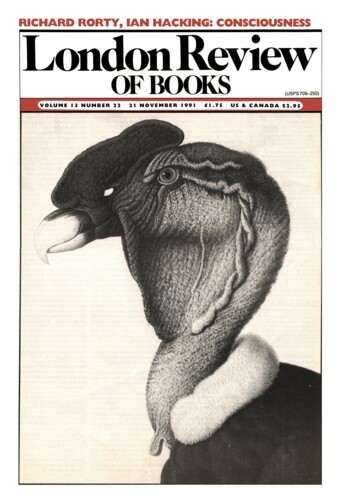
John Bayley, 21 November 1991

Frank Kermode observed in a recent article that critics are always being needed to rediscover work that, for whatever reason, has gone silent, Good literature is more silent than one might suppose: it waits mutely on the shelves, it cannot attract attention to itself, and in the conditions of our own or any other time it could wait till judgment day without being found and proclaimed. The finding and proclaiming, on an organised basis, might be part of the business of university English schools. On the other hand, there is nothing quite like doing the thing for oneself: opening the book in a shop or library and becoming riveted at once.

Singer’s Last Word

John Bayley, 24 October 1991

A story no doubt originating in Norway goes over the ground about persons of different nationality required to write an essay on elephants. The Englishman of course writes about hunting them, the French about their love-life, the Swede about elephantine manners and etiquette, the Dane about the ivory business. The Norwegian produces an essay on Norway and Norwegians. A laborious jest with many permutations, but it serves to show that a people likes to think that while other countries have their own characteristics they have what really matters – themselves. And for a people to write about itself can be both inspiration and good business.

In one of George Eliot’s Scenes from Clerical Life a lady addicted to reading tracts skims rapidly over references to Zion or the River of Life, but has her attention immediately caught by any mention of ‘pony’ or ‘boots and shoes’. A reader of modern biographies can see why. The best things in them are usually the facts, the objects, the unexplained and inexplicable things that cluttered up the lives of the august and famous, as they do everybody else’s, and now find a place in the story. The greasy trilby hat Ford Madox Ford put to dry in Jessie Conrad’s oven, provoking the only outburst of wrath ever seen on the part of that placid lady; the ‘good sandwiches’ which the soon-to-be-cast-off Hadley Hemingway promised to make for her husband’s outing to the races at Longchamps; ‘black-eyed Susan’, the New Mexican cow beloved by D.H. Lawrence: these are the things that stay in the mind when diagnoses and depreciations are forgotten.

In their very different ways, the three most prominent Oxford professors of English since the war have all been populist pretenders. John Carey, scourge of Modernist ‘intellectuals’...

Read more reviews

The first thing Alzheimer’s disease took away from Iris Murdoch was her luminous powers. At a conference in Israel in 1994, she was unable to answer her audience’s questions. In 1995,...

Read more reviews

Distant Sheep

Penelope Fitzgerald, 21 July 1994

John Bayley’s new novel is largely about those who are had on, or taken in, and this may well include his readers, who need to keep their wits about them. To begin with, he conjures up a...

Read more reviews

A Poetry of Opposites

C.H. Sisson, 9 July 1992

Whatever may now be the state of the market for A Shropshire Lad, the poetry of A.E. Housman has certainly been among the most read of the 20th century. Or in the 20th century, for the earlier...

Read more reviews

In a recent issue of Index on Censorship, Vaclav Havel, the dissident Czech playwright and essayist who has spent long periods in prison, tells the following tale: A friend of mine who is...

Read more reviews

The Things about Bayley

Nicholas Spice, 7 May 1987

There is a certain kind of knowledge – perhaps the most important – that cannot be explicitly taught or diligently learnt. For example, a tribe of Indians on the river Xingu lives on...

Read more reviews

Foreigners

Denis Donoghue, 21 June 1984

One of Anthony Thwaite’s poems, ‘Tell it slant’, swerves from Emily Dickinson’s line ‘Tell all the Truth but tell it slant’ to settle upon an aesthetic...

Read more reviews

Theatre-proof

Anne Barton, 2 July 1981

Twenty-one years ago, in The Characters of Love, John Bayley suggested that ‘there is a sense in which the highest compliment we can pay to Shakespeare is to discuss his great plays as if...

Read more reviews

Read anywhere with the London Review of Books app, available now from the App Store for Apple devices, Google Play for Android devices and Amazon for your Kindle Fire.

Sign up to our newsletter

For highlights from the latest issue, our archive and the blog, as well as news, events and exclusive promotions.

Newsletter Preferences