Jeremy Harding

Jeremy Harding is a contributing editor at the LRB. His books include Border Vigils: Keeping Migrants Out of the Rich World and Mother Country, a memoir. His essay collection, Analogue Africa: Notes on the Anti-Colonial Imagination, was published in March.

Diary: In Soweto

Jeremy Harding, 11 October 1990

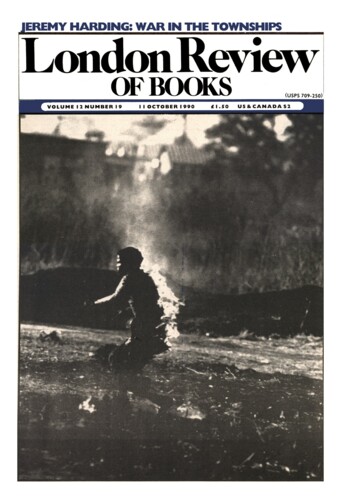
Last month, two days after the war on the Reef between Inkatha and the ANC erupted in Soweto, the families in Klipsruit Extension were moving out. The windows had been smashed in every single house on the dusty road through this respectable, middle-class development. Dozens of well-dressed middle-class Sowetans were loading mattresses, tables, cushions, chairs and pictures onto pick-up trucks and roof racks. There was a house set back from the road, fronting the open field through which Inkatha must have come. It belonged to the Kunene family, one of whom had recently died in a car crash. When Inkatha burst in, the family were holding a vigil for the dead man. The women must have been in the covered yard at the back preparing food for the funeral the next day. The big pots had been overturned and there was a litter of freshly-sliced vegetables on the floor. The rest of the makeshift outdoor kitchen had been broken up, its contents strewn on top of the vegetables – except for the meat, which had been stolen. All that remained of that, propped on the surface of a listing wooden table, was an enormous cow’s head, its horns angled up to the canopy and its dim eyes fixed on the dirt path at the back of the house.’
Got to keep moving

Jeremy Harding, 24 May 1990

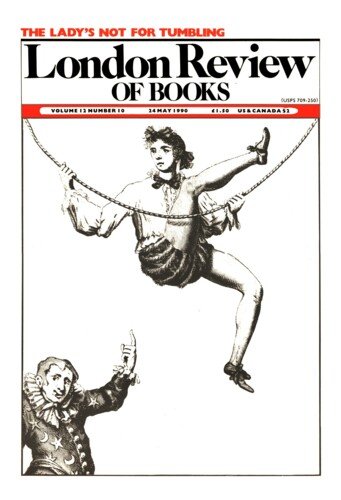
The idea that a falling object was about to defy gravity before it hit the ground is a familiar one in the mythology of the pop idol. It is the gist of Charles Shaar Murray’s book about Jimi Hendrix, who enjoyed a great career as a virtuoso guitar player between 1966 and 1970, when he died in a London hospital after an overdose of sleeping pills. In a sparkling homage, far more readable than most books about pop music, Murray argues that the extravagant left-hander who introduced a new vocabulary to rock guitar-playing was the unsung progenitor of a jazz we will never know.

Her Guns

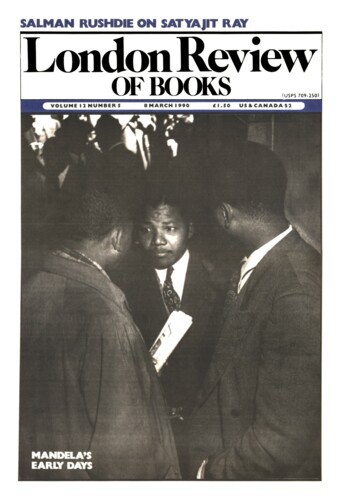
Jeremy Harding, 8 March 1990

As a young girl growing up in St Louis, Missouri, Martha Gellhorn had a habit of poring over maps; riding on the city’s tramcars, she would imagine she was bound for distant places with exotic names. Seventy years later, her war dispatches, fiction, travel writing and the peacetime journalism – collected here – bear witness to a lifetime of wanderlust. From the clattering cars of the St Louis Transit Authority, the dreamy child has disembarked as a grown woman in Europe, Asia, the Middle East, Latin America, the Caribbean and Africa. In all these places she has set down what she saw in her journalism and worked what was less readily apparent into her fiction: five novels, two collections of stories and four groups of novellas.’

Diary: On the Tyson Saga

Jeremy Harding, 31 August 1989

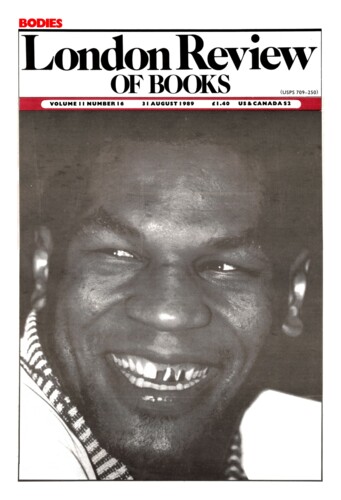
The Police Athletic League building stands on a large, unkempt lot in Atlantic City. It is a forlorn edifice with damp walls and a cracked facade. Carl ‘The Truth’ Williams, who fought Mike Tyson in July, is a regular visitor to the boxing gym on the upper floor, where the athletic young men – mostly black and Hispanic – spar in a raised ring, thrash oblong leather bags, pump metal, skip rope, and stalk their own images in three or four large mirrors, with a fury that must be reducing the life of the building still further. To stand at the centre of the gym in mid-afternoon is like being astride a pneumatic drill. The floor and walls vibrate with a combination of pounding feet, drubbed bags and jabbering speedballs until the frenzy of noise levels out to a sustained hum.’

Matsanga

Jeremy Harding, 16 February 1989

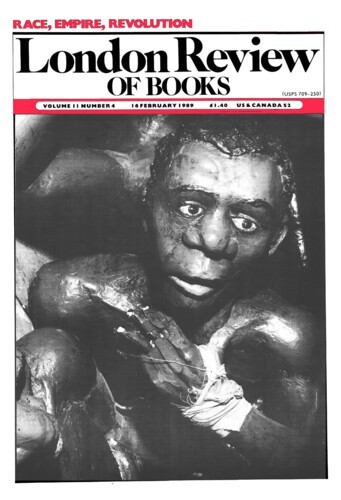
Last year, a two-page circular letter from an address in Central London arrived in dozens of offices and homes throughout Britain. It was a handsome campaign document, announcing the appearance of eight ‘easy-to-read briefings’ and the existence of ‘five local support groups in Glasgow, Birmingham, Berkshire, Leicester and Greater London’. The Mozambique National Resistance – Renamo, in Portuguese – has created havoc in Mozambique for a decade. United States sources hold the ‘anti-Communist’ insurgency responsible for tens of thousands of civilian killings. Renamo’s atrocities are too outlandish to warrant description in anything other than a pathology report. In its breezy national mailing, however, the ‘Mozambique Solidarity Campaign’ describes Renamo as a ‘progressive force’ representing ‘the argument for peace and national reconciliation’ in Mozambique. The campaign is patronised by many young right-wingers, including Marc Gordon of the International Freedom Foundation, an anti-communist organisation which enjoys extremist American funding. Like many Western ideologues who sup with the devil, Gordon has the long spoon of ignorance to hand: he has never set foot in Mozambique. In October, however, he got as far south as Brighton, to advertise Renamo’s case in fringe meetings at the Tory Party Conference. Gordon is touting the insurgency as a political alternative to Frelimo, the Marxist Government which took over from the Portuguese in Mozambique 13 years ago.’

Bloody-Minded

Basil Davidson, 9 September 1993

‘In olden times, which is when God was deciding what blessings he would give to the countries he was creating, after a long while he finally got to Angola and he asked Gabriel his angel to...

Read more reviews

Read anywhere with the London Review of Books app, available now from the App Store for Apple devices, Google Play for Android devices and Amazon for your Kindle Fire.

Sign up to our newsletters

For highlights from the latest issue, our archive and the blog, as well as news, events and exclusive promotions.

Newsletter Preferences