Jeremy Harding

Jeremy Harding is a contributing editor at the LRB. His books include Border Vigils: Keeping Migrants Out of the Rich World and Mother Country, a memoir. His essay collection, Analogue Africa: Notes on the Anti-Colonial Imagination, was published in March.

Most of the expatriates in France who had to run for their lives in 1940 made for Marseille, which had working consulates, maritime companies and smuggling networks. The people in the greatest danger were anti-Fascist Germans and Jews of any political persuasion, followed by assorted individuals who had blotted their copybooks in a manner the Gestapo was sure to ascertain or invent. ‘Human trafficking’ had become the order of the day and remained so, long after the hope of leaving by boat had turned out, for most, to be illusory.
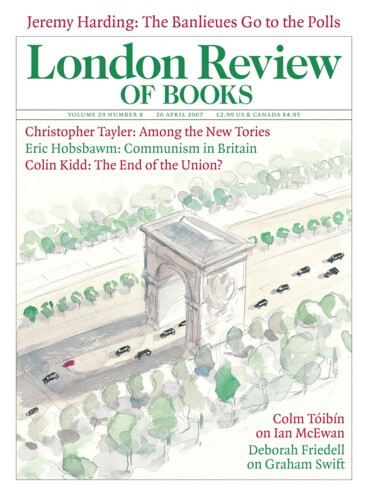
An elderly white man steps through his front gate on the allée de la Chapelle in the Paris suburb of Clichy-sous-Bois, ignoring the commotion two doors down, where a Haitian in his thirties is haranguing a bored reporter about being out of work. Behind them, through a front garden stacked with boxes and dead computer parts, journalists and visitors come and go, mobiles ablaze. The building is on loan as an HQ to the Association Collectif Liberté Egalité Fraternité Ensemble Unis. The acronym is much less ponderous: ACLEFEU, pronounced ‘assez le feu’ or ‘no more burning’. From here the members of the collective continue the painstaking work they began last year, persuading younger inhabitants in the area, and in banlieues all over France, to get their names onto the electoral register.

If any of us has seen the places in the developing world that Mike Davis catalogues remorselessly in Planet of Slums, it was probably from an aeroplane. That doesn't always mean 35,000 feet, for as Davis points out, poorer people tend to colonise the marginal land of cities where air terminals were once built at a comfortable distance from prosperous centres of medium or high population density. Prosperity in the newer, informal urban environment – in Caracas or Lagos, say – is reckoned by incomparably different standards. Davis, the urban historian who also excels at apocalyptic geography, sketches the various ways in which its inhabitants can make ends meet. He also lists ways, based mostly on exploitation, in which they might even profit. In the end, the burgeoning pauper conurbations are as wretched as they look from the cabin window.

Letter

Grand Refurbishing

4 January 2007

Writing in the last issue about the new Musée du quai Branly, I worried that the much-diminished Musée de l’homme would become a no-thrills, indoor Jurassic Park, having been left with its large prehistoric inventory (300,000 items), a prehistory library and plenty in the way of palaeontology (30,000 items). Since the last issue of the LRB went to press, 2012 has been announced...

At Quai Branly: Jacques Chirac’s museum

Jeremy Harding, 4 January 2007

Jacques Chirac’s museum on the quai Branly, opened last summer, continues to pull large crowds at weekends. Chirac, a long-time admirer of what used to be called ‘primitive’ art, made a great deal of noise at the start of his first presidential term about the need to show the various public collections to better advantage. He suggested, not entirely in passing, that some of...

Bloody-Minded

Basil Davidson, 9 September 1993

‘In olden times, which is when God was deciding what blessings he would give to the countries he was creating, after a long while he finally got to Angola and he asked Gabriel his angel to...

Read more reviews

Read anywhere with the London Review of Books app, available now from the App Store for Apple devices, Google Play for Android devices and Amazon for your Kindle Fire.

Sign up to our newsletters

For highlights from the latest issue, our archive and the blog, as well as news, events and exclusive promotions.

Newsletter Preferences