
Jeremy Harding

Jeremy Harding is a contributing editor at the LRB. His books include Border Vigils: Keeping Migrants Out of the Rich World and Mother Country, a memoir. His essay collection, Analogue Africa: Notes on the Anti-Colonial Imagination, was published in March.

From The Blog
29 January 2010

I moved out of London around the time the Clapton Park estate in Hackney got a lick of salmon paint. That was in 2002. I left our dog Megan with my uncle in Marylebone. When she had pups in 2004 he kept one and they called him Asbo. Last week, while my uncle was on a New Labour flickr site, Megan did a runner from the flat and headed out under the Westway. Asbo knew better and sat tight. My uncle tweeted a lost-dog alert. A fish-farmer in the Maldives got back about a different dog. Megan’s missing now, but most of the places she fetched up are on the record. She was first identified on CCTV, hackles up, pacing the north-west corner of Grange Primary School Ealing at 9.45 pm on 21 January: By the morning she was outside Didcot Girls’ School, baying at the new hall, which she may have taken for an abattoir. (frame) The trail went fuzzy after she ducked south to Thanet Campus (frame). By now she was a phantom dog pin-balling round the country with bared teeth, cracked paws and pale green eyes the size of artichokes. She briefly materialised butting the glass panels of the Youth Centre at Thornaby-on-Tees on the 23rd (frame) Hours later, she was filmed behaving in a confused and inappropriate way outside the University Campus, Suffolk. (frame) The story of her round-Britain excursion is told in Change we See, the site my uncle was browsing the night she lit out. You won’t ‘see’ Megan anywhere in shot. She’s already undergone a ‘change’. It looks from the photo-stream like Megan found a two-legged friend out there in the wilderness of brick and PVC. You can see that person in a mauve outfit with a black scarf, directing his mother to the east Building of the Driffield School (frame) And there’s that same person, a day or so later, waving our dog into the Alfred Bean Hospital for a spell in the (experimental) canine unit. (frame) Unlike our dog, the unit’s not yet up and running. It wasn’t ready and she wasn’t either. That’s why we’ve had no news of her. New Labour are the only people with a record of the places our dog visited on her incredible journey around Britain. For instance: The Eaglescliffe Allweather pitch Harris Girls Academy in Dulwich. My uncle says New Labour are probably the only people who can tell us why our dog became the pet from hell in the first place. I moved out of London around the time the Clapton Park estate in Hackney got a lick of salmon paint. That was in 2002. I left our dog Megan with my uncle in Marylebone. When she had pups in 2004 he kept one and they called him Asbo. Last week my uncle was on a Flickr site where citizens upload photos of New Labour's successes: buildings, sports grounds, more buildings. Good, bad, indifferent. As if no other party in history had commissioned so much as a public toilet. My uncle was distressed and so were the dogs. Asbo started to howl and then Megan did a runner. My uncle saw her heading out under the Westway. He tweeted a lost-dog alert. A fish-farmer in the Maldives got back about a different dog.
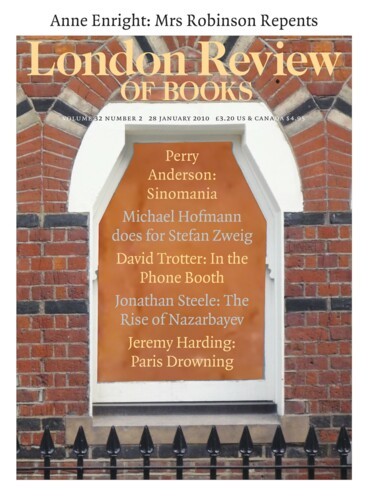

Pavements Like Jelly: Paris Under Water

Jeremy Harding, 28 January 2010

For seven days Paris was like a sinking ship, filling with water from above and below, as its inhabitants took to the lifeboats. On 24 January 1910 the Assembly met to vote an emergency budget for the city and other regions hit by the flood. Members had to be rowed across the courtyard of the Palais Bourbon to take part. The following day, the electricity in the Assembly went down, as it had already in much of Paris.

From The Blog
18 December 2009

The first things a new nation needs are a football team and an army. The last thing it needs is for either to disappear overnight and it’s an embarrassment to Eritrea, which won independence from Ethiopia in 1993, that all 12 members of the national squad should have dumped their strip in the wheelie-bins at the back of their hotel during a CECAFA tournament in Kenya and vanished without further ado. ‘Cazzo,’ I hear the Eritrean leadership whispering to itself. ‘But at least we’ve still got the army.’ The trouble is that the army – or rather military service – is one of the reasons so many Eritreans want to get out. (The UN puts the monthly emigration figures in the low hundreds.) Another is poverty, another is the angular, repressive style of the regime, which hasn’t changed its ways since it got control of the liberation struggle in the mid-1970s.

From The Blog
8 December 2009

Dubai’s latest moment of turmoil is being talked up as a test of ‘Islamic finance’. But is it really? The problem: in 2006 Nakheel Development Ltd issued bonds to the value of three and a half billion dollars, and can’t pay out when they mature next week. The issue in question is ‘sharia-compliant’. This kind of bond, known as a ‘sak’ (plural ‘sukuk’) has seen huge growth in the Islamic and non-Islamic world over the last ten years. I’ve explained how sukuk work in the LRB and how state borrowers and corporations in the West are getting keen on them: The UK Treasury had been planning an issue but it went on hold after the banking meltdown; last month General Electric issued $500 million of sukuk with Middle Eastern investors in view. Very roughly, a bond is Islamic when there’s a tangible underlying asset on which the issue is based – for instance real estate – and when there are no guarantees saying the investor can’t lose: risk has to be shared between borrower and lender. The rapid convergence of Islamic and conventional finance plus the high-level collaboration between intellectuals and product-engineers in both camps have done wonders for sharia-compliant instruments, but there are pitfalls. One is the preference of conventional investors for a guarantee on some kind of return. That’s not permissible in Islamic finance, though if you’re an investment banker or corporate fundraiser you might find a sharia expert who could see a way around the difficulty and put his imprimatur on your product to make it attractive. Looking for a friendly scholarly opinion on a product is known as ‘fatwa shopping’.

From The Blog
17 November 2009

Last Thursday Nicolas Sarkozy gave a long speech at La Chapelle-en-Vercors. It was supposed to be in support of farming, but Sarkozy turned on his heel at the cowshed and launched into a lively exposition of French identity, republican identity, and the identity of everything and nothing. That’s a winning formula. Or it was in 2007 when he campaigned for the presidency on the same combination. It’s probably an opener for the regional elections in March 2010. Sarkozy may well be drawing a pension by the time anyone can say what this great piece of oratory about culture and values really adds up to. Is it worth the struggle? For those who don’t want to find out the hard way, here’s a 17-point résumé: 1. You’re really French when you grasp that the Girondins and the Jacobins were two sides of the same coin. 2. Yes, coins.

Bloody-Minded

Basil Davidson, 9 September 1993

‘In olden times, which is when God was deciding what blessings he would give to the countries he was creating, after a long while he finally got to Angola and he asked Gabriel his angel to...

Read more reviews

Read anywhere with the London Review of Books app, available now from the App Store for Apple devices, Google Play for Android devices and Amazon for your Kindle Fire.

Sign up to our newsletters

For highlights from the latest issue, our archive and the blog, as well as news, events and exclusive promotions.

Newsletter Preferences