Jenny Diski

Jenny Diski was born in London in 1947 and went into foster care at the age of eleven. As a teenager she spent time in psychiatric wards, before being taken in by Doris Lessing, the mother of a schoolfriend. When the LRB’s first editor, Karl Miller, met her in the early 1990s, Diski had been divorced, published five novels and was writing a column about supermarkets in the Sunday Times called ‘Off Your Trolley’. Her first piece for the LRB was a Diary about her ‘ex-Live-in-Lover’. She went on to write six more novels and more than two hundred pieces for the paper, on subjects as diverse as Roald Dahl, disgust, Jewish seafaring, Mrs Freud and Mr Thatcher, Antarctica and UFOs, but her best subject was always herself.

As Mary-Kay Wilmers wrote after Diski’s death in 2016, she ‘wasn’t self-obsessed’. When she heard that she had inoperable cancer she told the oncologist that ‘under no circumstances is anyone going to say that I lost a battle with cancer. Or that I bore it bravely.’ But she embraced ‘the worst cliché of all’, the cancer diary (‘another fucking cancer diary’); seventeen entries were published in the LRB and collected after her death as In Gratitude. A selection of her essays, Why Didn’t You Just Do What You Were Told?, came out in 2020.

From The Blog
22 January 2014

Being told to say sorry for my wrongdoings was my introduction to the double bind. I got the hang of how it worked, but never figured any way out of it. 'Don't just stand there. Haven't you got anything to say for yourself?' It became clear pretty quickly that a rational discussion of the pros and cons of my misdemeanour was not what the parent had in mind. 'Well? And you haven't even got the decency to say sorry.' Deep breath while I prepared myself for entering the mire. 'I'm sorry.' 'No you're not. You're just saying that, because you think you should.' This was almost always true. I was certainly sorry for the trouble I was in, but rarely sorry in a contrite way. It would go on like this. The demand for an apology, the apology, the rejection of the apology and further fury until some punishment was decided on and I was sent in disgrace to my room.


Diary: On Knitting

Jenny Diski, 21 November 2013

Until recently nothing about my experience of knitting or anything I had noticed about it suggested that it might become a cultural ‘thing’. Certainly no sign that I would ever find it a daily itch. The history of my failure in the handicrafts began early. I really looked forward, in my single-figured life, to mixing the paste to pour into the rubber moulds that made plaster of...

On Knickers

Jenny Diski, 10 October 2013

Was there ever a time when clothes were worn purely for warmth? La Mécanique des dessous, the book of the exhibition at the Musée des Arts Décoratifs in Paris (until 24 November) begins its investigation into underthings in the 14th century. You have to start somewhere and the actual beginning is too difficult: speculative, lacking the beautiful, horrific, enticing objects...

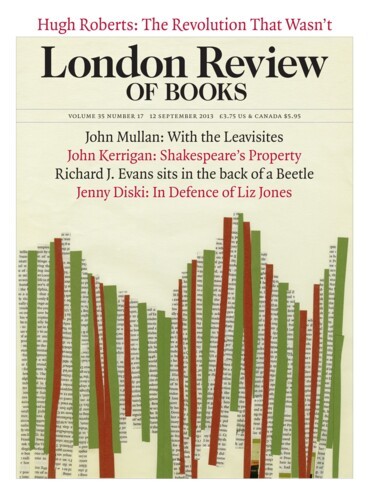
Diary: In Defence of Liz Jones

Jenny Diski, 12 September 2013

I have to acknowledge a misunderstanding. Only when I got her book did I realise that Liz Jones is not Samantha Brick. Scandalised Twitter links melded them together in my lazy mind as the same person in spite of the huge clue that one was called Liz Jones and the other Samantha Brick. The mind has mountains and makes molehills. I was led to an article in the Mail by Samantha Brick over a year ago. The piece told in notably style-free prose how Brick’s exceptional beauty had been the cause of injustice and suffering in all the important aspects of her life.

Diary: In Praise of Older Men

Jenny Diski, 6 June 2013

There’s a joke going round on Twitter that ‘they are arresting the Seventies.’ The ‘Seventies’ they are arresting is the decade rather than the mean age of those being rounded up by Operation Yewtree, though 73-year-old Jimmy Tarbuck is the latest entertainer from the period known to have been questioned about historical sex abuse allegations. Max Clifford,...

Montaigne had his own literary stalker. Eight years after the Essays first appeared in 1580, he received a breathless letter from a young woman called Marie le Jars de Gournay, who declared...

Read more reviews

A good God is hard to find: Jenny Diski

James Francken, 4 January 2001

Was God created by a woman, a writer who dreamed up the early stories in the Bible? Differences in vocabulary and style suggest that the Old Testament is a composite of various sources. The...

Read more reviews

Bad Blood

Lorna Sage, 7 April 1994

This is a compendious, layered novel – see ‘historiographic metafiction’ in the narratology handbook – the sort of novel that intercuts time zones and genres of fiction...

Read more reviews

Drabble’s Progress

John Sutherland, 5 December 1991

Some readers do not much like Margaret Drabble’s later novels because they are so different from her earlier successes. She may have lost one public and not as yet entirely won over...

Read more reviews

Read anywhere with the London Review of Books app, available now from the App Store for Apple devices, Google Play for Android devices and Amazon for your Kindle Fire.

Sign up to our newsletter

For highlights from the latest issue, our archive and the blog, as well as news, events and exclusive promotions.

Newsletter Preferences