Jacqueline Rose

Jacqueline Rose’s novel Two Women will be published in autumn 2026. She is co-director of the Birkbeck Institute for the Humanities.

From the Inside out: Eimear McBride

Jacqueline Rose, 22 September 2016

The Lesser Bohemians, McBride’s second novel, sets itself a challenge: how on earth does anyone ever manage to talk to somebody else? How close in language can, or should, you try to get? The issues of sexual, and of linguistic, proximity turn out to be one and the same thing. McBride has said that in writing and rewriting the novel, she was most worried about the representation of sex: ‘Actually,’ she then qualifies, ‘it was really about trying to maintain the connection between the inner life and the physical life.’ What makes this novel so powerful is the way she jams the bodies into the speech.
Letter

Trans

4 May 2016

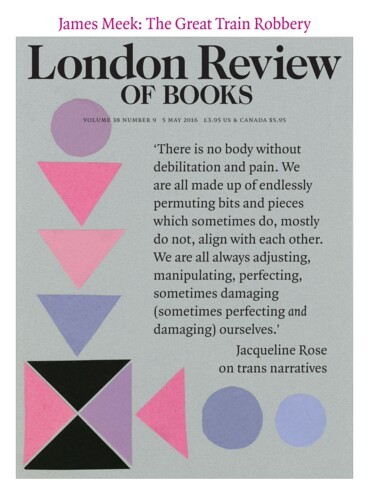
It is unclear who is being addressed in Beatrix Campbell’s second letter on trans. Rachael Padman, Jay Prosser and myself have all stated that we do not condone no-platforming as general policy. Nor is it clear why she sees this as the most important issue to pursue in her engagement with trans. That trans people might feel defensive about what is said about them surely needs to be understood in...

Today, trans people – men, women, neither, both – are taking the public stage more than ever before. In the words of a Time magazine cover story in June last year, trans is ‘America’s next civil rights frontier’. Perhaps, even though it doesn’t always look this way on the ground, trans activists will also – just – be in a position to advance what so often seems impossible: a political movement that tells it how it uniquely is, without separating one struggle for equality and human dignity from all the rest.

Bantu in the Bathroom

Jacqueline Rose, 19 November 2015

On 3 March 2014, the first day in the trial of Oscar Pistorius for the killing of Reeva Steenkamp, Judge Thokozile Matilda Masipa made her way across courtroom GD at North Gauteng High Court in Pretoria slowly and haltingly. She suffers from severe arthritis and for the duration of the trial she sat on an orthopaedic chair, much smaller than the vast leather seats of the two assessors on either side. Judge Masipa’s entry couldn’t have been more different from that of the defendant she was there to judge. According to one observer, Pistorius ‘strode’ up to the dock.

Corkscrew in the Neck: Bad Summer Reading

Jacqueline Rose, 10 September 2015

There seems​ to be something about having the word ‘girl’ in the title of a book that guarantees huge sales. First, Gone Girl, by Gillian Flynn, which I – like many readers, I assume – couldn’t put down, but which on reflection I found deeply repellent (more than one or two critics have concurred). Apparently the film is even worse, as in, even more misogynist,...

Boris Johnson’s japes are comparable in neutralising effect to the softening charm of Tony Blair. How can such a matey, blokey person, ‘someone you could have a pint with’, possess darker, colder...

Read more reviews

‘Profonde Albertine’, the narrator writes close to the end of Proust’s novel. By ‘deep’ – profonde – he means ‘unreachable’. She was mostly...

Read more reviews

Jacqueline Rose has written a timely and courageous book. One immediate sign of this is its dedication to the late Edward Said, and its rewriting of the title of one of his most important books,

Read more reviews

There are good reasons, and a few bad ones, for lifting minor characters out of famous texts and putting them centre-stage. One bad reason might be that refiguring a large reputation quietly...

Read more reviews

Homelessness

Terry Eagleton, 20 June 1996

In the days of F.R. Leavis, English literary criticism was wary of overseas, a place saddled with effete, Latinate languages without pith or vigour. Proust is relegated to a lofty footnote in...

Read more reviews

Slick Chick

Elaine Showalter, 11 July 1991

We all know the story. A brilliant, neurotic young American woman poet, studying on a fellowship at Cambridge, meets and marries the ‘black marauder’ who is the male poet-muse of her...

Read more reviews

Read anywhere with the London Review of Books app, available now from the App Store for Apple devices, Google Play for Android devices and Amazon for your Kindle Fire.

Sign up to our newsletter

For highlights from the latest issue, our archive and the blog, as well as news, events and exclusive promotions.

Newsletter Preferences