Frank Kermode

Frank Kermode, whose books include Romantic Image (1957), The Sense of an Ending (1967) and Shakespeare’s Language (2000), was the Lord Northcliffe Professor of Modern English Literature at University College London and the King Edward VII Professor of English Literature at Cambridge. He inspired the founding of the LRB in 1979 and wrote more than two hundred pieces for it.

His first, in the first issue of the paper, was on millenarianism, ‘the myth concerning the End’, and his last on Philip Pullman and the parable of the prodigal son. In between he wrote on poets (‘T.S. Eliot and the Shudder’), novelists (Zadie Smith), critics (Paul de Man), Shakespeare, music, psychoanalysis and his wartime experience in the navy (‘My Mad Captains’). A selection of his pieces for the paper is available from the LRB store. He died in 2010 at the age of ninety and a collection of short memoirs by LRB contributors can be found here. ‘Papers speak through their writers,’ Mary-Kay Wilmers wrote after his death. ‘And of all the London Review’s writers Frank Kermode was the one through whom we spoke most often and most eloquently.’

The survival of poetry, especially if written before the invention of print, has often been a matter of luck or accident. Consigned to caves in the deserts of the Middle East, it might be preserved by the hot, dry climate for a couple of thousand years before somebody stumbled on it. And we are told that some hot, dry Alexandrian bureaucrat, no poetry lover, decided that seven plays by Sophocles, enough for one codex, would serve for the teaching of grammar and rhetoric. The surplus hundred-odd went for scrap.
Was it a supernova? the Nativity

Frank Kermode, 4 January 2007

Very few schoolboys know that of the four Gospels only two offer any account of the conception and birth of Jesus, and even those schoolboys probably care little that Matthew and Luke, the two which do provide Nativity narratives, fail to agree about many important details. Moreover, there are received ideas about the Nativity narrative that have no warrant in either version. So, it may be asked, who cares? Yet to look into these matters is to come on problems both interesting and intractable and, to some people, important.

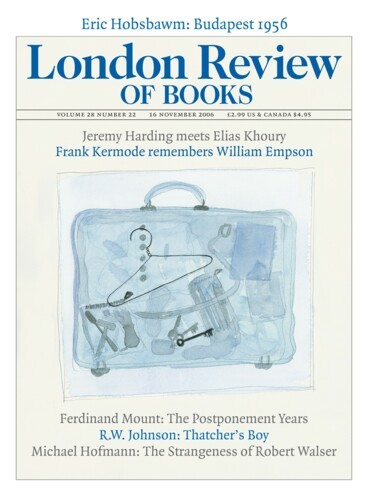
‘Disgusting’: remembering William Empson

Frank Kermode, 16 November 2006

In 1940 Empson was back in England, having spent much of the previous decade in Japan and China. His arrival in China had coincided with the Japanese invasion and the resulting southward migration of the National Peking University. He went along, rather enjoyed the hardships of the trek, relying on his excellent memory to teach English with little aid from books. In the autumn of 1939 he made his way homeward via the United States. Arriving the following January he settled in his flat in Marchmont Street and considered his future, at least as uncertain at this date as anybody else’s.

Going Against: Is There a Late Style?

Frank Kermode, 5 October 2006

The odd thing is that most of the contributors to these books doubt whether it is possible to offer a clear and distinct idea of the subject under discussion. Indeed, Karen Painter, one of the editors of the Getty volume, says right out that ‘late style does not exist in any real sense.’ But she and her colleagues continue to search for distinguishing marks of lateness in the work of major artists in their last years, to ask whether they give evidence of failing powers, such as might in the ordinary course of things be expected: senescence; illness; the decay of the senses; the certainty that death, always feared at a distance but now in the room, is taking a hand. Will these afflictions be reflected in a style markedly different from those they used in the periods of early promise and full maturity?

This memoir takes its title and its epigraph from Wordsworth:

I have owed to them In hours of weariness, sensations sweet, Felt in the blood, and felt along the heart.

The poet laureate thus salutes a distinguished predecessor. Yet there is nothing particularly Wordsworthian about Andrew Motion’s book. The only character who uses the expression ‘in the blood’ is the poet’s father, and what he means is that when the time comes Andrew is bound to enjoy hunting. There is little evidence here of childish wildness or wickedness, no hint of Wordsworth’s animating discipline of fear – ‘more like a man/Flying from something that he dreads, than one/Who sought the thing he loved’ – and even less in the way of ‘aching joys’ and ‘dizzy raptures’.

The Oxford English Dictionary cites more than 33,000 passages from Shakespeare to illustrate the sense of English words. About 1900 of its main entries have first citations from Shakespeare....

Read more reviews

Out of the Lock-Up: Wallace Stevens

Michael Wood, 2 April 1998

Asked in 1933 what his favourite among his own poems was, Wallace Stevens said he liked best ‘The Emperor of Ice-Cream’, from Harmonium (1923). The work ‘wears a deliberately...

Read more reviews

A Sort of Nobody

Michael Wood, 9 May 1996

Criticism for Frank Kermode is the articulation of assumptions, a sort of phenomenology of interpretative need. Its job, as he says in The Sense of an Ending (1967), is ‘making sense of the...

Read more reviews

Real Absences

Barbara Johnson, 19 October 1995

‘Reading others people’s letters, like reading private diaries, offers thrilling and unexpected glimpses into the lives of others,’ claims the dustjacket of The Oxford Book of...

Read more reviews

Kermode’s Changing Times

P.N. Furbank, 7 March 1991

Frank Kermode having now become ‘Sir Frank’, it seems a good moment to take a look back over his remarkable career: though by no means because that career is at an end, for he is...

Read more reviews

Kermode and Theory

Hayden White, 11 October 1990

Frank Kermode belongs to no sect of literary criticism, and he has founded no school. Like William Empson, whom he praises as a ‘genius’ of criticism, Kermode has always been more...

Read more reviews

Loose Canons

Edward Mendelson, 23 June 1988

Frank Kermode’s History and Value reads the literature of the Thirties as ‘a love story, almost a story of forbidden love’. The story is usually told in political terms, but the...

Read more reviews

Reading the Bible

John Barton, 5 May 1988

‘Everyone communes with the Bible,’ wrote Marilyn Butler recently in her Cambridge inaugural lecture, commenting on the recent re-inclusion of the Biblical canon in the canon of...

Read more reviews

Mulberrying

Andrew Gurr, 6 February 1986

Like relics of the True Cross, there are said to be enough splinters to make an orchard from the mulberry tree planted by Shakespeare in his garden at New Place. The Shakespeare canon has excited...

Read more reviews

From Plato to Nato

Christopher Norris, 7 July 1983

Eagleton’s book is both a primer and a postmortem. It surveys the varieties of recent and present-day literary theory, only to suggest – in its closing chapter – that they had...

Read more reviews

Advanced Thought

William Empson, 24 January 1980

Frank Kermode’s new book contains a great deal of graceful and dignified prose, especially in the last chapter, and many of the examples are of great interest. It seems to argue that no...

Read more reviews

Read anywhere with the London Review of Books app, available now from the App Store for Apple devices, Google Play for Android devices and Amazon for your Kindle Fire.

Sign up to our newsletter

For highlights from the latest issue, our archive and the blog, as well as news, events and exclusive promotions.

Newsletter Preferences