Frank Kermode

Frank Kermode, whose books include Romantic Image (1957), The Sense of an Ending (1967) and Shakespeare’s Language (2000), was the Lord Northcliffe Professor of Modern English Literature at University College London and the King Edward VII Professor of English Literature at Cambridge. He inspired the founding of the LRB in 1979 and wrote more than two hundred pieces for it.

His first, in the first issue of the paper, was on millenarianism, ‘the myth concerning the End’, and his last on Philip Pullman and the parable of the prodigal son. In between he wrote on poets (‘T.S. Eliot and the Shudder’), novelists (Zadie Smith), critics (Paul de Man), Shakespeare, music, psychoanalysis and his wartime experience in the navy (‘My Mad Captains’). A selection of his pieces for the paper is available from the LRB store. He died in 2010 at the age of ninety and a collection of short memoirs by LRB contributors can be found here. ‘Papers speak through their writers,’ Mary-Kay Wilmers wrote after his death. ‘And of all the London Review’s writers Frank Kermode was the one through whom we spoke most often and most eloquently.’

Out of the jiffybag

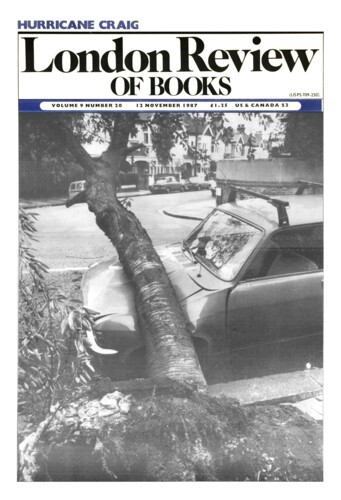
Frank Kermode, 12 November 1987

Here begins a review of two books which are largely collections of reviews, and some readers, reviewing it, are sure to ask whether this flea-on-flea process is desirable or even tolerable. My feeling is that such criticism is prejudiced. That which appears in the ephemerae isn’t necessarily ephemeral. Not all reviews are written lefthandedly by authors who save their best efforts for quite different sorts of writing. They may, as Jonathan Raban’s title suggests, be working for love as well as money, and it is easy to understand their wish to give their best work in this kind a more permanent form.

A Little of this Honey

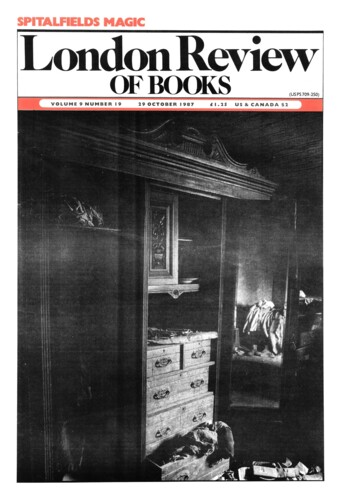
Frank Kermode, 29 October 1987

Richard Ellmann’s Life of Joyce, generally regarded as the best literary biography of our time, was the work of his middle years. The last third of his own life was largely given to this biography of Wilde, which was in some ways a very different sort of undertaking. There were surviving acquaintances of Joyce, but nobody who knew Wilde is available for questioning; the material, though copious, must be sought in libraries. But Ellmann was an exceptionally gifted researcher, never bragging about his finds, just folding them quietly into his narrative, as he does in this book.

Taken aback

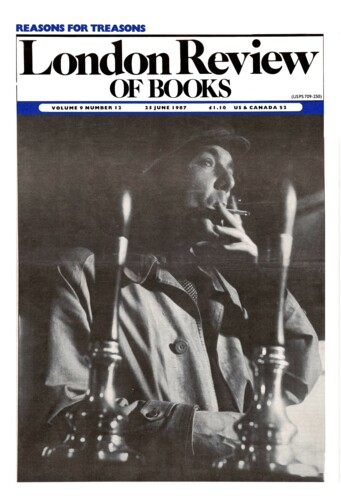
Frank Kermode, 25 June 1987

William Golding’s Rites of Passage, which appeared seven years ago, purported to be an account, by a young toff, good-natured but still wet behind the ears, of a voyage to Australia, around 1814, in a clapped-out English warship reduced to carrying emigrants. Keeping a journal for the amusement of his noble patron, he tells of a comical amorous adventure with an emigrant female, a patronising friendship with an ex-lower-deck first lieutenant (‘allow me to congratulate you on imitating to perfection the manners and speech of a somewhat higher station in life than you were born to’), and various puppyish acts of indiscipline and breaches of Naval etiquette which set him at odds with the captain. The ship is rotten and stinking, and it rolls and pitches abominably, but although they are all in the same boat the voyagers continue to observe the customs of their classes, the seamen forward, the middle-class emigrants amidships, the petty officers in their messes, the officers in their wardroom, and the captain on his quarterdeck. The professionals are desperate for action, partly as the quickest way to preferment; the bourgeoisie is not. The young gentleman is confusedly betwixt and between.

How do you spell Shakespeare?

Frank Kermode, 21 May 1987

When Oxford decided to do Shakespeare they clearly made up their minds that the scale of the operation must be very grand, and a team of scholars has been working hard for eight years to get it done quickly, done right, and done with the greatest possible display and novelty. One has to admire not only the industry of Professor Wells and his associates, but their flair for publicity, as evidenced by the enormous solemn fuss about the poem ‘Shall I die?’, now accorded an honoured place in their canon, and also by the proclaimed scope and originality of their enterprise, which, though not essentially different from other such enterprises, is different in many eye-catching ways, and must have set the Press some unique problems.

Big John

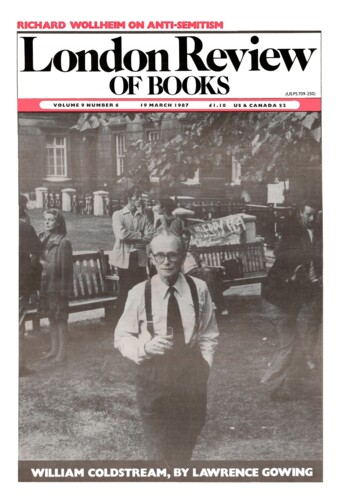
Frank Kermode, 19 March 1987

The subtitle claims that this is ‘the First Part of the Confessions of Anthony Burgess’, who is officially known as John Burgess Wilson; and the book appears on the author’s 70th birthday, as part of his preparation for the coming encounter with Big God. There is, however, to be a Second Part, provisionally entitled You’ve had your time; we are told it will probably be even longer than this one, which takes the younger Wilson from birth to a midlife illness, falsely diagnosed as fatal. This gave considerable impetus to Burgess’s subsequent career, as no doubt the sequel will demonstrate.

The Oxford English Dictionary cites more than 33,000 passages from Shakespeare to illustrate the sense of English words. About 1900 of its main entries have first citations from Shakespeare....

Read more reviews

Out of the Lock-Up: Wallace Stevens

Michael Wood, 2 April 1998

Asked in 1933 what his favourite among his own poems was, Wallace Stevens said he liked best ‘The Emperor of Ice-Cream’, from Harmonium (1923). The work ‘wears a deliberately...

Read more reviews

A Sort of Nobody

Michael Wood, 9 May 1996

Criticism for Frank Kermode is the articulation of assumptions, a sort of phenomenology of interpretative need. Its job, as he says in The Sense of an Ending (1967), is ‘making sense of the...

Read more reviews

Real Absences

Barbara Johnson, 19 October 1995

‘Reading others people’s letters, like reading private diaries, offers thrilling and unexpected glimpses into the lives of others,’ claims the dustjacket of The Oxford Book of...

Read more reviews

Kermode’s Changing Times

P.N. Furbank, 7 March 1991

Frank Kermode having now become ‘Sir Frank’, it seems a good moment to take a look back over his remarkable career: though by no means because that career is at an end, for he is...

Read more reviews

Kermode and Theory

Hayden White, 11 October 1990

Frank Kermode belongs to no sect of literary criticism, and he has founded no school. Like William Empson, whom he praises as a ‘genius’ of criticism, Kermode has always been more...

Read more reviews

Loose Canons

Edward Mendelson, 23 June 1988

Frank Kermode’s History and Value reads the literature of the Thirties as ‘a love story, almost a story of forbidden love’. The story is usually told in political terms, but the...

Read more reviews

Reading the Bible

John Barton, 5 May 1988

‘Everyone communes with the Bible,’ wrote Marilyn Butler recently in her Cambridge inaugural lecture, commenting on the recent re-inclusion of the Biblical canon in the canon of...

Read more reviews

Mulberrying

Andrew Gurr, 6 February 1986

Like relics of the True Cross, there are said to be enough splinters to make an orchard from the mulberry tree planted by Shakespeare in his garden at New Place. The Shakespeare canon has excited...

Read more reviews

From Plato to Nato

Christopher Norris, 7 July 1983

Eagleton’s book is both a primer and a postmortem. It surveys the varieties of recent and present-day literary theory, only to suggest – in its closing chapter – that they had...

Read more reviews

Advanced Thought

William Empson, 24 January 1980

Frank Kermode’s new book contains a great deal of graceful and dignified prose, especially in the last chapter, and many of the examples are of great interest. It seems to argue that no...

Read more reviews

Read anywhere with the London Review of Books app, available now from the App Store for Apple devices, Google Play for Android devices and Amazon for your Kindle Fire.

Sign up to our newsletters

For highlights from the latest issue, our archive and the blog, as well as news, events and exclusive promotions.

Newsletter Preferences