Frank Kermode

Frank Kermode, whose books include Romantic Image (1957), The Sense of an Ending (1967) and Shakespeare’s Language (2000), was the Lord Northcliffe Professor of Modern English Literature at University College London and the King Edward VII Professor of English Literature at Cambridge. He inspired the founding of the LRB in 1979 and wrote more than two hundred pieces for it.

His first, in the first issue of the paper, was on millenarianism, ‘the myth concerning the End’, and his last on Philip Pullman and the parable of the prodigal son. In between he wrote on poets (‘T.S. Eliot and the Shudder’), novelists (Zadie Smith), critics (Paul de Man), Shakespeare, music, psychoanalysis and his wartime experience in the navy (‘My Mad Captains’). A selection of his pieces for the paper is available from the LRB store. He died in 2010 at the age of ninety and a collection of short memoirs by LRB contributors can be found here. ‘Papers speak through their writers,’ Mary-Kay Wilmers wrote after his death. ‘And of all the London Review’s writers Frank Kermode was the one through whom we spoke most often and most eloquently.’

A.J. Ayer, says Ben Rogers, had a ‘pampered upbringing, even by Edwardian standards’. He suffered much at prep school, then went to Eton, where he suffered less and got over it. The next move, to Christ Church, was painless. Oxford gave him Gilbert Ryle as his tutor and appointed him to a lectureship before he graduated.‘
Diary: being a critic

Frank Kermode, 27 May 1999

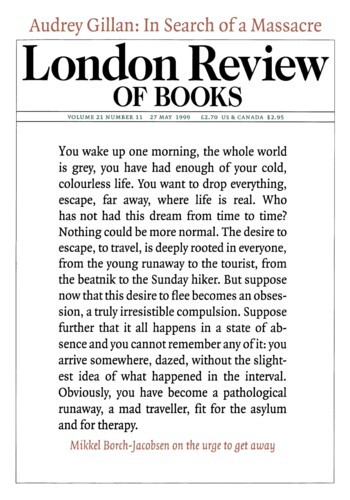
If you wanted to make your way as a literary journalist in the days of Addison you might have done well to begin by heading for Button’s coffeehouse in Russell Street where the great man held court, and be as submissively impressive as possible. Almost three hundred years later, though sadly not for very long, you could make your way to the Pillars of Hercules in Greek Street, where Ian Hamilton, editor of the New Review, was usually to be found. The suppliants, mostly young men not then long out of the universities, have very properly combined to congratulate the sage or gaffer on his 60th birthday. Some of them got their first chance in that pub. A few of the celebrants are, or have been, English dons – John Fuller, Simon Gray, Dan Jacobson; but even they arrived by what might be called the bohemian route.’

To develop a full-scale portrait of a character from hints, often terse and reticent, in the gospel narratives – using for the purpose your imagination and whatever help you can get elsewhere – is, it seems, an attractive idea. A couple of years ago, reviewing in these pages a book that gave Judas Iscariot the treatment (LRB, 2 January 1997), I tried to explain why I found the result unpersuasive. Now here’s a biography of Pontius Pilate, a long, sometimes lively and sometimes learned piece of work, that is equally unconvincing.

Overflow: John Updike

Frank Kermode, 21 January 1999

That John Updike has a Trollopian fidelity to his characters is evident from the four books of the Rabbit series; this new book is the third of a sequence about the New York Jewish novelist Henry Bech. As it carries him into his seventies it may be that this is the last of Bech, as Rabbit at Rest was presumably the last of Rabbit, but as long as the real author is alive, fertile and motile, one cannot be sure.

Paint Run Amuck: Jack Yeats

Frank Kermode, 12 November 1998

We attach the epithet ‘great’ rather loosely to artists, but there is probably some tacit agreement about which ones deserve it. It doesn’t seem wrong to call W.B. Yeats a great poet, and in certain contexts he may be called a great Irish poet, though most of the time it might seem odd to insist that Dante was a great Italian, or Shakespeare a great English, poet, partly because we vaguely think of them as transcending nationality. But Yeats was the necessary great poet of the national cultural renaissance that accompanied a struggle for political independence with which he was inevitably and willingly associated: he would have been a great Irish poet even if he had not become supra-national, more universal than that description suggests.‘

The Oxford English Dictionary cites more than 33,000 passages from Shakespeare to illustrate the sense of English words. About 1900 of its main entries have first citations from Shakespeare....

Read more reviews

Out of the Lock-Up: Wallace Stevens

Michael Wood, 2 April 1998

Asked in 1933 what his favourite among his own poems was, Wallace Stevens said he liked best ‘The Emperor of Ice-Cream’, from Harmonium (1923). The work ‘wears a deliberately...

Read more reviews

A Sort of Nobody

Michael Wood, 9 May 1996

Criticism for Frank Kermode is the articulation of assumptions, a sort of phenomenology of interpretative need. Its job, as he says in The Sense of an Ending (1967), is ‘making sense of the...

Read more reviews

Real Absences

Barbara Johnson, 19 October 1995

‘Reading others people’s letters, like reading private diaries, offers thrilling and unexpected glimpses into the lives of others,’ claims the dustjacket of The Oxford Book of...

Read more reviews

Kermode’s Changing Times

P.N. Furbank, 7 March 1991

Frank Kermode having now become ‘Sir Frank’, it seems a good moment to take a look back over his remarkable career: though by no means because that career is at an end, for he is...

Read more reviews

Kermode and Theory

Hayden White, 11 October 1990

Frank Kermode belongs to no sect of literary criticism, and he has founded no school. Like William Empson, whom he praises as a ‘genius’ of criticism, Kermode has always been more...

Read more reviews

Loose Canons

Edward Mendelson, 23 June 1988

Frank Kermode’s History and Value reads the literature of the Thirties as ‘a love story, almost a story of forbidden love’. The story is usually told in political terms, but the...

Read more reviews

Reading the Bible

John Barton, 5 May 1988

‘Everyone communes with the Bible,’ wrote Marilyn Butler recently in her Cambridge inaugural lecture, commenting on the recent re-inclusion of the Biblical canon in the canon of...

Read more reviews

Mulberrying

Andrew Gurr, 6 February 1986

Like relics of the True Cross, there are said to be enough splinters to make an orchard from the mulberry tree planted by Shakespeare in his garden at New Place. The Shakespeare canon has excited...

Read more reviews

From Plato to Nato

Christopher Norris, 7 July 1983

Eagleton’s book is both a primer and a postmortem. It surveys the varieties of recent and present-day literary theory, only to suggest – in its closing chapter – that they had...

Read more reviews

Advanced Thought

William Empson, 24 January 1980

Frank Kermode’s new book contains a great deal of graceful and dignified prose, especially in the last chapter, and many of the examples are of great interest. It seems to argue that no...

Read more reviews

Read anywhere with the London Review of Books app, available now from the App Store for Apple devices, Google Play for Android devices and Amazon for your Kindle Fire.

Sign up to our newsletters

For highlights from the latest issue, our archive and the blog, as well as news, events and exclusive promotions.

Newsletter Preferences