Donald MacKenzie

Donald MacKenzie, a sociologist of science and technology, is a professor at the University of Edinburgh. His book with Koray Caliskan, Inside Digital Advertising, was published by Polity in November 2025.

What’s in a Number? The $300 Trillion Question

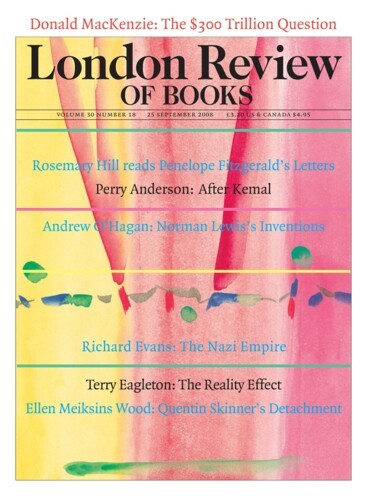
Donald MacKenzie, 25 September 2008

Judged by the amount of money directly dependent on it, the British Bankers’ Association’s London Interbank Offered Rate matters more than any other set of numbers in the world. Libor anchors contracts amounting to some $300 trillion, the equivalent of $45,000 for every human being on the planet. It’s a critical part of the infrastructure of financial markets but, like plumbing, doesn’t usually get noticed. Only a handful of economists, and no other academics, have ever looked in any detail at Libor, and even the financial press didn’t show much interest in how Libor is calculated until this spring, when there was sharp controversy over whether these crucial numbers could be trusted.

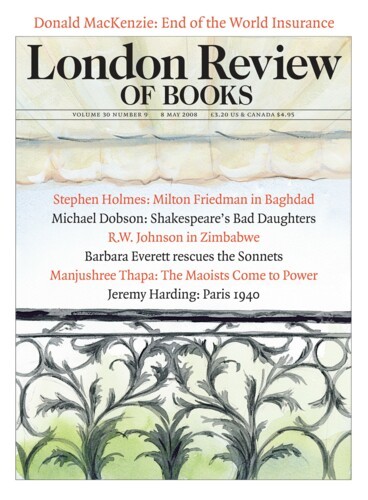
Last November, I spent several days in the skyscrapers of Canary Wharf, in banks’ headquarters in the City and in the pale wood and glass of a hedge fund’s St James’s office trying to understand the credit crisis that had erupted over the previous four months. I became intrigued by an oddity that I came to think of as the end-of-the-world trade. The trade is the purchase of insurance against what would in effect be the failure of the modern capitalist system.

Zero Is a Clenched Fist: Trading from the Pit

Donald MacKenzie, 1 November 2007

The new financial trading floor of the Chicago Board of Trade is a striking sight, and Caitlin Zaloom describes it well. Opened in 1997, it occupies a ‘huge stone block’; the trading floor itself is ‘the size of Grand Central Station’, and has no windows or even a public entrance. The walls are ‘unadorned granite, shiny, cold and imposing’, with huge...

Many people, especially on the political left, instinctively dislike the idea of emissions trading. Among the roots of this dislike is a variant of what the economic sociologist Viviana Zelizer calls the ‘hostile worlds’ doctrine. Her particular concern is with the worlds of economic relations and personal intimacy. In that context, the ‘hostile worlds’ doctrine is that the intrusion of economic considerations corrupts intimacy, and conversely that kinship and other intimate relations need to be stopped from corrupting what should be impersonal economic transactions. Zelizer questions whether the hostile worlds doctrine is right: for example, is paid care of children or of the elderly necessarily inferior to that provided by kin? Is your relationship to your children really damaged by paying them to hoover the house or clean the windows?

A lycée in Lyon, 1944. A young Polish refugee is hiding in the school. His identity papers are forged, and deportation to the death camps may await him if he is caught. His attention, however, is not on the dangers outside but on a mathematics lesson. When he first started taking the classes, ‘he sat uncomprehending before the meaningless words and numbers on the...

Hereditary Genius

A.W.F. Edwards, 6 August 1981

We are all prisoners of our backgrounds as well as slaves to our genes, and no field of science is riper for sociological investigation based on this premise than the development of biometry, and...

Read more reviews

Read anywhere with the London Review of Books app, available now from the App Store for Apple devices, Google Play for Android devices and Amazon for your Kindle Fire.

Sign up to our newsletter

For highlights from the latest issue, our archive and the blog, as well as news, events and exclusive promotions.

Newsletter Preferences