Christopher Hitchens

Christopher Hitchens, who died in 2011 at the age of 62, wrote several dozen pieces for the LRB between 1983 and 2002. A Hitch in Time, a collection of some of them, is published by Atlantic.

Diary: The Salman Rushdie Acid Test

Christopher Hitchens, 24 February 1994

In all the stultifying discussion of Prince Charles’s fitness to grasp the orb and sceptre of kingship, there is one qualification that is almost never canvassed. I refer to his ability to give the annual Christmas broadcast to the Commonwealth. No light matter this – it was a dreaded annual penance for his grandfather – and made no lighter by his presumptive inability to end the chat by saying: ‘My wife and I … ’ But never mind. He is in every other respect ideally suited to the task; even better at discharging blank or ‘false-alarm’ fusillades than he is at receiving them.’…
In the bright autumn of my senescence

Christopher Hitchens, 6 January 1994

If there is one term that illustrates the rapidity with which historical truth can degenerate before one’s very eyes, that term is ‘Vietnam Syndrome’. According to those who employ this smooth and evasive construction, the lesson of the Vietnam War is that the United States suffered greatly from being ‘entangled’ in a ‘quagmire’ in Indochina, and should henceforth be extremely prudent about overseas military commitments. Jimmy Carter put it very gruffly, when he said that both America and Vietnam had suffered equally. Henry Kissinger, in his memoir Years of Upheaval, phrased it even more prettily: ‘Hanoi and Washington had inflicted grievous wounds on each other; theirs were physical, ours psychological and thus perhaps harder to heal.’

Say what you will about Harold

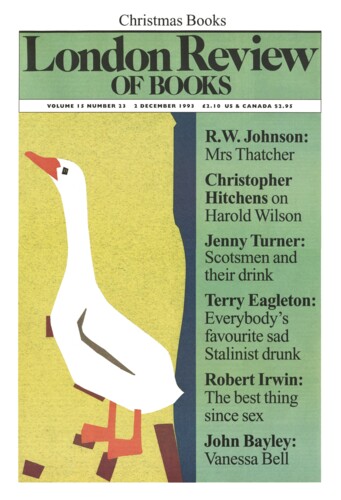
Christopher Hitchens, 2 December 1993

Since it can be properly said that nothing in Harold Wilson’s political career became him like the leaving of it, there is some justice in the fact that he is now best-remembered for one photograph and for one action. The photograph shows him next to the Duke of Grafton while assuming his stall at Windsor as a Knight of the Garter, and the action was the compiling (would that be the word?) of a resignation honours list that rewarded those who – oh, dash it, I don’t know – shall we say made money rather than earned it? Anyway, in the photograph Wilson looks like nothing so much as a grinning monkey on a stick, and in the matter of the honours list he achieved the near-impossible feat of discrediting the discredited and making a laughing-stock out of something already rather disagreeably risible. So I suppose that one can spare about ten milliseconds of sympathy for those, suggestively calling themselves ‘revisionist’, who have attempted to sweeten Harold Wilson’s memory. (I mean our memory of him; not his memory of us, which has notoriously faded.)’

Letter

Walk on by

18 November 1993

Andrew O’Hagan’s essay on the beggar’s art (LRB, 18 November 1993) is also a wonderful treatise on the ways in which we must all learn to bear the sufferings of others. Recently I heard a pointful story from the great Herb Caen, columnist for the San Francisco Chronicle. A lady vegetarian councillor in that most compassionate of cities was walking between lunch and work, and passed a derelict...

Diary: On Peregrine Worsthorne

Christopher Hitchens, 4 November 1993

In Simon Raven’s Alms for Oblivion novel sequence, we are introduced to the hopeless young charmer Fielding Gray. His father is remote and sourly reactionary; his mother develops ominous signs of chippiness and puritanism. Young Fielding gets through most of the right hoops but usually in the wrong way. His public school, in other words, is slightly too minor. He is cheated of the joys of Cambridge only to taste them later on. His regiment is raffish rather than distinguished. His career as a gentleman-scribbler is a ropey one, very much circumscribed by the simultaneous eclipse of the British Empire and of the idea of the leisured man of letters. Nor are matters helped by such vulgar difficulties as the need to pay tradesmen, the need to keep up an appearance of sexual continence and the need to maintain a steady flow of copy.

In his book about religion, Peter Hitchens has a lot more to say about his brother Christopher than Christopher has to say about Peter in his book about himself.* ‘Some brothers get...

Read more reviews

The Positions He Takes: Hitchens on Paine

John Barrell, 30 November 2006

‘If the rights of man are to be upheld in a dark time, we shall require an age of reason,’ wrote Christopher Hitchens last year on the dust jacket of Harvey Kaye’s recent book...

Read more reviews

Winning is very important to Christopher Hitchens. Dr Johnson was said to ‘talk for victory’, and by all accounts it seems the same might be said of Hitchens. He certainly writes for...

Read more reviews

In this short book, Christopher Hitchens sets down the main charges against Kissinger: murder, violation of human rights and complicity in mass atrocities on a scale equalled only by Eichmann,...

Read more reviews

‘The crude commercialism of America, its materialising spirit, its indifference to the poetical side of things, and its lack of imagination and of high unattainable ideals are entirely due...

Read more reviews

Why Calcutta?

Amit Chaudhuri, 4 January 1996

Among the welter of images and mythologies that constitute the middle-class Bengali’s consciousness – P3 and Ganesh underwear, the Communist hammer and sickle, Lenin’s face,...

Read more reviews

Against it

Ross McKibbin, 24 February 1994

Christopher Hitchens may not be ‘the nearest thing to a one-man band since I.F. Stone laid down his pen’, but he comes close. For the Sake of Argument records a life of action, of...

Read more reviews

Further Left

R.W. Johnson, 16 August 1990

Many years ago it was the habit of the PPE tutors in Magdalen College, Oxford to hold a discussion group for their undergraduates. At one such meeting we were somewhat disconcerted to find we had...

Read more reviews

Royalties

John Sutherland, 14 June 1990

Deference to royalty in this country is enforced by a judicial and popular savagery which is always there but only occasionally glimpsed. The glimpses are instructive. In 1937 the diplomat...

Read more reviews

Opportunities

David Gilmour, 1 June 1989

Hitchens was right to go West. He needed lusher plains of political corruption across which to spread himself. He needed a country of wide horizons and myopic international vision. And he needed...

Read more reviews

Passionate Purposes

Keith Kyle, 6 September 1984

There used to be a type of book known as the ‘Secret History’ of some international problem. With some passion, extensive citation of material, and a somewhat self-regarding manner,...

Read more reviews

Read anywhere with the London Review of Books app, available now from the App Store for Apple devices, Google Play for Android devices and Amazon for your Kindle Fire.

Sign up to our newsletter

For highlights from the latest issue, our archive and the blog, as well as news, events and exclusive promotions.

Newsletter Preferences