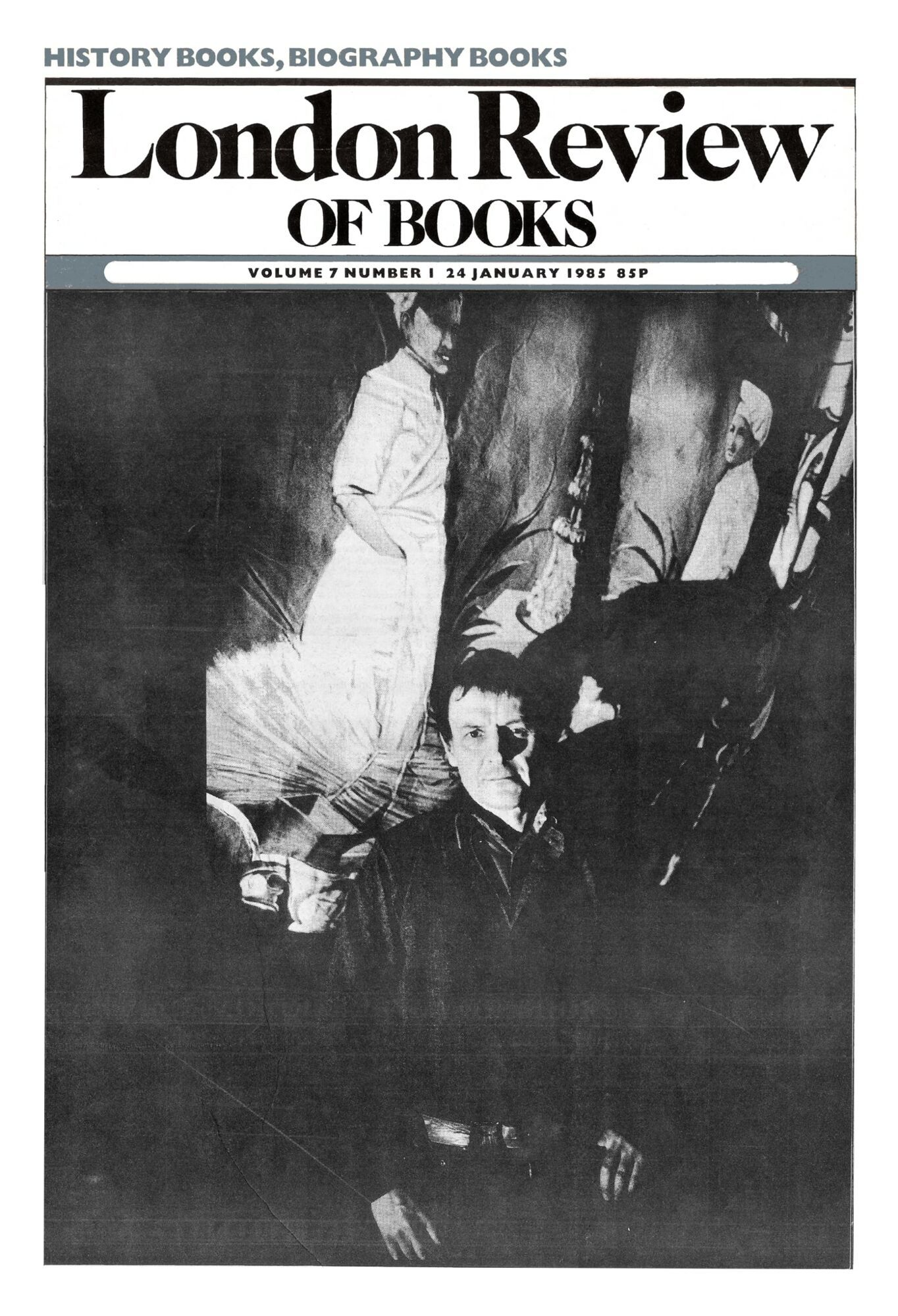
Two events of the last year have attracted a lot of notice. One is the production of Michael Hastings’s play, Tom and Viv, and the other the publication of Peter Ackroyd’s biography, T.S. Eliot. They of course share a subject, the poet himself. But this choice of subject, the life of the writer with perhaps the biggest public image of any in our time, suggests something else they have in common. These two works are in one way more alike than might be expected from the ‘creative’ or ‘fictional’ mode of the one, and the ‘critical’ or ‘factual’ mode of the other; and what brings them together, apart from some confusion of these categories, is their similar capacity to throw light on what is wrong with the present public image of the literary.
The problems of Tom and Viv are more obvious, and may be dealt with more rapidly. They start from the fact that drama is an art of embodiment, and always highlights any errors of thinking by objectifying them. One such was revealed the moment Hastings’s curtain went up on a tea-party in the garden of Viv’s middle-class family, with the backcloth portraying a mansion considerably larger than Blenheim Palace. This social slip, entailed by Hastings’s theory that Tom married Viv as a step in his social climbing, only epitomised all the more serious things that went wrong with the play. A strength of Hastings’s other work is its social compassion, its commitment to those seen as deprived. Since his theme here is a writer’s destruction of his private self by the hunt for status, the dramatist has to take the self-evidently less successful partner, the poet’s wife, as the feeling centre of the play (the result reverses, that is, such images as we meet in Henry James’s stories of artists with ruthless and worldly wives). And to act out his theme Hastings has chosen a figure of public note in a curiously simple and literal sense, an actual near-contemporary of his own. This actuality is important. Tom and Viv were played with a vraisemblance at moments startling, and the production was widely advertised by a poster blown-up from a striking snapshot of the Twenties or Thirties, showing Eliot blocked off by a towering Virginia Woolf from a cowering Vivien. The trouble with this insistence on actuality is that in practice the source-materials continually resisted the interpretation imposed on them. The play’s numb hero could never have written a line, and the action finds nothing to do with his blankness that even approaches the interest of Eliot’s real creative life. The pervasive contradiction of the play by matters of fact works in small details like the following. Hastings makes his warm-hearted heroine guiltless of her husband’s involvement in fascistic politics as well as free of his social snobbery (she forms a tender relationship with a working-class woman): Vivien Eliot’s journals reveal little feeling beyond her possessive attachment to her husband, and an at least formal membership of the Fascist Party, which Eliot himself never joined. These facts, which may suggest some connection with the portrayal of women in The Waste Land, written little more than a decade earlier, also point to the discrepancy of Hastings’s virtuous Viv. In general, the trouble with Tom and Viv was not the question of its being ‘mean to Eliot’ (discussion of the play in correspondence columns strikingly lacked the assumption that literature might have to do with truth, rather than merely the socially agreeable). The real problem was its failure in that dramatic function of truth, credibility. Depending for most of its interest on the public and historic actuality of its persons, the play found it hard to handle this interest or to contribute to it.
Difficulties confront any dramatist who chooses a poet as a central character: the creative life of an artist isn’t something that can be convincingly translated into dramatic action, with its crises and climaxes. This problem was intensified by the public and external mode of Tom and Viv, which worked – where it did work – with the vigour of a political cartoon or caricature. As a result, Tom lacked all three of the leading characteristics that made Eliot a writer, intelligence, irony and imagination: all of them essentially ‘contained’ or inward powers. What is thought-provoking is that Ackroyd’s entirely non-dramatic study should elicit some of the same objections. His T.S. Eliot is of course not, like Hastings’s play, a work of ‘faction’, that new art in which fiction gets its appeal from its appearance of factuality. Yet in terms of information, this Life hasn’t much that is new to any reader familiar both with Eliot’s immediate milieu and with some of the literary journals and letters of the last seventy or eighty years: the biography’s quality is a matter of what might be called aesthetic charm and efficiency, not of scholarly discovery. If, however, Ackroyd’s book groups itself with Hastings’s play, the main reason is not this literary character that makes it coherent and persuasive, but rather the nature of what appears to be his interest in Eliot: a focus, as marked as the dramatist’s, on the public or external existence of the man – indeed, Ackroyd’s identification of the poet with that public or external existence. It is a curious fact that he actually uses the word ‘fiction’ while defining his craft in peculiarly public terms: ‘Biography is ... a convenient fiction, since no one can probe, without the risk of farcical failure, those hidden perceptions or experiences which run alongside the observable life but may not necessarily touch it ... Just as the events themselves can be known but not the experiences which they provoked, so we cannot hope to understand Eliot as he knelt in that chapel or in the presence of his God ... We cannot reach into the mystery of his solitude.’
The closing sentence has to be one of two things. It may be merely exalted cliché: it may mean something so true of everyone as to be scarcely worth saying. If it isn’t mere cliché, but is trying to make a real point about the poet, then it is decidedly odd: for its pronouncement is evidently less true of poets than of most other people, since poets almost by definition have the unusual gift of being able through language to communicate their inward experience to other human beings. This simple fact is proved by the rest of Ackroyd’s paragraph. The phrase ‘that chapel’ alludes to the church at Little Gidding: the subject is Eliot’s visit there in 1936, and to East Coker in 1937. Although Little Gidding has some historical interest in its own right, that is not in general why we are reading about it here; and the places interest us now because Eliot wrote poems, and somewhat difficult inward poems, that happen to bear the names of these places. That the biographer should argue that ‘we cannot hope to understand Eliot as he knelt in that chapel’ must bring some surprise not merely to the poet’s co-religionists but to any ordinary reader of his verse. And, in fact, to any human being who lives in the belief that sympathy and imagination may open people to each other. All in all, Ackroyd’s concept of biography can only be true insofar as it is false, a kind of fiction (as he says himself) based on fact – a ‘faction’: one acceptable only as a very personal art, its premises (as peculiar as those of the ‘factional’ dramatist) requiring a disbelief in the possibility of understanding one’s more communicative fellow human beings.
As such, Ackroyd’s thesis has its own attractiveness, its own elegant extremity. But its limitations will be obvious in dealing with a poet most of whose work is at least as much involved with ‘hidden perceptions and experiences’ as it is with the ‘observable life’ (it is Ackroyd himself, as we shall see, who speaks of ‘Burnt Norton’ as containing something ‘concealed’). The crux of the matter is that Eliot becomes eligible for biographical treatment by virtue of poems which are themselves a form of ‘event’, a form of life requiring to be properly ‘observed’: which is to say read. The primary requirement for any biographer of a poet is the capacity to read the work that distinguishes him. Nor is this an ‘academic’ contention in the narrow sense. The idea that we have no means of understanding the inward life of a writer would strike strangely all good writers who have assumed and stated the opposite. Borges, for instance, the poet and fabulist: ‘A book is not an isolated being: it is a relationship, an axis of innumerable relationships.’ When, in a well-known essay, ‘Borges and I’, the writer starts to attempt the distinction between ‘the man’ and ‘his work’, he finds them so fused, and that fusion so evidently accessible to his readers, as to make him end with the simple sentence: ‘I do not know which of us has written this page.’ Eliot is better-known for his insistence on the need to separate, as Borges at first tries to do, the self that lives and the self that writes, but Eliot also made his own later fusion of the two: ‘The experience of a poem is the experience both of a moment and of a lifetime. It is very much like our intenser experiences of other human beings.’
Ackroyd seems to come closer to this position in quoting as his biography’s closing sentence Eliot’s own ‘We also understand the poetry better when we know more about the man.’ The trouble is that there is room for some difference of opinion as to what ‘understanding the poetry’ amounts to, or ‘knowing more about the man’; and it is not always clear in the course of this Life (and the same is true of many other good modern literary biographies) that the biographer means the same by them as does Eliot and at least some of the poet’s readers. It seems as true of Ackroyd’s Life as of Hastings’s play that their image of Eliot’s poetry depends on their image of the poet, and that their image of the poet is of the public and social man; and it is unlikely that Eliot meant quite that. Ackroyd’s portrait of Eliot is of a man we can’t understand – it is the image of a person taken essentially from the outside. That at the same time he deals almost too fully with the troubles of Eliot’s first marriage (compared, say, with William Empson’s very different, idiosyncratic but suggestive analysis of the filial Eliot at the period of The Waste Land) in no way affects this position. Hastings, too, takes as his subject the private life and yet gives us, as both condition and diagnosis, a man without ‘inside’, and hence a man who could never have written poetry. The tone and stance of Ackroyd’s book is more genial and sympathetic to Eliot. Yet he, too, makes of the poet what the title of one of his book’s most appreciative reviews, John Carey’s, called ‘The Hollow Man’. Moreover this is not, in Ackroyd’s case, a mere technicality, an unfortunate function of the concept of biography as necessarily external. His Life firmly presents Eliot as characterised by an essential emptiness at the centre. It portrays a habit of life abnormally withdrawn from other people, and governed by what Ackroyd describes as ‘this lack of connection, or of what is called “empathy” ... a detachment which indeed suggested something “missing” ’.
Specific discussion of Eliot’s personal character seems neither appropriate nor necessary here. Ackroyd’s presuppositions in any case make it hard, because he begs too many questions. And it is, in fact, this question-begging which proves interesting – more so, that is, than other forms of ‘something “missing” ’. It’s possible to feel, for instance, that the poet of The Waste Land may have ‘empathised’ some aspects of Vivien’s nature all too well, if we recall that later commitment on her part to a political party in itself hardly a model of empathy, or deserving the active exercise of much sympathy. Again, and more importantly, Eliot’s main claim to fame – which attracts biography – lies in his writing and thinking, two occupations hardly pursued without some measure of ‘detachment’. Integrity of mind demands at least temporary withdrawal from purely social activity and perhaps from social affiliation: yet we should have to be very clear what we were doing before we called ‘consciousness’ necessarily dehumanising. This is an objection that seems all the more important in that what Ackroyd calls here ‘detachment’ is of course an axial principle in Eliot’s poetry, and is that selflessness which in ‘Little Gidding’ is described as transforming History from ‘servitude’ into ‘freedom’. This is only one of a number of occasions on which Ackroyd can be detected using against Eliot principles and categories rather clearly derived from Eliot’s own poetry. In this practice there are irrationalities that focus what is wrong in the way both Hastings and Ackroyd attempt to isolate and define the personality, or the life, in distinction from the work that the poet produced: a personality which, in this depleted form, they go on to find in some respect ‘missing’, a ‘Hollow Man’. One of Eliot’s own poems of course originates the concept and name of ‘The Hollow Men’: and it may be out of some kind of fullness that someone may think of himself as ‘hollow’ (Socrates’s ironic ‘all I know is that I know nothing’ is the oldest and toughest of philosophical underminings).
The tendency at work here worsens as Ackroyd goes on to impose on the poems that socialised and depleted image of the poet which he has himself created (this is one way, it must be agreed, of ‘understanding the poetry better when we know more about the man’). What this ‘understanding’ entails is my main subject here: the effect the biographical image of Eliot has on our reading of the poetry. Moreover, there is something to be learned from Eliot’s case about literature in general. He may seem in some ways too much a ‘special case’ to serve this purpose. Certain things may make him appear so – the curious connection, for instance, between his reticences and his theatricalities, the intensely inward nature of his poems and his ambitions to be a dramatist. Or again, perhaps more importantly, there is the fact that few other so private poets can rival the splendour of his public image. During his lifetime, Eliot acquired an extraordinary personal authority. After his death, a counter-movement set in, marked by a sense of boredom and an impulse to cut him down to size. But both reverence and rejection are to some extent what might be called socialised reactions, not much concerned with literature: a fact which gives a certain logic to the simplifications of a third phase which seems to be gaining ground at present, a vivid public interest in the ‘life’ without the ‘literature’. Biography and ‘faction’ are forms both valid in themselves and capable of providing rich enjoyment and information. All the same, a poet’s most important life, for a reader, is the life of his poems. The poems ought to take priority over the theories of a biographer: because if they don’t, the theories have the power, at least for a time, to sink the poems, or at any rate to make them less available. There are in Ackroyd’s account of Eliot’s poems, despite all the sophistications of literary procedure, strong signs of that lessening of availability. And the biographer’s own techniques and theoretical bases so help to explain that lessening of availability as to suggest that, after all, Eliot’s case is in no way a ‘special’ one: rather, that what is at issue is not his own poetic character but our present disabilities as a reading public. What happens to Eliot’s poetry is probably nothing but representative of the case that I want to argue here: that acts of ‘socialisation’ can bring with them dangerously empty images of literature.
Ackroyd’s Life mentions Eliot’s poems only briefly, but what it has to say bears invariably on their ‘externality’ (‘the identity of the poem, and indeed of the poet, is ... factitious’). By starting out from the public and social realm, the ‘observable life’, that is to say, he creates a ‘hollow’ poetry. The book repeatedly finds Eliot a poet of mere ‘words’, of mere ‘rhetoric’, one whose feelings limitedly ‘cluster around literary cadences’: outstandingly a parodist, and one much given to echoing other writers. Insofar as we can impute any meaning at all to this ‘factitious’ poetry, Ackroyd sees it as positively concerned with futility. The Waste Land, he argues, constituted, before Pound took it over and reduced it to its elements of pure ‘music’, a structure both embodying and arguing a sense of sheer emptiness. Much of the Life is hard to argue with, because it contains so much that is largely and generally agreed to be true: the problems arise at the point at which ‘largely’ means-and means crucially – ‘not entirely’. It may be said, moreover, that the charm and difficulty of all works involving ‘faction’ is that they avail themselves of both the status of fact and of the freedom of fiction. Being free as fiction is free, they are elusive of disproof.
Ackroyd’s image, for instance, of Eliot’s verse-style in its echoic and parodistic light is not only accurate but has in fact been the insight of the more subtly perceptive criticism for a good many decades. As an interpretation of Eliot, it has merely become more pointed, or seemed to make more sense, at a moment in literary history when the poet’s former public mana has waned, and the authority of his statements is in decline. But in this self-evidency of the truth gestured at, there is a limit to its depth. The fact is that all poets use words and rhetoric. Yet Eliot’s is not a verse hard to distinguish or recognise. It has a ‘character’, and it has one in the full sense of that term. Words like ‘words’, ‘rhetoric’ and ‘futility’ simply don’t go far enough to account for an overriding quality in The Waste Land, by which – as in all the most distinguished writing a style becomes the expression of something one has to call moral vision. Despite, or even because of, the enormous metaphysical or cultural burden criticism has loaded on the poem, some basic qualities of its moral nature seem to have remained oddly unperceived. Its second book stands free of Ackroyd’s claim that Pound reduced the poem to ‘music’; and in its substantiality raises the simple question why the poet should have placed in juxtaposition two scenes in many ways so different. But rich woman and poor are seen at a glance to be a pair of predators. Eliot’s first title, in place of ‘A Game of Chess’, was ‘In the Cage’: cages trap wild animals, and games of chess are mere human battles to the death contracted to a safe domestic scale. Each scene is dominated by a woman who, whether rich or poor, equally turns a love-relationship into a lethal game of power. In the first passage, ‘love’ has become the glamour of an aggressive sexual cruelty (‘like a burnished throne’); in the second, ‘friendship’ shows itself as a betraying and nagging egoism (‘I didn’t mince my words’). The ritual is equally if differently played out by the two subordinates in each passage, the meanly passive suffering-in-silence husband or lover, who wins thereby his own oblique victory, and the pitifully evading and battening Lil, too feeble even to finish her own sentences.
The echoic and parodistic forms of ‘A Game of Chess’ are not ‘mere’ rhetoric; the brilliance lies in the conversion of aesthetic means to moral ends. The verse displays the ‘mock-heroic’ of power misused, of ritual corrupted. The same may be said of the classic but ruinous quatrains that in ‘The Fire Sermon’ detail the encounter of typist and clerk, and of the shadowy Dantesque echoes that later attend the remembered loves of the Thames-daughters. What is really at issue is not love, nor even the absence of love, but a wordless dignity, most intense in circumstances of indignity. Hence the appropriateness of the remnants of heroic forms that haunt the poem. The peculiar splintering of the conventions that occurs in The Waste Land forces us to see its characters (they make sense on no other terms) all as aspects of one human ego, of one central and dominant self. None of these many personages will so far descend in honour as to admit to suffering: for to suffer would be to lose. Thus the poem’s deepest notes involve an exact recognition of the terms on which the ego prides itself on its elevation above the ‘so many’ others in life who have lost the battle, been ‘undone’. It is a pride both self-destructive and illusory. Perhaps the most moving line in The Waste Land is that which revives for a moment, as if to begin writing it, that self that it calls a ‘broken Coriolanus’, who is visited at evening by aetherial rumours: whether of victory or defeat, we can hardly tell.
No poem, however ambitious, can moralise out of existence the sources of human pride and vanity. It may be this impossibility that makes Ackroyd speak of The Waste Land in terms of futility. But when one considers the involving moral and imaginative power of the whole, the remark seems a gross understatement; it seems to miss, even, things about the poem of specific interest to a biographer, concerning Eliot’s evolving moral consciousness in the years of his first marriage. I am not proposing a simple ‘biographical’ reading of this or any other poem. But Ackroyd’s critique of The Waste Land in the light of his sense of Eliot’s ‘detachment’ argues strongly for the reverse of the process he outlines. Only by a respect for the ‘experiences’ perpetuated in the poetry can the now lost ‘events’ of the life be understood. Whatever the word means, ‘biography’ begins in the poems.
My point is made strongly for me by Peter Ackroyd’s account of one of the poems in Eliot’s Four Quartets. He prefaces his half-page discussion of ‘Burnt Norton’ with a full page on Eliot’s relationship with Mr and Mrs Perkins, the aunt and uncle of the poet’s friend Emily Hale. It is concerning Miss Hale that the biographer conjectures: ‘And so it was in the company of a woman he had known and admired before he met Vivien, and whom he might conceivably have married if his wife were not alive, that he visited Burnt Norton.’ My purpose is not to quarrel with this modest and lucid observation. Nor is it particularly worrying that Ackroyd goes wrong as he attempts to support his hint by stating that the opening lines of ‘Burnt Norton’ derive from a draft of the Second Tempter’s evocation of past sensualities in Murder in the Cathedral: when as a matter of fact the ‘old Tom, gay Tom’ quoted by Ackroyd comes from the First Tempter, not the Second, who offers worldly power and status – not noticeably the possessions of Miss Hale. What is important, as both the hypothesis and the slip are not, is Ackroyd’s honest admission that he cannot on his own biographical terms make sense of the poem: ‘We look for a recognisable landscape, and find it concealed.’ Having set up ‘Burnt Norton’ as a biographical event, the localisation of something like a secret love affair, he then finds that he cannot read the poem. He therefore draws a conclusion that must be dangerous: ‘ “Burnt Norton”, in fact [my italics], gains its power and its effect from the modification, withdrawal or suspension of meaning, and the only “truth” to be discovered is the formal unity of the poem itself.’ By claiming that the territory of ‘fact’ is the biographer’s alone – and we may remember the definition of biography as ‘convenient fiction’ – Ackroyd discovers the absence of fact in Eliot’s poem. By identifying this ‘fact’ with ‘truth’, and by going on to elaborate a context of such phrases as ‘the poet as orator’, ‘only a satisfying illusion’, and ‘a hooded figure on the stage’, he necessarily so extends the force of that earlier ‘concealed’ as to make of the poet something very like a liar, and of the poem an obscurely indecent or crooked secret.
Though marked by humour and tenderness, Eliot’s verse is not in its methods the most humane in English literature. There is a certain darkness in it, as well as a playfulness occasionally savage. But what Ackroyd gestures at is something different: any ‘hooded figure on a stage’ must strike a watcher as so sinister as to impute a viciousness to the poet so alluded to. This threat not merely of incapacity but of refusal to communicate, this chosen secrecy, comes oddly as a description of the poet who in his first, second and fourth Quartets commits himself to the struggle to find words of truth, a task felt as so serious that ‘Words strain, /Crack and sometimes break, under the burden.’ There is a clear disparity here that needs explaining, which the biography perhaps does not sufficiently come to terms with or bring to consciousness. I want to suggest that the difficulty lies in the fact that Eliot is the most significantly ‘anti-biographical’ poet who has written in English. Everything in his work not only supports, but supports with judgment, that expressed wish in his life not to have a biography written. But this is far from an impulse of secrecy. Reticent as Eliot’s own nature clearly was, the poetry is, in its own way, like all poetry, the opposite of reticent. Poets, like Hamlet’s players, ‘tell all’. But Eliot’s verse also reflects the logical consequences of his Modernist or Symbolist affiliations: and these may tend to make the poet the enemy of the biographer, because staking claims for poetry different from and perhaps above the biographer’s mere ‘truth to fact’. It was Mallarmé’s ambition to write the great Book of the Universe, and any Symbolist poet – given that the saint of the movement was Narcissus – at least writes the great Book of his own life.
To some degree, of course, the poet’s hostility to the biographer is a reaction that may be experienced by any writer, whether or not he has some attachment to Modernism. Two incompatible systems of meaning are in conflict. The poet’s is being made subordinate to the biographer’s; yet the biographer is a rival artist with less claim than the writer to the materials at hand and almost certainly less skill in mastering them. William Golding’s latest novel ends in mid-sentence, indeed in mid-word, presumably because the would-be biographer has just shot – presumably dead – the artist-narrator. Philip Larkin has similarly written a (fairly) friendly hate-poem to his future biographer, although himself so warmly opposed to what he sees as the inhumanity and self-conceit of Modernism as to make some critics read him as if his work were hardly art at all, but rather a sort of versified straight autobiography. Hence the odd and frequent slip by which the beautiful ‘Livings III’ is called a poem ‘about Oxford’, although its only two obvious references (‘Snape’ and ‘sizar’) place it in Cambridge: the fact being that, although Larkin was himself both undergraduate and visiting fellow at Oxford, his poem achieves a wholly imaginative world of mixed and multiple references. Every writer surely seeks some extension beyond and freedom from the limits of his own mere autobiography. Shakespeare himself, even in the Romances the reverse of ‘escapist’, gives his Tempest island a topographical siting that is not only mixed but self-contradictory, in order to set that, too, ‘free’, with the freedom Prospero ends the play by asking his audience for.
Eliot is in some ways a very special case, and yet perhaps still a representative one. However briefly and clumsily, it might be said that his verse was a continual struggle to keep the truth of life, and especially of life in its aspect of Time and History, while at the same time disregarding or even destroying the truth of ‘biography’. Almost every poem Eliot wrote is in love with the clock and calendar, deeply dependent on them for its rate of progress, and topography is nearly as vital a factor as chronology. Yet it is also true that every major poem by Eliot wages a kind of war on the concept of ‘ordinary existence’, de-creating it into its natural random and fragmentary forms:
In succession
Houses rise and fall, crumble, are extended,
Are removed, destroyed, restored, or in their place
Is an open field, or a factory, or a by-pass.
Syntax and rhythm mime the vertigo of the ‘normal’. Eliot’s always powerfully elusive and expansive vocabulary leaves room for that opening ‘In succession’ to imply, not merely temporal sequence, but (after all) two of the chief concerns of biography, success and inheritance. The two terms could be glossed together by the phrase ‘going up in the world’, and it is the theme of the Quartets that ‘the way up and the way down are the same.’ It is a part of the job of these four poems, and of ‘East Coker’ in particular, to envisage the chaos of the world’s practical life in its mere success and successiveness: a procession of ‘the vacant into the vacant, /The captains, merchant bankers, eminent men of letters ... all go into the dark.’ With a violence the more startling for its quiet urbanity, the ironic and ruthless underminings of each Quartet reduce all ‘succession’ down to an open field in which alone may be observed the true human hungers, the real needs of the self.
There is, nonetheless, a real commitment to time and place in these poems, whose highly formal and abstract art is everywhere equalled by a heroic and unwavering attempt to move outside the self into the ‘History’ that is ‘now and England’. In terms purely of technique, one can describe the Quartets as an attempt to go ‘beyond’ Symbolism and Modernism: for Eliot’s struggle in these poems is to achieve the purity of what Valéry called the ‘Dance’ of Art, but to subordinate it and make it serve a truer, humbler, prosier ‘Walk’ of Life – a submission, at every level, of the Image to the Word. Eliot’s hope is, one might say, to get that sound of the human voice never quite heard in Symbolist poetry, however beautiful: to make his poetry, in this as in a theological sense, a poetry of Incarnation. A simple way in which this complex dual process is reflected is through the names Eliot gave to his four poems. Of course these are just the names of four places Eliot happened to visit and to remember, and where he happened to be (so the more biographically-minded critic might put it) ‘inspired’; and certainly the names preserve that liberating respect in the Quartets for mere here-and-nowness, for the random thisness of life. (So much so, that it remains disappointing that Eliot was persuaded by his friend Hayward to drop his first idea for a title for the whole work, the ‘Kensington Quartets’, which half-mockingly adulterates the cerebral chamber-music aspect of these poems with the name of the handsome but heavy-genteel London village behind Harrods where Eliot lived during the later Thirties.) This commitment to sheer human contingency matches the actual way in which the sequence had developed. When the advent of world war prevented Eliot from planning a new play he tentatively began a poem on the model of his last, ‘Burnt Norton’, and from ‘East Coker’ there emerged ‘The Dry Salvages’, then ‘Little Gidding’.
But this randomness is obviously not the only principle at work here. If we return to the question of their names, it seems curious – given the vast amount written on the Quartets – that it appears to have passed unnoticed that all four places involved have something in common, a shared significance. They are all associated with the concept of such blessing as comes from human loss; all involved with processes of ruin, rebuilding or re-discovery.
‘Burnt Norton’, ‘East Coker’, ‘The Dry Salvages’ and ‘Little Gidding’ began as obscure places once known or visited, and are made familiar now to the poet’s readers in the inverted commas of art: turned into a private yet deeply legible system of shared meaning, and thus surviving. But if these titles – like the poems which follow them – are all in some sense symbols of survival, of continuity against the odds, it is not of course precisely the locations that survive, but something else which the poems define: a human wish, a hunger for belonging, such as places come to symbolise to us. To read the poems ‘for’ the places, as Ackroyd suggests, is to be disappointed, and to miss much; it is to feel what The Waste Land says in one of its deleted lines, ‘Not here, O Ademantus, but in another world.’ In the course of these poems, the hunt for place makes location in one sense unclearer, but the human wish and need clearer. In this sense, the transformative process epitomised in the titles of the Quartets extends further: it is the very substance of Eliot’s poetry, even of his style. Three lines from ‘Burnt Norton’ both tell of and show this highly personal metamorphosis of life into art:
only in time can the moment in the rose garden,
The moment in the arbour where the rain beat,
The moment in the draughty church at smokefall
Be remembered.
‘Only in time’: but it will not, so to speak, be the biographer’s time. In theory, all these three moments could be calendared and the locations of garden, arbour and church traced. It is the triumph of his art to convince us that these things ‘happened’. But that conviction needn’t stop the reader equally ‘happening’ to notice other things about these lines – things which the reading mind can master in an instant, but which may take pages of clumsy analysis to fail to make absolutely clear. Briefly, the climactic image of the draughty church is, though brilliant and haunting, rather odd. A church, to be draughty, must first be solid (Victorian Gothic? Country Perpendicular? – but at least solid). For a moment that solid structure holds the chilly body of the reader, wholly inside whatever there is to be inside. But at ‘smokefall’ there is a sudden expanding imagination of unseeable evening air, and the church falls apart – not merely draughts, but smoke. What happens is encouraged by the fact that ‘smokefall’, which is neither in the OED nor in Webster, appears to be a private word that Eliot made up, meaning (one guesses) the autumnal early evening or Evensong hour at which chimney or bonfire smoke drifts downward as the wind drops: an intense yet uncertain apprehension that also helps to dissolve the church. This is the never witlessly devout Eliot who had written not long before in ‘The Rock’:
if the Temple is to be cast down
We must first build the Temple.
The ‘draughty church’ only compounds a paradoxicality latent in each image of these three lines. ‘The rose garden’ connotes a place as universally familiar as, say, Piccadilly Circus (and the speaker in ‘Burnt Norton’ is clearly metropolitan, a weekend visitor merely, soon to descend into the London Tube). But even in the Thirties rose gardens of this kind were hardly more than an already dated and also class-ridden convention harking back to an Edwardian nostalgia for the Renaissance (that Edwardian garden-nostalgia becomes important in ‘Little Gidding’, with its refusal to ‘summon up the spectre of a Rose’). ‘Arbour’ similarly calls up a delicious garden retreat, but essentially one whose rustic charm depends on its openwork, its airy interstices: that the rain should ‘beat’ on this lack of surface is strangely evocative, familiar and yet as impossible as the church filled with smokefall.
The point of all these paradoxical images is that, although they evoke place with a wonderful momentariness, their impossibilities turn the mind away from the implied occasion towards that yearning, half-apprehending wish embodied in them. That wish is a form of the ordinary human imagination; and every Quartet turns in the end to speak self-reflexively of art. Similarly, although Eliot’s style changes with every poem he writes, what remains stable in it is a tension and poise such as marks a phrase like ‘the draughty church at smokefall’: a tension both delicate and powerful, and seeming to suggest that these contexts might one day float apart into freedom, the draughty church into space and smokefall into time. In this sense, the whole of his verse might be called a draughty church, a structure that both invites and eludes any biographer. But there is another sense, and one beyond the stylistic, in which this might be said of Eliot’s verse. This is in his poetry’s practical manifestation of all that is insubstantial or transitory in human affairs: but, ‘draughty’ as it may be, not unsanctifiable. (Indeed, the draughts, or sense of hopeless incapacity, may become the breath of the spirit.) Eliot’s ‘draughty church’ is in one of its aspects only a late and personal translation of St Paul’s meiosis for all worldly existence as ‘no continuing city’.
Eliot has been praised, and justly, for his sense of place: but where precisely his ‘places’ are is another question. ‘I can only say, there we have been; but I cannot say where.’ Closely examined, his verse is a place where history, geography and indeed biography become entirely hazy. That ‘haze’ is a part of ‘smokefall ’, the lapse and disintegration of the natural which begins when Eliot’s poetry begins, and grows gradually towards a moral certainty that the actual will fail us.
Hence the remarkably steady if inclement weather of Eliot’s earlier poems: ‘the yellow fog’, ‘the yellow smoke’, ‘the smoke and fog of a December afternoon’, ‘Afternoon grey and smoky’, ‘the smoke coming down above the house-tops’, ‘the burnt-out ends of smoky days’, ‘the smoky candle-end of time’. Smoke is Symbolist, a development of the Late Romantic love of soft climates: the later French Symbolist poets and painters liked London, as did their Anglo-American spokesman, Whistler, for its ‘Rain, steam and fog’. The young Eliot had learned to look at St Louis and Boston with the eyes of Baudelaire (‘l’existence brumaire’, ‘our foggy lives’) and Mallarmé (‘chers brouillards qui émitoufflent nos cervelles’, ‘beloved fogs that muffle up our brains’). But Eliot stole rather than borrowed. In his verse, fog and smoke become metropolitan properties that swirl around an indoors that is from the beginning pure theatre: ‘And in the room, the women ... ’, ‘Four wax candles in the darkened room, /Four rings of light upon the ceiling overhead’. One of the reasons ‘The Chair she sat in, like a burnished throne’ shines so strangely in The Waste Land is that we see it encompassed by ‘the brown fog of a winter dawn’, and by ‘the brown fog of a winter noon’. It is set up, as on a stage. More precisely, the situations of these earner poems are like the stage-sets that could still be met with some thirty-odd years ago, when they were presumably relics of an original Expressionist theatre: a brilliantly-lit room revealing through and behind itself the extent of a huge night sky. Prufrock ‘sees through’ in this way his elusive drawing-room, which is encircled by always-encroaching smoke and fog and set on the edge of an engulfing ocean; and the lamplit streets of the ‘Preludes’ and the ‘Rhapsody on a Windy Night’ have outer space behind them.
The reader of these early poems becomes habituated to what is less a symbol than a settled apprehension of things that finds varying formulations of itself. The apprehension remaining the same, the forms can be recognised and quickly understood even when the literary properties at first sight differ. There is less distance than appears between the smoky, benighted drawing-room stage-sets, or Gerontion’s ‘draughty house /Under a windy knob’, and the ruined chapel of The Waste Land. It is of interest in itself that Eliot chose to use those versions of the Grail story which made, as all did not, the Siege Perilous a specifically ruined place:
In this decayed hole among the mountains
In the faint moonlight, the grass is singing
Over the tumbled graves, about the chapel
There is the empty chapel, only the wind’s home.
It has no windows, and the door swings ...
This magical place owes some of its awe to its ruinous, wide-open syntax and punctuation, that disintegrates meaning into suggestion: ‘The door swings ... ’ as the ambiguous end-phrases look backward and forward, unnervingly. The ruined chapel is half-way between the transparent drawing-rooms and the draughty church, and it illuminates the peculiar topography they all share. The lines define an unforgettable location, but one that hardly exists on any map; the place is a state of mind, though not a state incapable of movement, of change (‘the door swings’). The ‘decayed hole’ toothaches with absence and anxiety, the graves are tumbled like a bed, the chapel is empty as a tomb; this is a place where no one lives but where the wind is at home.
Criticism is tempted to do for Eliot’s poetry what it is in a sense natural for the imagination of any reader to do: to repair the ruins, to make whole the structure. This is a poetry that invites complicity in the reader (‘Let us go then, you and I’; ‘Other echoes/Inhabit the garden. Shall we follow?’). But it is not always easy to ‘follow’ in the right direction; commentary and interpretation are sometimes as much a work of ‘faction’ as is Tom and Viv. Yet Eliot’s powerful inwardness has its own inbuilt controls and directives: ‘Not here, O Ademantus.’ Only some comment is relevant to his poetry, and this must often begin from an appreciation of what is not there – of what is not meant to be there. It is sometimes proposed that the fragmentariness of the Quartets is ‘a problem’, as perhaps it is: but all Eliot’s verse is fragmentary (and all verse ever written stops before the end of the line), and the Quartets only differ – if at all – in their voicing of the conscious acceptance of the fragmentary, in their raising of the human experience of fragmentation to the level of philosophy. Thus, the early drawing-room returns most poignantly in ‘East Coker’:
There is a time for the evening under starlight,
A time for the evening under lamplight
(The evening with the photograph album).
Dislocated, this floats in air. The fragmentary looked-back-at album-studying cosiness, with the stars overhead, retains something of the quality of magic-lantern-slide found in all Eliot’s early smoke-surrounded rooms; the image glows but is transparent. We ‘see through it’. For conscious judgment cannot unknow the difference between the radical yearning for some ‘eternal home’ and the pathos of mere objects, the flotsam and jetsam thrown up among the wreckage of a life: a ‘photograph album’ of domestic memories becomes a part of that ‘haul’, in ‘Dry Salvages’, ‘that will not bear examination’. Socrates deprecated the unexamined life, and the Quartets do in this sense effect an examination, even a philosophical inquiry. The poet-philosopher heard most clearly at this point is the Biblical Ecclesiastes (‘There is a time ... a time’). To the preacher Ecclesiastes, the mere accumulation of times brings in the end only the saving knowledge that all is Vanity. It is this sense of Vanity, of the things that are never truly there, that brings the chill air into ‘the draughty church at smokefall’. But the draughts are also breath, and are the beginning of living in a world that is real: ‘Home is where one starts from,’ and ‘The wind is at home.’
Eliot’s Symbolist predecessors discovered something like ‘smokefall’. Laforgue liked to walk and think and compose at early evening, ‘les premiers soirs’, and Mallarmé, too, had his sunset illuminations. In Eliot ‘smokefall’ becomes more paradoxical, more intellectual and esoterically Christian. His poems and plays have their birth in the emerging consciousness that things have their end, that there are limits to experience. Where they focus on dusk and dawn – that is, on natural ends and beginnings (the cock-crow in The Waste Land is the knowledge of an ideal betrayed, and of the dawn coming) – the Quartets confront what has been basic to Eliot’s art. The section of ‘Little Gidding’ which many readers find the most intense, the encounter with the ghost, takes place at an utter or latter smokefall,
At the uncertain hour before the morning,
Near the ending of interminable night.
Eliot’s drafts show how he struggled to find a word for this dark pre-dawn that was as good as ‘smokefall’. He was in part defeated and had to settle for the phrase ‘waning dusk’; for the rest, he could express his purpose only through the figure of the ghost. This takes its power from the fact that it both climaxes and departs from the ghosts of the earlier Quartets. The haunters of the imagined garden of ‘Burnt Norton’, and the midsummer midnight spirits of ‘East Coker’, are in each case, so their contexts make us feel, ghosts of love, performing a circular ‘dance’ diminished in ‘The Dry Salvages’ to the mere recurring haunting memory of ‘the evening circle in the winter gaslight’. For the conclusive ghost of ‘Little Gidding’ all loves dwindle to self-love, and the only ‘dance’ he promises is that within purifying fires. Speaker and ghost walk together, treading ‘the pavement in a dead patrol’; and, like many of Eliot’s personages, they ‘meet nowhere’, brought together in their acknowledgment of what life and art can never do. In a late critical essay, Eliot recommends translation from foreign masters because it cannot possibly succeed. These lines from ‘Little Gidding’ take their power from their sense of defeat; the whole passage has a grim humility that goes with its being cast into a magnificent and laboured Dantesque pastiche separated from its original by over six hundred years. The sustained artifice is appropriate to the ghost’s character as mirror-image of the poetic self, ‘Narcissus’, ‘double part’ or ‘doppelganger’ – and, if doppelganger, then (according to ghost-lore) a premonition of death: death of the love and pride of self, death of Vanity. But his valediction sounds like a benediction. He witnesses to a dawn he cannot survive, ‘seeing through’ everything, magisterially, as he fades.
Artistry of this order defines experience with its own forms. In an interesting discussion of the representation of time in certain paintings, utilising recent research into the peculiar workings of memory, Ernst Gomb-rich suggests that paradoxical and even irrational conventions in works of art assist us to ‘see’ temporal processes through what he calls ‘an effort after meaning’ shared by both artist and audience: ‘It is ... the effort after meaning which leaps ahead and completes the shape as we tend [in the action of memory] to complete a sentence or musical phrase.’ Eliot’s poetry is shaped by that inherent human effort after meaning, both completing what is given and yet simultaneously disintegrating such emptinesses (‘vanities’) of the self and its world as stand in the way of that meaning. In his ‘draughty church’, breakdowns of life and art meet and revive each other, as in the sanatoria of the poet’s late plays: intermediate, even critical ante-rooms where experience of the vanities of existence becomes the good scepticism of art. Ironic recognition is embodied in the ghost of ‘Little Gidding’, a self-discovery achieved through dead or foreign masters-an imitation of Dante, the ghost of Hamlet’s father, and the classic, time-honoured bleakness of Johnson’s among many other ‘Vanities of Human Wishes’: the sombre voice of Eliot’s ghost is well-authorised. In the same spirit, Eliot’s poems thoughout his career will adopt a convention with a flair and authority dependent on the belief that it must break down. If we start, say, with the fine pastiche Mannerism of ‘Paint me a cavernous waste shore,’ we shall certainly end with the padding of Doris’s broad feet. What is manifested in a small way in the quatrain poems affects the larger decorum of the longer works. If one had been able to take seriously the myth of The Waste Land, the poem would not have been written. ‘Ash-Wednesday’ has a liturgy that seems quite private; and the exquisite disharmony that governs the changing styles of the Quartets makes of their composer a ‘Musician of silence’, like the artist of Mallarmé’s memorable phrase. At their least ‘silent’, their least Symbolist, the Quartets move deliberately, even humorously, towards that verge of poetry which is almost ordinary human gabble.
Because one has only learnt to get the better of words
For the thing one no longer has to say, or the way in which
One is no longer disposed to say it.
The last line and a half here seem to me as near as makes no matter to being unscannable by any system. Only a human voice survives; the poetry looks, as it were, over the edge of the impossible, and then inches back into the confines of verse again:
And so each venture
Is a new beginning ...
This is the poetry of the draughty church, always within view of the unmaking at its limits, the dissolving smokefall.
Send Letters To:
The Editor
London Review of Books,
28 Little Russell Street
London, WC1A 2HN
letters@lrb.co.uk
Please include name, address, and a telephone number.
