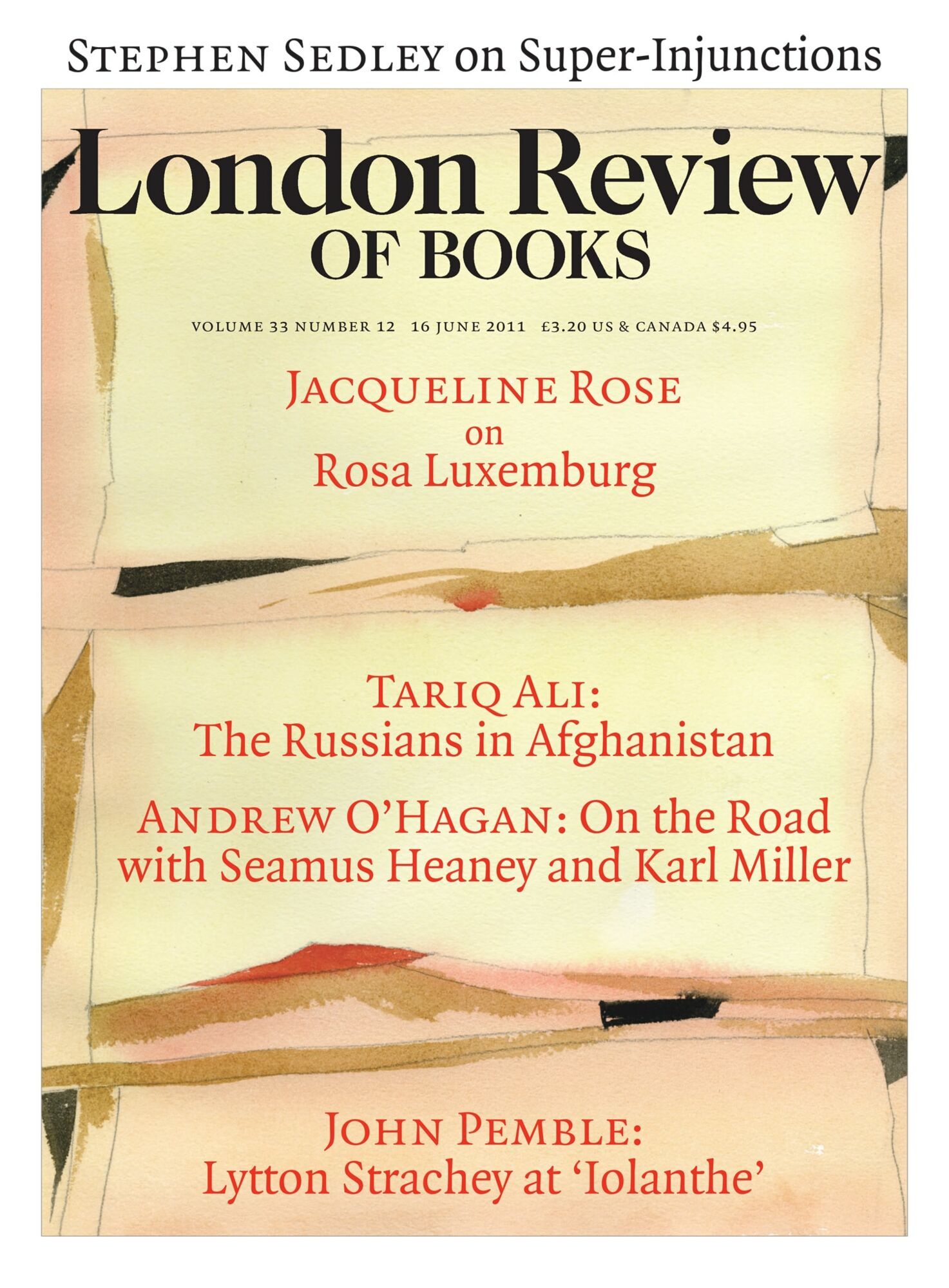
On the occasion of the publication of a reader of her work by Duke University Press and of this essay, Paul Myerscough interviewed Jacqueline Rose in front of an audience at the London Review Bookshop. An audio recording of the interview can be found here.
We live in revolutionary times. I cannot imagine now what it would have been like to be thinking about Rosa Luxemburg if the revolutions in Tunisia, Egypt and Libya had not taken place. I do not know whether it would have been easier or more difficult. But one thing revolutionary moments do is force us to revise our sense of time, stretching us between past and future, as we comb backwards for the first signs of upheaval, and look forward to see what is to come. For many observers, but mainly those in power, the uncertainty is a way of stalling the movement of revolution, curbing its spirit by calling it to account in advance for a future that it can’t predict or foretell. These are the fear-mongers, who point to a range of monstrous outcomes – say, anarchy or Islamic control – as a way of discrediting what is happening this moment, now; who manipulate the dread of a terrible future (and the future may always be terrible) to dull the sounds of freedom.
Rosa Luxemburg was not one of them. Writing to Luise Kautsky on 24 November 1917 from Breslau prison, where she had been held because of her opposition to the war, she praised Kautsky for still holding on to the ‘groping, searching, anxious’ young woman inside her – Kautsky was 53 at the time. When Kautsky visited Luxemburg in prison in May, her inner torment, her ‘restless, dissatisfied searching’ had been evident in her eyes (younger than the rest of her, Luxemburg insists, by 20 years): ‘How I love you precisely for that inner uncertainty!’ For Luxemburg this was as much a political as a personal virtue. ‘Far from being a sum of ready-made prescriptions,’ she wrote, again from Breslau prison, in her 1918 essay ‘The Russian Revolution’, socialism is ‘something which lies completely hidden in the mists of the future’. There was something radically unknowable at the core of political life. She could be tyrannical in her dealings with others, but – perhaps for that very reason – she hated nothing so much as the attempt to subject the vagaries of public and private life to what she saw as over-rigorous forms of control. To the immense irritation of her opponents and detractors, she elevated uncertainty to a principle, a revolutionary creed. It is, as I see it, the thread that runs through her unwavering belief in democracy and freedom, as well as in socialism. Uncertainty is what allows us to see how these three depend on each other, and is the link in her life and thought between the public world of politics and the intimacies of the mind.
The letters in this new volume, more than two-thirds of which haven’t previously been translated, give us fuller access in English than we have had before to Luxemburg’s personal and political life. The selection is based on the German collection, Herzlichst Ihre Rosa (‘Warmly yours, Rosa’), edited by Georg Adler and Annelies Laschitza, published in 1989, which consisted of 190 letters from the first five volumes of the Gesammelte Briefe. From the sixth volume of the Briefe, the English edition adds a further 40. In addition to photographs, the German edition also included images of paintings and botanical specimens collected by Luxemburg but not reproduced here. The images allow us to see more clearly how versatile her talents were: in Laschitza’s list, revolutionary Marxist; propagandist, teacher and speaker; stylist and rhetorician; lyricist and word-artist; translator and linguist; painter and botanist. For Luxemburg, letter writing was a daily task (there are 2350 letters in the first five volumes of the Gesammelte Briefe). It was, one feels reading this collection, the way she spoke to others and to herself. She was also a polyglot, writing in Russian, Polish, German and English. An earlier collection of 1979, Comrade and Lover, edited by her biographer Elzbieta Ettinger, had the advantage of translating the Polish letters directly from the originals (in this new collection all the letters have been translated from German).
That the letters survived is remarkable: a tribute to the colleagues, friends and lovers who dispersed them across several continents to save them from the ravages of the world wars. Sophie Liebknecht’s collection, the famous Letters from Prison, which appeared in 1920, disappeared only to be reissued in Germany immediately after the defeat of Hitler. As Laschitza puts it, the preservation and publication of the letters attests to the ‘strife-filled’ history of Luxemburg’s reception. It was not until the 1980s that the Gesammelte Briefe were published in the German Democratic Republic by the Institute of Marxism-Leninism under the central committee of the Socialist Unity Party – a fact not without irony, given the ambivalence of Lenin’s response to Luxemburg. In Britain, the appearance of the letters marks a beginning. Verso is planning to issue her Complete Works in 14 volumes, making the entire body of writing available for the first time in English. The moment has clearly come for a return to Rosa Luxemburg.
How far should revolutionary thinking be allowed to go? Everything Luxemburg touched she pushed to an extreme – jusqu’à outrance, ‘to the outer limit’, to use her own phrase, the slogan she proposed to her lover Leo Jogiches. ‘We live in turbulent times,’ she wrote in 1906 to Luise and her husband, Karl Kautsky, also from prison, this time in Warsaw, convicted of aiming to overthrow the tsarist government. ‘All that exists deserves to perish,’ she wrote, quoting Goethe’s Faust. It is of course the whole point of a revolution that you cannot know what, if anything, can or should survive. For Luxemburg the danger was as real as it was inspiring. ‘The revolution is magnificent,’ she wrote, again in 1906. ‘Everything else is bilge’ (the German quark, which has since made its way into English, literally means ‘soft white cheese’). But whatever the conditions in which she found herself – in Warsaw, she was one of 14 political prisoners crammed into a single cell – she never lost her fervour: her joy, as she put it, amid the horrors of the world. ‘My inner mood,’ she wrote after listing the indignities of her captivity, ‘is, as always, superb.’ ‘Enthusiasm combined with critical thought,’ she wrote in one of her last letters, ‘what more could we want of ourselves!’ She had the relish and courage of her convictions (although ‘conviction’ might turn out to be not quite the right word). There is no one, I will risk saying, who better captures the spirit – the promise and the risk – of revolution than Rosa Luxemburg.
In January 1919, after the defeat of the Spartacist uprising in Germany, Luxemburg was murdered by government henchmen, the proto-fascist Freikorps which included many future Nazis. Two years later, Clara Zetkin, the renowned socialist feminist and one of Luxemburg’s closest friends and key correspondents, returned to Germany from a visit to Moscow with instructions from Lenin recommending the publication of Luxemburg’s collected works – despite her ‘errors’, Lenin said, she was an ‘eagle of the revolution’. One manuscript, however, he wanted burned: ‘The Russian Revolution’, the essay Luxemburg had written in 1918 from her prison cell. (She almost invariably welcomed prison sentences as an opportunity for thought, and some of her most eloquent letters were written from prison.) The essay would be published in 1922 by Paul Levi, her former lawyer and, some say, briefly her lover. He chose his moment carefully, preparing the manuscript only after the Kronstadt uprising of 1921, one of the first people’s revolts against the Bolshevik regime.
In fact there was no limit to Luxemburg’s praise for the Revolution. It was, she begins her essay, the ‘mightiest event’ of the war: ‘its outbreak, its unexampled radicalism, its enduring consequences’ were the strongest rejoinder to the ‘lying phrases’ of official German Social Democracy, which had represented an essentially imperialist war as a battle to liberate the oppressed people of Russia from the tsar. The day her former revolutionary allies, the parliamentary faction of the German Social Democratic Party, voted in favour of the munitions budget in August 1914 was, it is generally agreed, the darkest day of Luxemburg’s life – according to Zetkin, both she and Luxemburg seriously contemplated suicide. Instead of uniting against war and in their own shared interests, the workers of the world would now be drenched in one another’s blood. In response to the tragedy, she suggested – with the biting irony that was a hallmark of her speeches and writing – an amendment to the famous ending of The Communist Manifesto: ‘Workers of the world unite in peacetime – but in war slit one another’s throat!’ The Revolution of 1917 had overthrown the tsar, exposed German Social Democracy’s hypocritical capitulation to an imperialist war, and put paid to the belief that Germany, or rather Central Europe, was the advanced civilisation, the properly industrialised society from which the backward Russians had everything to learn.
If Luxemburg was hated by her Social Democratic peers, it was at least as much for her unconcealed enthusiasm for what was happening in Russia as for her opposition to the war, of which her revolutionary comrades – ‘of late lamented memory’ as she scathingly puts it – had become the willing, murderous accomplices. Much of the hostility towards her was pure chauvinism. Luxemburg was born in Zamosc in Russian-occupied Poland in 1871; her family moved to Warsaw when she was three (one of her earliest political memories would have been the pogrom of 1881). Assimilated Jews, they belonged neither in the Jewish community, which rejected them, nor with the Poles, whose predominant political mood was a fervent anti-Russian nationalism with which Luxemburg would never identify. She was always an outsider. She arrived on the doorstep of the German Social Democratic Party as a young Jewish woman radical in 1898. The misogyny her presence provoked would become legendary (the best account is given by Adrienne Rich). And although she never self-identified as Jewish, being Jewish is something with which she was always identified. As Ettinger puts it, ‘she represented a nation the Germans considered inferior and a race that offended their sensibilities.’ None of that was altered – in many ways it was exacerbated – by the fact that she rapidly rose up the party echelons to become a star. In the words of Hannah Arendt, she ‘was and remained a Polish Jew in a country she disliked and a party she came soon to despise’.
It is a peculiarity of Luxemburg’s thought – one of her unique contributions – that her critique didn’t temper her enthusiasm for revolution but intensified it. In ‘The Russian Revolution’, the two main areas of dispute between her and the Bolsheviks were land distribution (which she feared would create a new form of private property) and national self-determination (on which more later). The core issues, however, were democracy and freedom. ‘Revolutions,’ she had already said, admonishing Lenin in her essay ‘The Mass Strike, the Political Party and the Trade Unions’ (1905), ‘do not allow anyone to play the schoolmaster with them.’ The previous year she had accused him of subordinating Russia to the ‘servile spirit of the night-watchman state’. As she acknowledged in ‘The Russian Revolution’, no one knew better than Lenin that socialism demands a ‘complete spiritual transformation in the masses’, but, she continued with uninhibited ruthlessness, he was ‘completely mistaken’ in his chosen means: ‘decree, dictatorial force of the factory overseer, draconian penalties, rule by terror’. (You can see why he wanted the manuscript burned.)
The demand for a constituent assembly had been a central plank of Bolshevist agitation, but in 1917, on the point of seizure of power, the demand was dropped. There is always a risk that democracy will throw up the wrong result – that surely is the point. For Lenin, the elections following the October Revolution, in which ‘the peasant masses’ had returned Narodnik and Kerensky supporters to the assembly, indicated the limits of democracy in a revolutionary situation. For Luxemburg, this was a betrayal of everything the Bolsheviks had been fighting for, and risked strangling the Revolution at birth. ‘As Marxists,’ she cites Trotsky, ‘we have never been idolisers of formal democracy.’ ‘Nor,’ she snapped back, ‘have we ever been idolisers of socialism or Marxism.’ For Luxemburg, freedom of thought (against idol-worship of any kind) was integral to democracy. In a speech of 1907, with Stalin apparently in the audience, she described slavish adherence to The Communist Manifesto as ‘a glaring example of metaphysical thinking’ (at another point she describes Marxism as a ‘gout-ridden uncle afraid of the breeze’). In fact she had always insisted that in conditions of rampant inequality, formal democracy was a hoax. Only under socialism would true democracy have a chance to be born. Without democracy, no socialism. It is the non-negotiable political aim:
The remedy which Trotsky and Lenin have found, the elimination of democracy as such, is worse than the disease it is supposed to cure: for it stops up the very living source from which alone can come the correction of all the innate shortcomings of social institutions. That source is the active, untrammelled, energetic political life of the broadest masses of the people.
The people, like their representatives, would continue to grow and change. Trotsky’s view rules out the possibility that the latter might be influenced by the former. It shuts down the future, freezing us in place and time, like the image of the heavens which shows us ‘the heavenly bodies not as they are when we are looking at them but as they were at the moment they sent out their light-messages to the earth from the measureless distances of space’. She was, as the letters confirm, a word-artist – the pointed wings of swallows wheeling in the sky outside the prison ‘snipped the blue silk of space into little bits’. For Luxemburg, there is no politics without a poetics of revolution. If you want to understand the revolution, look to the stars.
This isn’t anarchy – Luxemburg is very precisely calling for elections and representative parliamentary forms. Her demands were specific: freedom of the press, right of association and assembly (which had been banned for opponents of the regime). Anything less, she insisted, would lead inevitably to the ‘brutalisation’ of public life. For her, politics was a form of education: in many ways its supreme, if not only true, form. As she had argued in relation to women’s suffrage in 1902, the well-tried argument that people are not mature enough to exercise the right to vote is fatuous: ‘As if there were some other school of political maturity … than simply exercising those rights!’ Not even the revolutionary party in Russia at the time of the mass strike could be said to have ‘made’ the Revolution: it had had ‘to learn its law from the course itself’.
The course of politics is therefore incalculable. This is Luxemburg’s famous theory of spontaneity, which has roused the ire of critics who only get the half of it, if that much. What Luxemburg is insisting on, as I see it, is that the unprecedented, unpredictable nature of the revolutionary moment be carried over into the life that follows, the period after revolution has taken place – this is why organisation was for her always subservient to spirit. What, we might ask, would our political landscape look like if it placed at the core of its self-definition the unlimitable, potentially outrageous – jusqu’à outrance – processes of revolutionary life? ‘New territory. A thousand problems,’ she wrote in ‘The Russian Revolution’: ‘Only experience is capable of correcting and opening new ways. Only unobstructed, effervescent life falls into a thousand new forms and improvisations, brings to life creative force, itself corrects all mistaken attempts.’ It works both ways of course: it is a definition of democracy that mistakes can be seen. ‘In a totalitarian regime,’ Hosni Mubarak said in an interview in 1994, ‘you never know the mistakes that are made. But in a democracy, if anybody does something wrong, against the will of the people, it will float to the surface. The whole people is looking.’
Luxemburg wrote ‘The Russian Revolution’ on the eve of the Spartacist uprising. We read it now with knowledge of the uprising’s brutal outcome, but we can still register Luxemburg’s passionate endorsement of the energy and potential of the people. She is talking about aliveness – what the psychoanalyst Michael Parsons recently described as the true meaning of faith, which is also wholly unpredictable (there is no formula for the psychic conditions under which it will survive or be destroyed). Failure never diminished Luxemburg’s faith, which is why I think she didn’t die in despair. Failure was unavoidable. It had to be seen, not as the enemy, but as the fully-fledged partner of any viable politics. The ‘ego’ of the Russian revolutionary who ‘declares himself to be an all-powerful controller of history’ cannot see that the working class ‘everywhere insists on making its own mistakes’. Strikes that end without any definite outcome, ‘in spite, or rather just because of this’, are of greater significance as ‘explosions of a deep inner contradiction which spills over into the realm of politics’.
Listen to the vocabulary. What matters is what explodes and spills, what erupts. Her key term for describing political struggle is ‘friction’. Luxemburg is not a party manager. She doesn’t compute, calculate or count costs and benefits in advance. She doesn’t hedge her bets. This doesn’t stop her being single-minded. She is asking for what might seem a contradiction in terms: a political vision directed unerringly at the future which also recognises that the world will surely err. ‘It would be regrettable,’ she wrote to the Russian Marxist Alexandr Potresov in 1904, ‘if firmness and unyieldingness in practice necessarily had to be combined with a Lenin-style narrow-mindedness of theoretical views, rather than being combined with broadness and flexibility of thought’ (you could be firm and flexible at the same time). The mistakes made by a truly revolutionary workers’ movement, she wrote in ‘Organisational Questions of Russian Social Democracy’ in the same year, are ‘immeasurably more fruitful and more valuable’ than the infallibility of any party. The greatest mistake a revolutionary party can make is to think that it owns the history which it has done something, but only something, to bring about. Luxemburg is taking a swipe at omnipotence and perfectibility together. The sole way for the revolution – for any revolution – to usher in a genuine spirit of democratic freedom, where all views are by definition imperfect and incomplete, is to recognise the fallibility at the heart of the revolutionary moment itself. The only flawless revolution would be a dead revolution. Or, as Lacan would put it, Les non-dupes errent, which can be roughly translated as: ‘Anyone who thinks they’ve got it right is heading down the wrong path’ – or ‘without mistakes, you’re going nowhere.’
So how far should revolutionary thinking go? Infinity was not a metaphor for Rosa Luxemburg. In 1916, the British astronomer O.R. Walkey claimed to have discovered the centre of the universe. The idea of the universe as a ball – ‘a kind of giant potato dumpling or bombe glacée’, as Luxemburg wrote to Luise Kautsky – is ‘certainly rubbish’, a ‘completely fatuous petty-bourgeois conception’. ‘We are talking about nothing more and nothing less than the infinity of the universe,’ she wrote (her vision never more far-reaching than when in a prison cell). There is of course a geopolitical dimension to my question. It was part of the dynamic of Luxemburg’s thinking that, like capital itself, it did not stop anywhere. She was one of the first Marxist theorists of globalisation (or of ‘historical-geographical materialism’, in David Harvey’s more recent phrase). Her unfinished Introduction to Political Economy, based on her lectures at the Social Democratic Party school in Berlin from 1907 to 1914, included a chapter titled ‘The Dissolution of Primitive Communism: From the Ancient Germans and the Incas to India, Russia and Southern Africa’ (that just about covers it).
As it spreads, ‘ever more uncontrollable’ and ‘with no thought for the morrow’, to the outposts of what would become empire, destroying all non-capitalist forms in its train, capital offers the gargantuan, deformed reflection of the expansiveness, the unceasing flow, of revolutionary life. Marx himself had proposed the endless extension of capital, but to Luxemburg’s mind he failed to provide an adequate account of it, most notably in Volume II of Das Kapital, which excluded foreign trade. In her account, he did not see clearly enough that the problem of accumulation – how to dispose of surplus capital in a productive way – could not be contained by the industrialised world. ‘Capital,’ she wrote in The Accumulation of Capital, ‘must begin by planning for the systematic destruction and annihilation of the non-capitalist social units which obstruct its development.’ Capital ‘ransacks the whole world … all corners of the earth, seizing them, if necessary by force, from all levels of civilisation and from all forms of society.’
Luxemburg didn’t idealise non-capitalist societies, recognising in ‘primitive communism’, for example, the elite-based forms of inequality, the encroachment of inheritance and property, the wars of conquest with their in-built drive to the oppression of conquered peoples. Militarism – she took the Incas and Sparta as her examples – was the key to exploitation, a form of foundational violence; hence her revulsion at Germany’s slide into militarism and war. But, she wrote in ‘The Dissolution of Primitive Communism’, there is one thing that primitive social forms ‘cannot tolerate or overcome’: contact ‘with European civilisation, i.e. with capitalism. For the old society, this encounter is deadly, universally and without exception.’
It is Marxism’s central credo that capitalism contains the seeds of its own collapse: the destructiveness of capital heralds its defeat. On this Luxemburg never relented, not even when the old order was reasserting itself with such murderousness all around her in the last months and days of her life. Lukács put this best when he said that Luxemburg’s writing transformed the last flowering of capitalism into ‘a ghastly dance of death, into the inexorable march of Oedipus to his doom’. In this she was a true daughter of Marx, even if some would say it was his greatest error (comparable to believing that the people unfailingly correct their own mistakes). Critics have argued that Luxemburg underestimated the adaptability of capitalism, its ability to pull itself up by its bootstraps, as it could be said to have done in the complacent aftermath of the banking-led credit crisis of 2008. In fact this issue was central to the argument she had in 1898 with Eduard Bernstein about revisionism. The crises or ‘derangements’ (her word) of capitalist economy, she said then, were the very means by which capitalism perpetuates itself. In any case, these critics are missing the point. Whatever Luxemburg is talking about, she is also talking about knowledge and truth, about what is struggling, against the debilitating façade of bourgeois life, to be understood. Precisely because of its unerring and malicious canniness, capitalism is unable to hide its ugliness from the world (periodically revealing that ugliness is simply the obverse of its inhuman powers of endurance). But this is also the reason people will turn to revolution, not just, to use Marx’s terms, because of the clash between the forces and relations of production, but because the mind always has the power to expose and outstrip injustice. Or to put it more simply – as we have witnessed so powerfully in Tunisia, Egypt, Libya, Syria, Yemen, Bahrain over these past months – there comes a moment when the people decide they have had enough.
Even out of the greatest disasters, something will be born (disaster is never simply disaster, failure never simply failure). Remember her description of the strike as an explosion of a deep inner contradiction that ‘spills’ into the realm of politics. In 1902, a volcanic eruption on the island of Martinique left catastrophe in its wake: ‘mountains of smoking ruins, heaps of mangled corpses, a steaming, smoking sea of fire wherever you turn’. ‘In the ruins of the annihilated city,’ she wrote in a newspaper article, ‘a new guest arrives, unknown, never seen before – the human being.’ It was, for Luxemburg, the revenge of the earth against the tyrannies and abuses of the world. She had nothing but contempt for the statesmen who were rushing to commiserate hot from the ravages of empire and the bloody suppression of domestic revolt: ‘Mt Pelée, great-hearted giant, you can laugh; you can look down in loathing at these benevolent murderers, at these weeping carnivores.’ Always there is a political lesson to be learned – and to this extent there is something of Brecht, one of her great admirers, in Luxemburg. The volcano had been rumbling for some time, but ‘the lords of the earth, those who ordain human destiny, remained with faith unshaken – in their own wisdom.’ They are the real dupes of history. Luxemburg is talking about hubris, capitalism as inflicting the supreme form, not just of physical, but of mental bondage. For the same reason, slavery’s greatest evil was the ‘exclusion of slaves from mental life’. Her 1907 essay on the topic ends with a promise: ‘In the socialist society, knowledge will be the common property of everyone. All working people will have knowledge.’ The lords of the earth, like the centralist dictators of party policy, make the fatal error of thinking knowledge belongs to them alone.
This is why teaching was so important to her. Although she was first reluctant to take it on, she came to view her classes at the party school in Berlin as one of her most creative activities (they also spawned many of her most important writings). Education was the strongest rejoinder to tyranny, especially education in the human sciences. She had lived through a period in Poland when revolutionary writings had to be smuggled over the border from Russia and most humanities teaching took place more or less underground (we should take warning). It meant, Ettinger writes, that the humanities acquired a ‘spiritual meaning alive to this day’. ‘We have tried to make clear to [the students] from first to last,’ Luxemburg said in a speech in Nuremberg in 1908, ‘that they will not get from us any ready-made science, that they must continue to go on learning, that they will go on learning all their lives.’ This is politics as continuing education. Learning takes on the colours of revolution – endless, uncontrollable life.
Luxemburg did not want to be master of the revolution, she wanted to be its teacher (the worst insult, she once said, was to suggest that intellectual life was beyond the workers’ reach; similarly, the tragedy of the war was the thousands dying in the trenches ‘in mental darkness’). Or even its psychoanalyst: in the ‘great creative acts of experimental, often of spontaneous, class struggle,’ she wrote in her 1904 critique of Lenin, ‘the unconscious precedes the conscious.’ This is not of course – or I would say not yet – the Freudian unconscious. In fact it is axiomatic in Marxism that history unfolds invisibly beneath the surface of political life; hence the counter-stress on consciousness (at the core of Lukács’s disagreement with Luxemburg), the belief in the Party as the sole purveyor of historical truth. This is not her vocabulary: ‘Something is moving inside me and wants to come out,’ she wrote to Jogiches in April 1899 in one of her most celebrated letters, not included in this volume but cited in the introduction.
In my “soul”, a totally new, original form is ripening that ignores all rules and conventions. It breaks them by the power of ideas and strong conviction. I want to affect people like a clap of thunder, to inflame their minds, not by speechifying but with the breadth of my vision, the strength of my conviction, and the power of my expression.
So, how far – to repeat my question once again – should revolutionary thinking be allowed to go? Luxemburg’s most famous formula, ‘Freedom is always the freedom to think otherwise,’ also comes from ‘The Russian Revolution’, which, contra Lenin, I seem to be treating as a type of last testament. The German is die Andersdenkenden, which means more precisely ‘those who think otherwise’, with its implication of thinking against the grain, thinking the other side of the dominant or, I would add (pushing it perhaps, but then again perhaps not), conscious thought. What happens when you allow thought, like revolutionary life, to proliferate and grow, to spread without inhibition wherever it will? In a letter of 1907 to her new young lover, Clara Zetkin’s son Kostya (Clara appears not to have objected to the liaison), Luxemburg complains of depression because she has got out of the habit of thinking. The editors of this collection add in parenthesis ‘systematic or intensive thinking’, but these words don’t appear in the German original, which simply has Denkeweise – ‘the way or path of thought’. For Luxemburg, thought, to be free, can go anywhere.
That is why, in my view, she was so hated. Not just a woman and a Jew, she was also partly crippled, walking with a pronounced limp (after a misdiagnosed childhood illness). She never talked about it, except possibly in her anonymous antiwar ‘Junius Pamphlet’, smuggled out of prison in 1915, where, in attacking the war for reducing the labouring population to the ‘aged, the women, the maimed’ she may be invoking an older image of herself. She never belonged. ‘A severe criminal stands before you, one condemned by the state,’ she announced in February 1914 to the protesters who had gathered outside the court in Frankfurt after her trial for inciting public disobedience against the imminent war: ‘a woman whom the prosecution has described as rootless’. She took pride in being, in the words of the prosecutor, ‘a creature without a home’. She couldn’t hide – and never wanted to. But the obliqueness of her position, her status as an outsider, also gave her a freedom to think the un-thought, to force the unthinkable into the language of politics. I have long believed this to be one of feminism’s supreme tasks, what it has to contribute to political understanding. I now realise that, without knowing it, I got the idea from Luxemburg.
Lacan situated the language of hysteria as only a quarter turn from the language of psychoanalysis because in hysteria, the membrane between conscious and unconscious life is stretched to transparency, almost to breaking point. The point isn’t to join in the chorus of insults directed at Luxemburg by diagnosing her as a hysteric (she was accused of far worse in her lifetime). In fact Lacan’s remark is a tribute: he is imputing to the hysteric a rare proximity to her or his own psychic truth. But the peculiarity, even eccentricity of Luxemburg’s position as a Jewish woman at the heart of revolutionary socialism meant that she could take political thinking to task, strip it of its façade, unleash what she described in a letter to Luise Kautsky in 1917 as ‘powerful, unseen, plutonic forces’ at work in the depths. Gorky’s The Lower Depths was one of her favourite plays. She went twice to its Berlin opening in 1903 and wrote to Clara Zetkin that she would continue going as long as her finances would permit.
How could you possibly believe that a revolution can or should be mastered or known in advance if you are in touch with those parts of the mind which the mind itself cannot master and which do not even know themselves? ‘There is nothing more changeable than human psychology,’ she wrote to Mathilde Wurm from Wronke prison in 1917: ‘That’s especially because the psyche of the masses, like Thalatta, the eternal sea, always bears within it every latent possibility … they are always on the verge of becoming something totally different from what they seem to be.’ Thirteen years earlier she wrote to her friend Henriette Holst: ‘Don’t believe it’ – she has just allowed herself a rare moment of melancholy – ‘don’t believe me in general, I’m different at every moment, and life is made up only of moments.’ The shifting sands of the revolution and of the psyche are more or less the same thing.
It is in this context that the correspondence is so crucial: not as the sole repository of intimacy, but because it shows the ceaseless traffic between the personal and political. For Luxemburg it was a radical failure of politics not to be in touch with the deepest parts of the self. ‘Do you know what gives me no peace nowadays?’ she wrote to Robert Seidel in 1898: the fact that people, ‘when they are writing, forget for the most part to go deeper inside themselves’. ‘I hereby vow,’ she continued, ‘never to forget when I am writing … to go inside myself.’ She was talking about the language of the party press – ‘so conventional, so wooden, so stereotyped’. But that isn’t all she is talking about. The question of the inner life was at the heart of her relationship with Jogiches. To put it bluntly, he didn’t seem to have one. There is no gender cliché that doesn’t spring to mind when thinking about Leo Jogiches. Constitutionally incapable of writing himself, he wielded Luxemburg, in Ettinger’s words, like a pen. He was her puppet-master. A brilliant organiser (to give credit where it is due), he was the spirit behind Polish revolutionary socialism. But he could never fully access the German revolutionary circles to which his lover’s meteoric entry gave him a pass. He seems not to have wanted to be seen in her company, certainly not to be seen as living with her (only partly, it appears, for her protection). He didn’t want the life of a couple, and although she pleaded for a baby – and later, when it was too late for her to have one biologically, to adopt – he refused (we only have her account as his letters have not been preserved). ‘As soon as I am aware of you in the same room,’ she wrote in 1899, ‘all my initiative evaporates immediately, and I “wait” for what you are going to say.’ His endless instructions leave a ‘single, indelible impression on me, a feeling of uneasiness, fatigue, exhaustion and restlessness that comes over me in moments when I have time to think about it.’ The one plus is that if he had agreed to live with her more fully, we wouldn’t have had these amazing letters, which pour into the void of their shared and unshared life.
Repeatedly she reproaches him for writing to her only about party and political matters, for neglecting all matters of the heart. All she sees around her is Sprawa (‘The Cause’, the name of their party journal, for which she did much of the writing). She could cope with all of that, if ‘in addition to that, alongside of that, there was a bit of the human person, the soul, the individual to be seen.’ But from him ‘there is nothing, absolutely nothing,’ whereas for her it is ‘quite the contrary’, as she encounters a ‘whole crowd of thoughts and impressions at every turn’ (once again she is making a plea for the myriad nature of thought). But she could also be merciless. At one point, when he declines into a depression while caring for his dying brother, she accuses him of ‘senseless, savage spiritual suicide’.
Jogiches lived for the cause, a cause she reproaches for destroying all that is finest in a human being – she is careful to warn Kostya Zetkin off politics. For Luxemburg, the only point of the cause was to increase the human quotient of happiness for which man was created ‘as a bird for flight’. ‘I have the accursed desire to be happy, and would be ready, day after day, to haggle for my little portion of happiness with the foolish obstinacy of a pigeon.’ Again these are not quite metaphors: ‘Sometimes, it seems to me,’ she wrote to Sonja Liebknecht in 1917, ‘that I am not really a human being at all, but rather a bird or beast in human form.’ ‘No other couple in the world,’ she wrote in one of her most poignant letters, ‘has such possibilities for being happy as we have.’ But Jogiches was incapable of grasping the mobility of the soul, the freedom of thought and affect in which alone such happiness could consist. It was for her the condition of all relationships, the inviolable rule of friendship: ‘I don’t want to know just the outer, but also the inner,’ she wrote in 1898 to Robert and Mathilde Seidel.
At the core of their struggle was the issue of power (his drive to master the world the mirror of his mastery or refusal of the inner life). ‘You have too much faith in the magic power of the word “force” in both politics and personal life,’ she wrote to him in 1899. ‘I, for one, have more faith in the power of the word “do”.’ Jogiches needed her success, but he hated it. ‘My success and the public recognition I am getting are likely to poison our relationship because of your pride and suspicion,’ she wrote as early as July 1896, two years before she moved to Berlin. But she is passionately involved with him, in many ways lives through and for him for the 15 key years of their affair. She submits to him, or at least says she will, and ties herself in knots trying to please him; she also relies on him for inspiration, fact-checking, editing of her work – one of my favourite moments is when, on receiving his changes to one of her articles, she writes that she ‘almost had a fit’. She also turns the tables:
I’ve been letting it run through my head a little, the question of our relationship, and when I return I’m going to take you in my claws so sharply that it will make you squeal, you’ll see … I have the right to do this because I am ten times better than you … I am now going to terrorise you without any mercy until you become gentle … Learn to kneel down in spirit a little … You must submit, because I will force you to through the power of love.
How can we not see in this struggle a rehearsal, or the grounds, of her later critique of Leninism? He was mentoring her. His entire correspondence systematically displays one ‘huge unpleasant thing’, like the letters of ‘a teacher to his pet pupil’ (Ettinger, translating directly from the Polish, uses ‘schoolmaster’, which makes the link to Lenin stronger). He could be violent. When she started her affair with Zetkin he threatened to kill her (it was not an idle threat: he showed up with a gun and followed her down the street). He insisted on retaining the keys to the flat they once shared. He exerted over her the terrorising, draconian, power of the night-watchman state. For Luxemburg, passion – like politics – was a question of freedom. ‘Blessed are those without passion,’ she wrote to her last lover, Hans Diefenbach (the affair was conducted by correspondence from prison), ‘if that means they would never claw like a panther at the happiness and freedom of others.’ ‘That,’ she continues, ‘has nothing to do with passion … I possess enough of it to set a prairie on fire, and still hold sacred the freedom and the simple wishes of other people.’ ‘You must let me do what I please and how I please,’ she wrote to Jogiches near the end of the affair: ‘I simply live the life of a plant and must be left just as I am.’ True passion stakes no claim. Like democracy, it does not own, control or master the other. It lets the other be. ‘I am only I once more since I have become free of Leo.’
There are a number of ways of thinking about the relationship between Luxemburg’s political and private lives that I think are misconceived. The most common is that the correspondence reveals the human being, the woman, behind the steely revolutionary: they show that Rosa Luxemburg was also ‘sensuous and full of laughter’ (as a Guardian sub-editor put it). There is nothing more sensuous than Luxemburg’s writings on revolution, and laughter for her could be as political as anything else. (Remember Mt Pelée in Martinique looking down and laughing at the weeping carnivores.) When the Frankfurt prosecutor asked for her immediate arrest in 1914 on the grounds that she was bound to take flight, she retorted: ‘I believe you, you would run away; a Social Democrat does not. He stands by his deeds and laughs at your judgments.’ Gillian Rose is surely right that Luxemburg raised facetiousness to a new political art. Nor do I accept Ettinger’s view that Luxemburg’s political identity hardened – as well it might have given the way the world was turning – mostly as a way of compensating for failure in her personal life. I don’t view her personal life as a failure. Unlike her biographer John Peter Nettl, I don’t see the years after her break-up with Jogiches as the ‘lost years’. Nor do I consider that, as Adrienne Rich suggests, Luxemburg’s life is evidence that a woman’s ‘central relationship can be to her work, even as lovers come and go’. I don’t think we have to make the choice. What interests me is not any notion of hierarchy between her public and private lives, but rather their profound intermeshing. And, through that, what her immersion in the dark night of the soul brings – like Martinique, like revolution – to the surface of politics.
‘Why,’ Luxemburg writes to Kostya Zetkin in 1907, ‘am I plunging again into dangers and frightening new situations in which I am sure to be lost?’ If politics for her is at moments a torment, it is also a compulsion. When she reproaches Jogiches for his immersion in the cause, she is also reproaching herself, with the difference – and for me it makes all the difference – that internally Luxemburg takes full measure of the force to which she submits. In the same letter to Zetkin – she is in London for the Fifth Congress of the Russian Social Democracy Party – she describes ‘an indistinct desire’ stirring somewhere ‘in the depths’, a longing to embrace the ‘shrill chords’, to ‘plunge’ into the whirlpool of London at night (the German stürzen, used both times, means ‘to plunge, to stream, to fall’). The street is full of staggering drunkards and ‘screeching’ flower girls ‘looking frightfully ugly and even depraved’. Here Luxemburg seems to be anticipating Virginia Woolf’s ‘Street Haunting’ or Djuna Barnes’s Nightwood (there is more than one way to be a ‘watchman of the night’). It’s always consoling to think that if you open the inner portals of your mind it will be flooded with light, but the whole point of venturing down such paths is that you can’t know where they will lead. Luxemburg is tempted by what she can’t control. It is no coincidence that her thoughts here so uncannily resonate with her belief in the unknowable spirit of revolution. For her deepest insights into both aspects of her life, Luxemburg plumbs the same source.
It is often argued on the left that the darkness and fragility of psychic life are the greatest threat to politics. Instead, through Luxemburg, we might rather see this life as the shadow of politics, or even its handmaiden, an unconscious supporter in the wings. It is not unusual, as we discover reading the letters, for Luxemburg to find herself in parts of the mind where she doesn’t wish to tread. Joyous, she was also permanently dissatisfied with herself. She knew all too well about the link between creativity and psychic pain (the ‘gnawing and painful, but creative spirit of social responsibility’). Contemplating the possibility of mental illness – being driven mad by Jogiches would perhaps be more accurate – she describes the sensation of thinking and feeling everything ‘as though through a screen of tracing paper’, the feeling of her thoughts ‘being torn away’. At another moment, she writes that her life has always felt as if it were taking place somewhere else, ‘not here where I am’, in another scene – psychoanalysis would call this eine andere Schauplatz (‘another stage’) – somewhere ‘far away, off beyond the rooftops’.
In one of his best-known images, Freud used the mystic or magical writing pad to describe the psyche as a set of infinite traces. The mind is its own palimpsest. It cannot be held to a single place. You never fully know yourself or the other. Luxemburg laments that she can scarcely be her own ‘adviser or counsellor’, but how could she be, she continues, given how extraordinarily difficult it is even for the closest friends to know and understand each other, given the fact that language so often fails. There is no way to capture the truth behind the words. ‘One may perhaps have an excellent understanding of the actual words, but the “lighting” [die Beleuchtung],’ she wrote to Robert and Mathilde Seidel in 1898: ‘Do you know what I mean?’ A year earlier she had included these lines from her favourite Polish writer, the Romantic poet and dramatist Adam Mickiewicz, in a letter to Jogiches:
If the tongue were true to the voice and the voice to the thought,
How then could the word keep the lightning of the thought in bounds.
Words deceive because thought is boundless. ‘Do you know what I mean?’ she beseeches her friends. How could they? When she has just laid on the page the fragments of her own failed understanding?
For psychoanalysis, it is axiomatic that our conscious utterances betray us: something always escapes. There is a point, Freud wrote in The Interpretation of Dreams, where all dreams plunge irretrievably into the unknown. The only chance of even getting close is to let the mind drift where it will. ‘The dream-thoughts to which we are led by interpretation,’ he wrote, ‘cannot, from the nature of things, have any definite endings; they are bound to branch out in every direction into the intricate network of our world of thought.’ Like revolution or the mass strike, we might say. This is Luxemburg: ‘It flows now like a broad billow over the whole kingdom, and now divides into a gigantic network of narrow streams; now it bubbles forth from under the ground like a fresh spring and now is completely lost under the earth.’
Which is why Freud’s only instruction to patients – the sacrosanct but some would say increasingly neglected founding principle of analysis – was to free-associate, to say whatever, however strange and unpredictable, came into their heads. For Freud the ungraspable nature of the human mind summoned up the necessity of freedom. ‘The method of free association,’ Christopher Bollas writes, ‘subverts the psychoanalyst’s natural authoritarian tendencies.’ It is a new method of thinking, he continues, which unleashes the ‘disseminating possibilities that open to infinity’. Infinity as infinity (the universe with no centre). As with revolution, you have to risk lifting the lid. The world must be allowed to fall apart in order – perhaps – for it to recover itself. First horrified, appalled, almost broken by the vote for the war, Luxemburg then realised that in order to move further, ‘all of this will still have to disintegrate and come apart more.’ She was, of course, writing at the same time as Freud. Out of the unconscious, Luxemburg lifts something I would call an ethics of personal and political life.
Luxemburg’s disagreement with Lenin can also be seen in these terms. As Nettl puts it in his biography, ‘Unlike Rosa Luxemburg, who groped for new and deeper causes hitherto unknown for a moral and political cataclysm on a unique scale, the mere understanding of which taxed her greater powers to the full, Lenin was merely preoccupied by the size of the problem.’ Luxemburg is offering a counter-erotics of revolution (no coincidence, surely, that for recent feminist psychoanalytic thought, female sexuality is boundless).
Jusqu’à outrance – beyond the limit. There is one more crossing to make. The unconscious knows no national boundaries. Far from being a petty-bourgeois or Eurocentric concept, Freud’s universalism was at least partly his advance-guard riposte to those who would castigate psychoanalysis as a German and/or Jewish science. The question of nationalism shadowed the emergence of psychoanalysis as much as it did the revolutions of the times. It was something that Luxemburg lived to the quick. When she left Poland as a young woman of 18, already at risk of arrest for her association with underground revolutionary groups in Warsaw, she crossed the border hidden under straw in a peasant’s cart. A local Catholic priest agreed to organise her flight when he heard that this Jewish girl wishing to be baptised in order to marry her lover had to flee to avoid the violent opposition of her family. She would cross and recross national boundaries for the rest of her life. When she later moved to Germany, she arrived, according to Ettinger, ‘carrying the bundle of her Jewish family’s letters, party instructions to introduce herself as a Pole, and the marriage certificate that changed her citizenship from Russian to German.’
Where, if anywhere, did she belong? ‘Predictably,’ Ettinger writes, the Polish Socialist Party ‘pointed to Luxemburg’s Jewish origin as inevitably blinding her to the real needs and wishes of the Polish nation. The same was said in 1970, at a symposium in Warsaw commemorating the 100th anniversary of her birth.’ (In 1910, the Polish nationalist newspaper Independent Thought maintained that her physical disability was an example of the degeneration of the Jews.) Rootlessness is also an asset, however. Luxemburg came from a world, in the words of Arendt, in which ‘a universal humanity and a genuine, almost naive contempt for social and ethnic distinctions were taken for granted.’ ‘One aspect of Rosa’s internationalism,’ Nettl writes, ‘was to prefer the foreign.’ ‘I do see the strengthening of international feeling,’ she wrote to Henriette Holst in 1904, ‘to be, in and of itself, a means of fighting against bigotry and ignorance.’ The world, she said, should strive for Goethe’s ‘universalism of interests’.
This is why she had no time for the concept of national self-determination, which was so central in her dispute with Lenin (and not only with him). It was the fervent nationalism of the official Polish Socialist Party which led Luxemburg and Jogiches to split off and form the Social Democracy of the Kingdom of Poland and Lithuania in 1893. ‘The nation as a uniform social-political whole,’ she observed in 1908, ‘simply does not exist.’ She would have no truck with the Jewish Socialist movement, the Bund, which fought for the recognition of Jews as a national minority, and which Jogiches supported (it was one of their few political disagreements). She could not see the Jews as a special case. ‘What do you want with this particular suffering of the Jews?’ Luxemburg wrote to Mathilde Wurm in 1917 in one of her most controversial letters, not included in this collection, ‘The poor victims on the rubber plantations in Putumayo, the Negroes in Africa with whose bodies the Europeans play a game of catch are just as near to me … I have no special corner of my heart reserved for the ghetto; I am at home wherever in the world there are clouds, birds and human tears.’
To say that Luxemburg was impatient with her Jewishness would be an understatement. She refused to read the Dreyfus affair as a Jewish matter, seeing it in terms of the struggle of socialism against militarism and clericalism. And yet that is not the whole story. Her letters are peppered with Yiddish, although more than once she uses the word ‘kike’. For Arendt, it is paradoxically her cosmopolitanism that shows how deeply identified she was with her Jewishness (a majority of the anti-nationalist breakaway Polish party were Jews). If she was at least partly in flight from it, it also returned, unbidden, to her. In the ‘Junius Pamphlet’ she compares socialists opposing the war to ‘the Jews whom Moses led through the desert’ (she is paraphrasing Marx). She also has moments of startling prescience, writing to Sophie Liebknecht in the midst of the war that, although the time for pogroms in Russia was over, in Germany they might be about to begin. The ‘Junius Pamphlet’ ends with her reciting the murderous refrains of the war – ‘Deutschland, Deutschland über alles’ – which ring out as the soldiers and workers of France, Germany, Italy and Belgium grapple ‘in each other’s death-bringing arms’. For Luxemburg, nationalism was violence. The war taught her how exciting, virulent, mind-numbing, patriotism could be. In Arendt’s eyes, it is this inclusive, borderless vision that makes Luxemburg a true European, passionately engaged till the end of her life ‘in the destinies’ – note the plural – ‘of the world’. It meant, among other things, that she could see through the rhetoric of war. It is a ‘distorted form of bourgeois hypocrisy’, she wrote in the ‘Junius Pamphlet’, ‘that leads each nation to recognise infamy only when it appears in the uniform of the other.’
If freedom is the freedom to think ‘otherwise’, then the question is: to which others are you willing to accord the right to be free (instead of imputing infamy to them as a prelude to killing)? Luxemburg’s universalism is the flipside of her openness to the other, however far it takes her. One day in 1917, walking through the prison courtyard in Breslau, she noticed a military supply wagon driven by water buffaloes instead of horses. Wild beasts brought from Romania, they were ‘accustomed to their freedom’ and had to be ‘beaten terribly before they grasped the concept that they had lost the war’. Pushed beyond endurance, they mostly perished (there were said to be at least a hundred of them in Breslau alone). As she watched a soldier flailing the buffaloes, one bleeding animal drew her attention: ‘I stood before it, and the beast looked at me; tears were running down my face – they were his tears.’ Luxemburg didn’t wail and moan from the sidelines but catapulted herself into the place of the beast – two years later she would be clubbed, shot and thrown into the river. But she never loses her sense of irony. The soldier struts the yard, smiling and whistling a popular tune to himself: ‘And the entire marvellous panorama of the war passed before my eyes.’
Send Letters To:
The Editor
London Review of Books,
28 Little Russell Street
London, WC1A 2HN
letters@lrb.co.uk
Please include name, address, and a telephone number.
