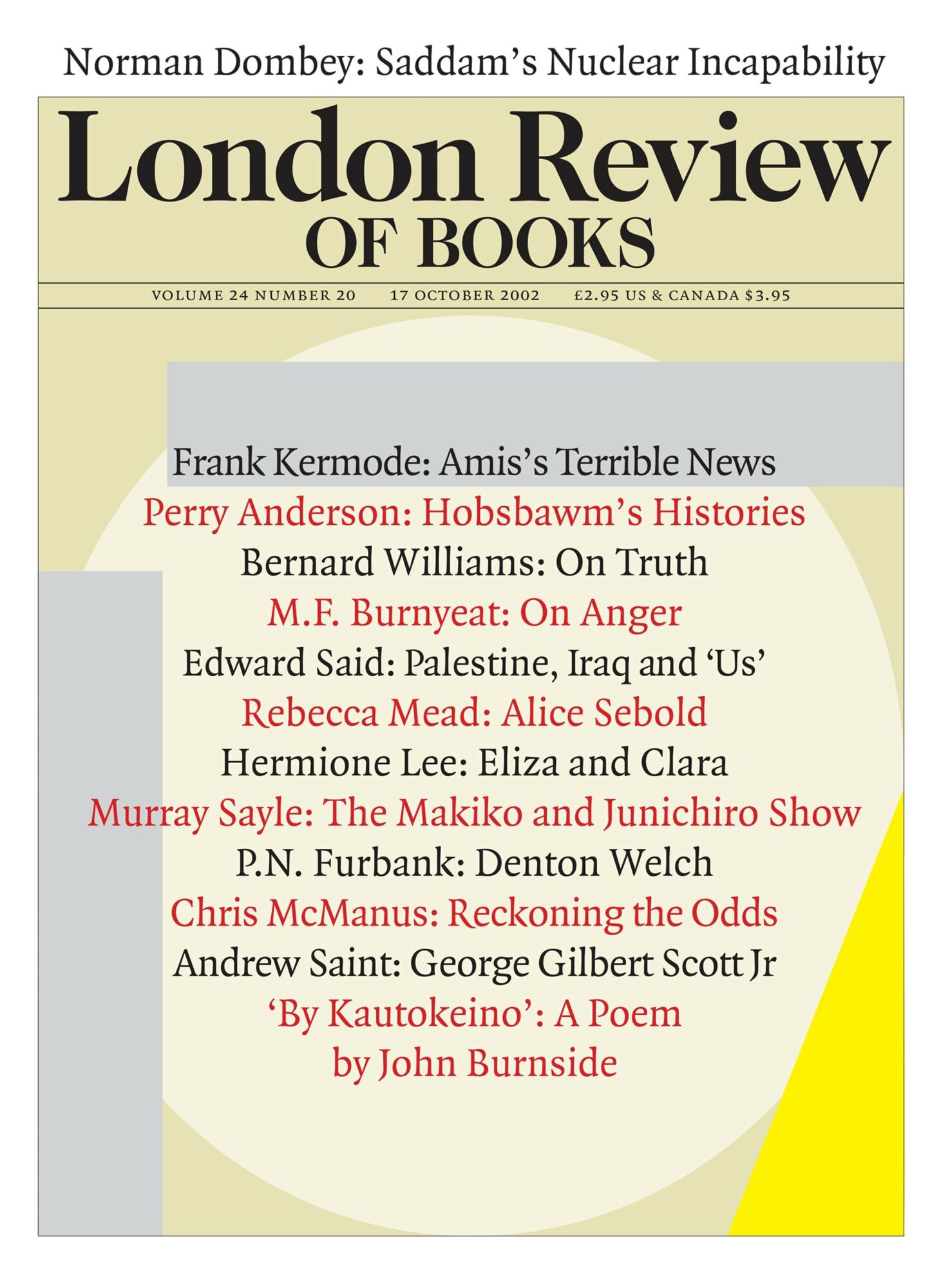
Presented as a pendant to Age of Extremes, a personal portrait hung opposite the historical landscape, what light does Interesting Times throw on Eric Hobsbawm’s vision of the 20th century, and overall narrative of modernity?1 In overarching conception, The Age of Revolution, The Age of Capital, The Age of Empire and Age of Extremes can be regarded as a single enterprise – a tetralogy which has no equal as a systematic account of how the contemporary world was made. All display the same astonishing fusion of gifts: economy of synthesis; vividness of detail; global scope, yet acute sense of regional difference; polymathic fluency, equally at ease with crops and stock markets, nations and classes, statesmen and peasants, sciences and arts; breadth of sympathies for disparate social agents; power of analytic narrative; and not least a style of remarkable clarity and energy, whose signature is the sudden bolt of metaphoric electricity across the even surface of cool, pungent argument. It is striking how often these flashes of figuration are drawn from the natural world to which he says he felt so close in his youth: ‘religion, from being something like the sky, from which no man can escape and which contains all that is above the earth, became something like a bank of clouds, a large but limited and changing feature of the human firmament’; ‘Fascism dissolved like a clump of earth thrown into a river.’
Still, within the epic span of these four volumes, there is a definite break between the first three, conceived early on as a trilogy, and the last, which is more self-standing, with features that mark it off from its predecessors. Covering the epoch from the French Revolution to the First World War, the trilogy follows a consistent scheme, classically Marxist in its logic: each volume begins with an account of the economic foundations of the period, then a narrative of its political conflicts (in the first two volumes, headed ‘Developments’), followed by a panorama of social classes, and then a survey of the cultural and intellectual scene (headed ‘Results’). There is no clanking of theoretical armour; base and superstructure are never mentioned. Within the series, individual treatments repeatedly stand out: wonderful chapters on the Napoleonic Wars, on Romanticism, on the world boom of the 1850s and its losers, on the origins of the First World War, and many others. A decade before the term became common currency, ‘globalisation’ is already a theme in The Age of Empire.
The political sympathies of the trilogy are forthright. It is rare to find a historian writing (this is The Age of Capital): ‘the author of this book cannot conceal a certain distaste, perhaps a certain contempt for the age with which it deals, though one mitigated by admiration for its titanic material achievements and by the effort to understand even what he does not like.’ Hobsbawm’s general verdicts are often searing: ‘Altogether the introduction of liberalism on the land was like some sort of silent bombardment which shattered the social structure [the peasant] had always inhabited and left nothing in its place but the rich: a solitude called freedom.’ But the tang of particular judgments is always individual, and rarely predictable. Who would have thought to see the Congress of Vienna praised as sensible and realistic, or expected Louis Napoleon to receive more favourable treatment than Proudhon or Bakunin?
If the three Ages enjoy a well-nigh universal admiration, they have attracted less critical discussion than they deserve, as often happens in such cases. This is partly a matter of the scale of their performance, which virtually defies any all-round view of them. Lacking that, particular points of dissent or reflection are bound to remain somewhat arbitrary or marginal. But if the test of any major work is also the questions it prompts, a few loose thoughts may be worth bouncing off these superbly polished surfaces. The axis around which the trilogy organises the history of the ‘long 19th century’ – running, as it were, from 1776 or 1789 to 1914 – is, in Hobsbawm’s words, ‘the triumph and transformation of capitalism in the historically specific forms of bourgeois society in its liberal version’. Here we have, in nuce, the trio of objects of analysis – economic: social: political – that controls the unfolding of each volume.
Describing the aim of his work as ‘not detailed narrative, but interpretation or what the French call haute vulgarisation’, Hobsbawm leaves open the question of how far this commits him to explanation, a distinction that is not irrelevant to his achievement. At the outset of his enterprise, he remarks that The Age of Revolution will not try to explain the origins of capitalism, which lie in 16th or 17th-century Europe, but the breakthrough of the Industrial Revolution in England from the 1780s onwards. He keeps his promise with a powerfully focused account of the Imperial foundations of British industrialisation. ‘Launched, like a glider, by the colonial trade to which it was attached’, the cotton industry – its raw materials furnished essentially by slaves, its markets secured by naval power – represented the triumph of exports over domestic consumption. Subsequent historians have stressed the comparative advantage afforded by Britain’s coal-based energy as a key condition of the Industrial Revolution, a notion others have sought to do away with altogether. But none has seriously shaken Hobsbawm’s case for the importance of the imperial framework.
On the other hand, when we come to the second major epoch of industrial expansion, the global take-off of the 1850s that is the starting point of The Age of Capital, a gradual lowering of explanatory pressure sets in. ‘Why did economic expansion accelerate so spectacularly in our period?’ Hobsbawm asks, only to reply that ‘the question ought really to be reversed’ – the problem being rather why it did not do so earlier. This fin de non-recevoir seems something of an evasion, but in any case is not pursued. Instead, we are offered a more scattered menu of factors – the railway, improved communications, new gold supplies – that never really matches the scale of the change invoked, tailing away inconclusively with the spread of economic liberalism (‘how far the global movement to liberalise was cause, concomitant or consequence of economic expansion must be left an open question’).
At the next crucial juncture of the world economy, the slide into the Great Depression of 1873, even less is vouchsafed: while there is a graphic depiction of the uneven character of the slump, scarcely any causal analysis of it is ventured. Rather, when the tide turns again with the upswing of the 1890s, Hobsbawm simply notes that the whole period of The Age of Empire appears to have moved to a Kondratiev rhythm – some twenty years of recession, followed by twenty of expansion. But ‘since we cannot explain them, the Kondratiev periodicities do not help us much.’ Little is said of the possible reasons for the upturn, beyond the increased purchasing power of the big cities, after the price deflation of the downswing. Perhaps abstention from deeper probing of difficult questions like these is the price of the streamlined elegance of the trilogy, whose pace militates against the patient economic excavation Hobsbawm practised in essays such as ‘The Crisis of the 17th Century’ (1954).
If we move from the first to the second term of the programme of the trilogy, a different set of issues is posed, conceptual more than empirical. It might be said that these begin with the famous idea of the dual revolution itself – ‘twin craters of a larger regional volcano’. The problem here can be put very simply. At the end of the 18th century, the industrial revolution occurred in Britain, the political revolution in France. But why were they dissociated? According to traditional Marxist premises, a political revolution should occur when the advance of new economic forces of production bursts through the carapace of outmoded social relations. Yet in one country the blast of modern industry shook neither monarchy nor oligarchy; in the other, the eruption of the people brought no acceleration of advanced technology, but rather – as Hobsbawm notes – a consolidation of traditional peasant property. For a Marxist historian, this reciprocal asymmetry might seem to call for something more than empirical registration. To tax any work of magnitude with what it does not say, rather than learn from what it does, always risks being captious. But in this instance, the grace with which Hobsbawm’s histoire raisonnée glides across what might be thought analytic thin ice presages difficulties later on. For what it finesses is the nature of the relationship between ‘capitalism’ and ‘bourgeois society’, of which the trinitarian formula of the Ages says only that one is a historically specific form of the other, without further particulars.
The neuralgic point here is the career of the European bourgeoisie as a political class. In his first volume, after describing the Restoration settlement of 1815, Hobsbawm writes of the revolutionary wave of 1830:
In effect, it marked the definitive defeat of aristocratic by bourgeois power in Western Europe. The ruling class of the next fifty years was to be the ‘grande bourgeoisie’ of bankers, big industrialists and sometimes top civil servants, accepted by an aristocracy which effaced itself or agreed to promote primarily bourgeois policies, unchallenged as yet by universal suffrage, though harassed from the outside by the agitations of the lesser or unsatisfied businessmen, the petty bourgeoisie and the early labour movements.
This seems premature. If the bourgeoisie were already the rulers of Western Europe in the time of Lola Montes and King Bomba, what need for the upheavals of 1848? Why indeed conclude, at the end of an admirable survey of these, that it was now that ‘the bourgeoisie ceased to be a revolutionary force’? For that matter, in the half-century after 1830, universal male suffrage had arrived in both France and Germany, but were Bismarck and MacMahon mere burghers?
The second volume suggests another periodisation, but one that compounds rather than resolves such uncertainties. The years from 1848 to 1875 represent, above all, ‘the era of the triumphant bourgeois’, when its ascendancy ‘seemed beyond doubt or challenge’. Yet at the same time, Hobsbawm concedes, ‘in most countries the bourgeoisie, however defined, plainly did not control or exercise political power. What it did exercise was hegemony, and what it increasingly determined was policy. There was no alternative to capitalism as a method of economic development.’ What this description implies, but does not say, is that between economic and political realms, there was not a match but a torsion. The rule of capital did not necessarily mean bourgeois rulers. Here too is a central paradox, that appears to call for explanation. But again the narrative eludes it. In this case, it does so in part by dispersion. The great political upheavals of the period form a set that concentrates all the elements of this epochal twist: the Unifications of Germany and Italy, the American Civil War and the Meiji Restoration in Japan. The Age of Capital covers all of them, but distributing them under different chapter headings – ‘Conflicts and Wars’, ‘Building Nations’, ‘Winners’ – does not relate them in a way that would force the underlying historical issue.
If, at the height of its powers, the European bourgeoisie was never actually quite in power, enjoying mastery of the state, what was the curve of its development after the ‘brief and impermanent’ moment of its triumph? The Age of Empire shifts emphasis to the third term of the originating formula. ‘This book surveys the moment in history when it became clear that the society and civilisation created by and for the Western liberal bourgeoisie represented not the permanent form of the modern industrial world, but only one phase of its early development.’ Here for the first time Hobsbawm starts explicitly to disconnect economic form and social force. After a careful discussion of the fluid composition and boundaries of the class, he remarks that ‘the problem of defining the bourgeoisie as a group of men and women, and the line between these and the “lower middle classes”, has no direct bearing on the analysis of capitalist development at this stage’ – for ‘the economic structures which sustain the 20th-century world, even when they are capitalist, are no longer those of “private enterprise” in the sense businessmen would have accepted in 1870.’
The Age of Empire does not dwell on the continuing grip of aristocratic and agrarian elites at the summit of state and society in the Belle Epoque, in the way that a historian like Arno Mayer has done. But it traces a ‘dissolution of the firm contours of the 19th-century bourgeoisie’ in the emergence of the modern corporation, the emancipation of women, and above all in the crisis of liberalism – a moral and ideological self-destruction leading to 1914. ‘As bourgeois Europe moved in growing material comfort towards its catastrophe, we observe the curious phenomenon of a bourgeoisie, or at least a significant part of its youth and its intellectuals, which plunged willingly, even enthusiastically into the abyss.’ In effect, the upshot of the trilogy is thus a snapping of the links between the constituent elements that set it in motion. Capitalism no longer requires – this: or any? – bourgeoisie. The bourgeoisie is no longer committed to – this: or any? – liberalism. The demonstratives remain indeterminate, leaving the difference between the particular and the generic in suspense.
Chronologically, Age of Extremes resumes the narrative at the point its predecessor ends, with the outbreak of the First World War – a continuity underlined by the anticipation of some of its key themes in the epilogue that concludes the trilogy, looking ahead to the history of the 20th century. But conceptually, and architectonically, there is a break. Half as long again as the earlier volumes, the fourth is erected on a larger scale. Coming to it after them is rather as if, having ascended to what appeared to be the crest-line of a great mountain range, one were suddenly to find a peak of Andean proportions rearing up beyond it. There is no doubt at all that Age of Extremes is Hobsbawm’s masterpiece. Its presentation and internal construction repay close attention. The title is already a signal: the definite articles of the trilogy have gone, as have their pointed substantives. The replacements belong to another semantic set: less categorical and political, more existential. The actors have changed too. The most striking single discontinuity of the fourth volume is the complete disappearance from sight of the bourgeoisie, which – unlike chess, drugs or football – does not even rate an entry in the index. Did it vanish historically in August 1914? No historian is obliged to return to earlier themes, and a wish to break new ground is always commendable. But such a sharp caesura is unlikely to be just a matter of changing the subject, without significance for the direction of what follows.
Age of Extremes delivers its fundamental argument in the form of a periodisation. The ‘short 20th century’ between 1914 and 1991 can be divided into three phases. The first, ‘The Age of Catastrophe’, extends from the slaughter of the First World War, through the Great Depression and the rise of Fascism, to the cataclysm of the Second World War and its immediate consequences, including the end of European empires. The second, ‘The Golden Age’, stretching approximately from 1950 to 1973, saw historically unprecedented rates of growth and a new popular prosperity in the advanced capitalist world, with the spread of mixed economies and social security systems; accompanied by rising living standards in the Soviet bloc and the ‘end of the Middle Ages’ in the Third World, as the peasantry streamed off the land into modern cities in post-colonial states. The third phase, ‘Landslide’, starting with the oil crisis and onset of recession in 1973, and continuing into the present, has witnessed economic stagnation and political atrophy in the West, the collapse of the USSR in the East, socio-cultural anomie across the whole of the North, and the spread of vicious ethnic conflicts in the South. The signs of these times are: less growth, less order, less security. The barometer of human welfare is falling.
This is a powerful view of the century. The contrast it draws between first and second phases is clear-cut enough, and gives its force to the title of the book. What of the dividing lines between the second and third? Here there is an obvious sense in which Hobsbawm has remained faithful to his Marxist origins, since the primary demarcation between the two is economic. Each period, he observes, corresponds to a Kondratiev long wave – a quarter-century of dynamic upswing, followed by another of sluggish downswing. Once again he reiterates that Kondratiev cycles seem to exist, but have defied explanation. Since Age of Extremes opens by saying that ‘my object has been to understand and explain why things turned out the way did’ – a stronger emphasis than the ‘interpretation’ promised by the trilogy – reliance on the same inscrutable mechanism could be held a more serious admission of limit, since the coherence of the whole narrative in a sense turns on this deus absconditus.
As it happens, Hobsbawm does offer partial explanations of the Great Depression of the 1930s, of the boom of the Golden Age, and even – if more obliquely – of the Long Downswing. The first he attributes essentially to insufficient demand (wage stagnation) in the United States of the Jazz Age, anyway perhaps too isolationist for a responsible role in the world economy at large. The second he puts down to effective management of demand in the mixed economies of a chastened postwar capitalism, assuring regular wage increases to absorb output, and far better international co-ordination of trade and investment. The third he implies was due to excessive demand, as wages outstripped productivity in the late 1960s, unleashing generalised inflation, just as the gold-dollar system of the Bretton Woods epoch broke down. The symmetry of these suggestions is plain enough. Mostly Hobsbawm lets them fall without emphasis, with the sceptical air of a historian who distrusts the dogmas of economists of any sort, so too much weight should not be put on them. Yet they remain conventional, and surprisingly unaffected by contrary indications. Robert Brenner has shown, pretty conclusively, how little the onset of the Slump in America can be explained by wage repression, or the end of the postwar boom by wage explosion. He has also proposed a genuine theoretical explanation, of the kind Kondratiev was unable to provide, of the Long Downswing, backed by very detailed empirical evidence.2 The box is not quite so black as Hobsbawm suggests.
Still, whatever the reasons, the fact that in the second half of the past century the economic history of advanced capitalism divides at the point and in the way that Hobsbawm describes is beyond dispute. Out of the sea-change of the early 1970s, however, Hobsbawm develops a much more far-reaching contrast of epochs, tending to encompass every dimension of social life and every part of the globe. How sound is the superstructure built on this foundation? Virtually by definition, every Golden Age is suspect of legend. In this case, Hobsbawm has taken the phrase from a description of the postwar boom in the OECD zone by Anglo-American economists of the Left – Andrew Glyn, David Gordon and others – and totalised a phase of world history under it. The notion, as always and as he himself concedes, is a retrospective one: treasure discovered after the event. It is amid the rubble of the Landslide that what preceded it appear ingots. The validity of this contrast can be looked at in a number of ways. But if we confine ourselves to the principal issues addressed by Hobsbawm, three suggest themselves.
First, has the period since 1973 delivered substantially less material improvement for the majority of the world’s population than the period before it? Slower rates of growth, flatter wages, more unemployment and rising inequality in the rich Atlantic and Antipodean zones do not by themselves mean that the answer is yes. For the period of the Long Downswing has also seen a dramatic shift in the relative wealth of the most densely inhabited regions of the earth. China alone, after all, has a population larger than North America, Europe and Russia combined. Its growth rates in the period of the Landslide dwarf those of the Golden Age. Notwithstanding the acute economic crisis of 1997-98, South-East Asia – with a population considerably larger than South America’s – has posted faster development since the 1970s than in the 1950s and 1960s. Even India accelerated somewhat over the same span. In all this part of the world, where some three-fifths of humanity live, the sum of misery has been reduced more significantly than in the halcyon days of the Atlantic boom.
Thus, even allowing for the pit into which most of the former Soviet Union has fallen, the indescribable abyss of large regions of sub-Saharan Africa, and the universal increase of inequality, on any moderately Benthamite calculation the balance of well-being tips towards the later, not the earlier period. For confirmation, we can take Hobsbawm’s own most striking image of human improvement. The peasantry did not become extinct in the Golden Age, and has far from disappeared after three decades of Landslide. It still accounts for something like 45 per cent of the world’s population. But the greatest drop in its numbers, by a long way, has occurred in the past thirty years of breakneck Third World urbanisation. The Middle Ages, in the sense intended, ended for most of humanity in the age of Reagan, not Eisenhower.
A second central theme of Age of Extremes is the political violence of the century – the 187 million deaths by war, massacre, execution or famine that Hobsbawm places at the outset of his history. How do the Golden Age and the Landslide compare on this scale? The shape of the former was inseparable from the Cold War, to which Hobsbawm devotes a crisp chapter, putting the onus for it essentially on the United States, rather than either the Soviet Union or both powers. The apocalyptic tone and crusading zeal of the conflict came, he argues, from Washington alone. Yet no imminent danger of world war existed, each side accepted the division of the globe after 1945, and nuclear arms, irrationally accumulated and strategically inconsequential, were never used. The effect of this account of the high Cold War is to soften the dangers of mutual destruction so widely feared at the time, which might be thought to compromise the image of a Golden Age. Interesting Times, more consistently and candidly, speaks of life ‘under the black cloud of nuclear apocalypse’.
Still, even setting this aside, the period was murderous enough. The years from 1950 to 1972 included the Korean War, the French wars in Indochina and Algeria, three Middle Eastern wars, the Portuguese wars in Africa, the Biafran conflict, the Indonesian massacres, the Great Leap Forward and Cultural Revolution, and the American war in Vietnam. Total dead: perhaps 35 million. The global kill rate dropped steeply during the Landslide. From 1973 to 1994, when Age of Extremes appeared, its worst episodes were the Iraq-Iran War, the Cambodian massacres, the genocide in Rwanda, counter-revolutionary terror in South and Central America, the fourth and fifth Middle Eastern wars, and ethnic cleansing in the Balkans. Approximate deaths: five million. The barbarities of the present age are far from over. But in that respect there is no cause to regret its predecessor.
Why should the analytic schema of Age of Extremes be to this extent out of kilter with the historical record, in the two leading measures it selects for appraising the century? One reason in common suggests itself. In both, it is the weight of East Asia, and above all of China, that makes the difference – with far the largest casualties in the Golden Age, and far the highest rates of growth in the Landslide. In his autobiography, Hobsbawm writes: ‘To this day I find myself treating the memory and tradition of the USSR with an indulgence and tenderness which I do not feel towards Communist China, because I belong to the generation for whom the October Revolution represented the hope of the world, as China never did.’ There is a touch of over-generalisation in this: Brecht, from an earlier generation, or Althusser from his own, did not feel this way. But it can be taken as a personal fact, relevant to the historian. Given the extraordinary internationalism of Hobsbawm’s cast of mind, compound of political experience, professional erudition and imaginative sympathy, it would be absurd to reproach him for his European formation. But Age of Extremes retains the angle of vision of its origins in Vienna, Berlin and London, as the autobiography describes them. China lacks its proportionate place in the balance of the century. Japan, too, figures less than it should, not least during the Golden Age itself, or as its role in The Age of Capital would warrant. The only member of the nation to earn a mention is Kurosawa. Here cultural distance probably makes itself felt. Asked once what the country was like, after a visit, the historian stared into the middle distance and replied: ‘Mars.’ Affinities are always selective: the condition of engaging deeply with some foreign cultures, however many, is inevitably less contact with others.
The third major theme running through Hobsbawm’s account of the last half century is ‘the disintegration of the old patterns of human social relationships, and with it, incidentally, the snapping of links between the generations, that is to say, between past and present’. The socio-cultural comparator is not so clear-cut as the material or so lethal, but the emphasis of the narrative falls on the ‘crisis decades’ of the 1970s and 1980s as the time when moral ties that had given immemorial cohesion to human life – of family, birthplace, work, religion, class: solidarities of any ethical substance – crumbled most decisively. The result has been the spread of ‘an absolute a-social individualism’, whose psychological costs have increasingly found compensation in the twisted collective fixations of identity politics. Here, certainly, it is more plausible to assume an overall uni-directional development than in the case of economic growth or violent death. Since, reasonably enough, Hobsbawm dates the inception in the West of a cultural revolution against every known form of tradition to the 1960s, it follows that the wider impact of this transformation must fall in the subsequent decades.
The timing of such changes is one thing: evaluation of them another. Hobsbawm’s depictions of the 1960s and their aftermath, both in Age of Extremes and Interesting Times, are generally dyspeptic. In direction, they can be ranged together with the suggestions first adumbrated on the Left by Régis Debray, and then developed by Mark Lilla on the Right, that the hedonistic libertarianism of the period sprang from the same moral soil as the unbridled neo-liberalism of its successor – in the casting off of all restraints, first of sex and then of greed, in pursuit of naked individual desire. Hobsbawm does not make this connection quite so expressly, giving more importance to the autonomisation of youth as a historically unprecedented phenomenon, but his negative verdict on the ‘cultural revolution’ is clear.
There is, however, an obvious rejoinder to any jeremiad here. Has there been any single consequence of the great transvaluation as general and profound as the worldwide advance in the emancipation of women? This is a development whose brunt falls squarely into the Landslide. Modern feminism as a movement, and the mass entry of women into the labour force of the industrialised world on less unequal terms with men, essentially dates from the 1970s. Hobsbawm accords these all the sociological importance they merit, naturally without censure. But they do not figure much in his moral reckoning of the dissolution of traditional ties. With scarcely a word, the bourgeois family and its patriarchs, objects of withering analysis in The Age of Empire, have crept off the scene. Tacitly, their demise has ceased to be altogether a liberation.
With this we arrive back at the missing actors of the short 20th century. The changing position of women is allocated to the ‘social revolution’, as distinct from the deleterious cultural one, covered in the next chapter. In the former Hobsbawm lays out the major collective forces of the contemporary world, in a counterpart survey to his panoramas of class in the 19th century. What does it contain? In order: peasants (going or gone); students (multiplying); workers (declining); women (rising). Absent is any sequel or equivalent to the bourgeois who commanded the heights of the trilogy. Were they without descendants? The architecture of Age of Extremes masks the difficulty here, by not including any cross-section of Western societies between 1914 and 1950. In effect, we pole-vault from the milieu of the Belle Epoque, with which Age of Empire ends, over the interwar period, into the latter part of the Golden Age or even the Landslide. This conceals, yet also deepens, the hiatus within the series as a whole. For clearly the Western bourgeoisies, however understood, did not pack up at Versailles, but continued to loom large through the Age of Catastrophe – as Hobsbawm, arriving in Baldwin’s England, has every reason to know. Why then does he factor them out?
One clue to an answer may lie in a spatial anomaly of Age of Extremes. Economically, politically and culturally, the country that has for better or worse overwhelmingly dominated the span of history it recounts, to the point where the short 20th century is often simply called after it, is the United States. One would expect it to have roughly similar salience in the book. But in fact, there is no head-on treatment of the US at all. America features at relevant points in the narrative – First and Second World Wars, Great Depression, Cold War, Crisis Decades and so forth – in passages that are nearly always sharp-eyed, but there is no consolidated reflection of any kind. The contrast with Russia is striking. The index logs twice as many entries for the USSR as for the USA, but the disparity of attention is actually more marked than this. The Soviet Union receives three full-dress analyses: at the moment of Bolshevik foundation, of the high Stalinist system, and then decline under Brezhnev and implosion with Gorbachev and Yeltsin. No one would want less of the October Revolution and its consequences. But this centrality of the loser makes the relative marginalisation of the winner all the more pointed.
If Interesting Times sheds biographical light on the sources of an underlying discomfort with America, the reasons why that country’s entrances are sporadic in Age of Extremes – as if for much of the time it really belonged off-stage – are likely to be more structural: an effect of composition as much as of alienation. For the United States has participated in only the most mitigated sense in the triptych into which Hobsbawm divides the century. Of the time of catastrophe, it knew only the Depression: deep enough, but quickly sublimated into sentimental legends of the New Deal and America’s most successful President, against which Hobsbawm himself is not entirely proof (FDR’s regime ‘became a government for the poor and the unions’). The two world wars were, relatively speaking, so many canters abroad, bringing prosperity rather than distress to an untouched homeland. The Golden Age, as Hobsbawm notes in Interesting Times, was continuous with the experience of the wartime boom. The Landslide has lofted the country to an all-time pinnacle of power. If China is never quite integrated into one side of the picture, America does not readily fit in on the other. The disappearance from Age of Extremes of the class of masters tracked by the earlier books may have something to do with this slippage of focus.
For, whatever its vicissitudes in Europe, in the United States there can be no shadow of doubt that the bourgeoisie, haute or moyenne, was in command throughout the first half of the century. We need only think of such different figures as Taft and Wilson, Coolidge and Mellon, Stimson and Cordell Hull, Acheson and the Dulles brothers, not to speak of the two Roosevelts themselves. Not that Europe was without their equivalents – Adenauer, Pinay or Scelba – even after the war. But America was the land of the species at its most robust. Fifty years later, can we speak in the same sense of bourgeoisies in the West? Dropping them from his cast of characters, Hobsbawm is unlikely to have been moved by the now unseasonable connotations of the term. It is more probable that he was, in some ways understandably, perplexed as to what had happened to them. For among the effects of the ‘social revolution’ set in train from the 1960s onwards were mutations in what Marx called the character-masks of capital itself. A certain plebeian marination of styles and personnel has undoubtedly occurred. But the more significant change is one not of tone, but of scale. Never since the Gilded Age have financial buccaneers and industrial magnates stalked the earth with such giant strides, trampling over labour and swaggering through culture, from heights of wealth and power Gould or Morgan could scarcely have imagined. A glance at press or television is reminder enough of the ubiquity of this tribe. Omitting it, Age of Extremes offers a decapitated portrait of contemporary society.
What has been the political upshot of the social and cultural upheavals depicted in Age of Extremes? Certainly no matching revolution. If anything, the effect of its abbreviation of the landscape of wealth and power is to conjure up a world close to the dictum coined, though not endorsed, by Lutz Niethammer: the rulers have ceased to rule, but the slaves remain slaves. Such a verdict is not Hobsbawm’s way of putting things, but it poses the relevant question: what is his view of 20th-century democracy? For here, of course, is the final – and from any mainstream standpoint, obviously most conclusive – argument against his contrast of the Golden Age and the Landslide. How could he have overlooked the greatest human progress of all, that has spread across the world in the latter rather than former period? According to Freedom House (headquarters: Washington DC) the number of ‘liberal democracies’ on the planet increased from 22 in 1950 to 44 in 1972; but between 1973 and 2000 it saw a leap to 85. ‘Electoral democracies’, a more elastic category, number 119. No longer confined to Western Europe and its overseas extensions in the New World and the South Pacific, this form has now conquered all of Latin America; South Africa; Eastern Europe and most of the former Soviet Union; Thailand and Indonesia; Taiwan and South Korea; with new candidates lining up for admission annually. Isn’t this enough to show that all that has really been crashing down the slopes are tyrannies of one kind or another? On such a reading, the last twenty-five years have seen not so much a period whose gains and losses might be roughly comparable to those of its predecessor, but an immeasurably freer and better world.
That Hobsbawm would be an unlikely adept of this vision can be seen already from the trilogy, whose treatment of the emergence of mass electoral politics in the late 19th century is consistently cool. The Age of Empire observes that Lenin’s famous statement that ‘the democratic republic is the best possible political shell of capitalism’ – which would have startled an earlier generation of revolutionaries – was a plausible conclusion in the years before the First World War, when the ruling classes of Europe ‘discovered that parliamentary democracy, in spite of their fears, proved itself to be quite compatible with the political and economic stability of capitalist regimes’. After the war, however, the connection between the two proved highly fragile, and as Fascism spread, Communists argued the opposite case, that ‘capitalism must inevitably abandon bourgeois democracy.’ This proved equally wrong, as experience after 1945 was to show. But, though democracy then re-emerged as the favourite system of prosperous and cohesive capitalist societies, it was a reality in very few of the more than 150 states around the world. Such was Hobsbawm’s position in 1987, two years before the fall of the Berlin Wall.
How does democracy feature in Age of Extremes? Hobsbawm confines his discussion of it to two blocks of reflection, towards the beginning and at the end of the book. The first forms part of a more general analysis of ‘The Fall of Liberalism’ in the Age of Catastrophe, the core of which is a brilliant analysis of the rise of various types of right-wing authoritarianism, of which the most extreme was Fascism, in the interwar period. Democracies fell like ninepins, he argues, because they require conditions of prosperity, consensual legitimacy, social harmony and low policy demands on government which rarely obtained amid massive economic dislocation and social tension. By 1940, out of some 27 European states, only five survived as democracies. The whole chapter is a tour de force of terse diagnosis. But when the narrative moves to the postwar period, there is no equivalent account of the reconstruction of democracy in Europe and Japan, typically on broader suffrage bases than before; instead we move straight into the Cold War, with scarcely a mention of the fact that the ‘Free World’ was the banner under which the West fought it. Where democracy enters the story, it gets brusque treatment. Commenting on the rival superpowers, Hobsbawm writes: ‘Like the USSR, the USA was a power representing an ideology, which most Americans sincerely believed to be the model for the world. Unlike the USSR, the USA was a democracy. Unfortunately, it must be said that the second of these was probably the more dangerous.’
The absence of any particular attention to the spread of democracy as a modal political order during the Landslide is thus of a piece with the way it is handled in the Golden Age. But at the end of Age of Extremes, Hobsbawm returns to the theme, with a set of memorable remarks on the present. ‘No serious observer in the early 1990s,’ he opens, ‘could be as sanguine about liberal democracy as about capitalism.’ For the nation-state was being steadily weakened by the globalisation of financial and product markets, in a world economy that was becoming increasingly uncontrollable by any public authorities, or combination of them. Democracies were now systems in which governments exercised less and less power, yet had to take more decisions, of a technical complexity beyond the understanding of their citizens, while politicians were under perpetual siege from media which had become a more important part of the political system than parties or voting arrangements. Today peoples cannot in any realistic sense govern themselves; but nor can they be ignored by governments that can themselves no longer fully govern. The result of this impasse is inevitably a politics of official evasion, obfuscation or plebiscitary manipulation. In much of the West, contemporary elections have become little more than ‘contests in fiscal perjury’. Historically, in truth, ‘representative democracy is rarely a convincing way of running states.’
Amid the reigning gabble of non-stop – bureaucratic, academic, journalistic – democratese, such astringency is a bracing corrective. If any testimony were needed of just how unassimilable Hobsbawm’s work is to any comfortable consensus, these acrid verdicts would be enough. Descriptively, they correspond to the steady loss of substance of parliamentary and electoral systems, at a time of their greatest diffusion, that is certainly one of the hallmarks of the age. Analytically, however, they also signal a shift from the way in which democracy is conceived in the trilogy. The Age of Empire linked the function of democratic systems to the structures of class society, and the needs of capital, in the epoch of European domination of the world. If the democracy that existed then was to be criticised, it was in the name of a popular sovereignty and equality it thwarted. That was the point of Lenin’s maxim. The thrust of Age of Extremes differs. A century later, it is not the inequality of post-modern democracies that is the focus of critique, but their governability. The class character of the representative order, as a structure of systematically skewed power, is no longer at stake. Bourgeois democracy has exited along with the bourgeoisie. In its place is something more like a radical version of a normally conservative discourse. For ‘the crisis of governability’ was the watchword of the Trilateral Commission itself, set up by David Rockefeller and Zbigniew Brzezinski in 1973 to bring together ‘top politicians and businessmen’ from the US, Europe and Japan, to ponder problems of jointly running the world. Just as the insistence in Age of Extremes that the main problem of the world economy is not so much slow growth as ‘uncontrollability’ echoes a motif of the same milieu. Brzezinski entitled one of his works (cited in another context by Hobsbawm) Out of Control.
It is not that the problems to which Age of Extremes points in such passages are fictive. The endemic instability of international financial markets and the scientific complexity of many environmental issues pose the difficulties to existing regimes that Hobsbawm indicates. But a survey of democratic dysfunctions that remains too close to a technocratic critique misses the ideological force of the present order. There is little sense of the indispensable role played by democracy as a winning card in the outcome of the Cold War: not the ace in the stronger hand always held by the West, which was the appeal of higher consumption, but an essential knave or queen all the same. In keeping with the logic of the trilogy, Age of Extremes considers in detail the fall of liberalism between the wars. But the story of its recovery in the Golden Age, let alone of the potency of its mutation during the Landslide, is not told. Neo-liberalism, whose spread to all continents over the past two decades has made it perhaps the most universal ideology in world history, is dispatched virtually between commas, as a passing utopian fancy.
Such minimisation points to a tell-tale gap in the fabric of this concluding volume. The trilogy follows a regular pattern – first treating economies, classes and states; then arts, sciences and ideologies. In this scheme, the amount of coverage of the arts and sciences remains constant across all three volumes, and duly reappears in Age of Extremes, which has (in different ways) arresting chapters on each, in the last part of the book. If we look at ideologies, on the other hand, there is an unmistakable parabola. The Age of Revolution contains two chapters, one devoted to religious, and the other to secular ideologies: 42 pages. The Age of Capital, part of a chapter: 22 pages. The Age of Empire, a chapter: 13 pages. When we arrive at Age of Extremes, which many people think of as the era par excellence of ideologies, there is nothing at all. Ideas have lost their role in the history of the race. How is this apparent decline of interest in what once figured so largely to be interpreted?
One explanation might be an underlying methodological parti pris: the tendency, so to speak, of any historical materialist to see intellectual systems as no more than ancillary to the interplay of deeper economic and social forces, where the movement of a period is really determined. But too many Marxists have specialised in the history of ideas for this to be a convincing line of thought. Hobsbawm’s own original ambition, he tells us in Interesting Times, was to work out the links between superstructure and base, not the development of the base itself, and there is an obvious sense in which he remained faithful to it. An alternative explanation might be found in the character of the ideas which the successive instalments of his history confront. The first volume affords generous space to the great monuments of the Enlightenment and its sequels: the classical political economy of Smith and Ricardo, the radical legacy of Rousseau, the philosophical syntheses of Kant and Hegel, and the culmination of these traditions in Marx. The second gives short shrift to Comte and Spencer, pays wary but curt attention to marginalism, offers a low opinion of the beginnings of academic history, and dwells at length on different manifestations of mid-century racism. The third discusses the spread of Marxism, the declining popularity of evolutionary theories and, rather cursorily, the emergence of psychoanalysis and classical sociology.
The fourth, dealing with a period twice as long, contains a page on Postmodernism, a phrase or two on neo-liberalism, and that’s it. It is obviously tempting to conclude that coverage is proportionate to the affinities of the historian, declining first gradually and then precipitously as we move towards an ungrateful present. There is certainly something in this: it is one of Hobsbawm’s merits that he makes no secret of what he dislikes or disdains. But it cannot be the whole story, since the same logic does not apply to the arts. Age of Extremes contains a substantial chapter on the fate of these in the 20th century, a blistering attack on the claims of Modernism, and the futile and decadent projects of the avant-garde, from which Hobsbawm detects ‘the smell of impending death’ – a philippic expanded in his Neurath Lecture, Behind the Times: The Decline and Fall of the 20th-Century Avant-Gardes, in 1998. Distaste is no bar to determined engagement on this front. The reason ideas fall out of the frame must to some extent lie elsewhere.
Could adopted national reflexes be at work? In Hobsbawm’s impatient dismissal of arcane doctrines or over-complicated figures of thought, a note of bluff Englishry can at times be heard – the lowering term ‘guru’ recurs all too frequently in Interesting Times, assigned to thinkers like Raymond Williams or Gramsci. Perhaps there is an earlier strain of plumpes Denken too. These might help explain the curious absence of ideas from his self-portrait. Or more simply, setting aside any cultural factors, there could be a temperament in which a no-nonsense rationality, averse to what resists any straightforward logic, is a strong element. That certainly plays a role in the way so many central ideas and episodes of the 20th century are consigned to a single category beyond the ken of the historian. In the First World War, the aim of unconditional surrender was ‘absurd and self-defeating’. In the 1930s, Stalin’s terror was a ‘murderous absurdity’. In the Second World War, ‘there is no adequate explanation’ of Hitler’s folly in engaging in hostilities with the United States. During the Cold War, Western belief in the Soviet menace was ‘absurd’, and the nuclear arms race of the Cold War a ‘sinister absurdity’. The ‘murderous absurdities’ of Mao’s Great Leap Forward were followed by the ‘surreal absurdities’ of the Cultural Revolution. The American war in Vietnam is ‘almost impossible to understand’. Reagan’s rearmament was ‘apparent insanity’. Today the right to national self-determination has been reduced to a ‘savage and tragic absurdity’.
Such notes are closer to Voltaire than to Marx. Their echo at a crux of the argument of Age of Extremes suggests the ultimate reason for its avoidance of ideas. In the first pages of the book, Hobsbawm declares that the binary opposition between Western ‘capitalism’ and Soviet ‘socialism’, which dominated the short 20th century, was an arbitrary and artificial construction, and that the conflict between them is of limited historical interest – comparable in the long run to the Wars of Religion or the Crusades. Returning to this theme in his conclusion, Hobsbawm writes that the ‘debate which confronted capitalism and socialism as mutually exclusive and polar opposites’ may well ‘turn out to be as irrelevant to the third millennium as the debate between Catholics and various reformers in the 16th and 17th centuries on what constituted true Christianity proved to be in the 18th and 19th’.
This trope is not just a framing device. One particular chapter makes it a structural feature of the narrative. ‘Against the Common Enemy’, substantially longer than the account of Fascism itself, is devoted to the anti-Fascist alliances of 1935-45: the Popular Fronts before the war, the Resistances after 1941, and above all the military pact between the USSR, UK and USA that eventually defeated the Wehrmacht. Here, Hobsbawm argues, the lines were drawn not between capitalism and Communism but between the descendants of the Enlightenment and its opponents. The unity of the struggle against Fascism, mobilising an extraordinary array of forces, was ‘not negative but positive and, in certain respects, lasting’ – based ideologically on shared values of progress, science and education, and practically, on active management of the economy by the state. In many respects the victory of this common front forms ‘the hinge of the 20th century’.
The element of wishful projection in this idealised image of the partners of Yalta and Potsdam, their best selves secretly at one with each other, is plain enough. Historically, capitalist and Communist regimes viewed each other with cold instrumental distance throughout their coalition of necessity. For Stalin, his alliance with the USA meant no more, or less, than his earlier pact with Germany (he made the same miscalculation about both). For Truman, who had welcomed the Nazi attack on the Soviet Union as weakening both powers, contingency plans for an atomic blitz on the USSR began within weeks of the end of the war. The ‘lasting unity’ of anti-Fascism lasted no longer than Fascism itself. Capitalism and Communism were mortally antagonistic systems, as both sides knew. The Cold War was not an aberration. The scrambling of analogies in Hobsbawm’s construction, turning 18th and 17th centuries upside down – five years of Enlightenment, followed by 45 of Religious Wars – says enough. The ideas pitted against each other in the Cold War were terrestrial, not theological: schemes of social organisation, tested against each other in this world, not credal niceties about a supernatural one beyond it. They cannot be waved away, after the event, as so many irrelevances.
That this is so, Age of Extremes itself brings starkly home. Far from the end of the Cold War leaving a pacified world, relieved of outdated sectarian passions – cruising, as it were, into the calm waters of a contemporary settlement at Utrecht – it has, according to Hobsbawm’s own account, tipped us into cataracts of unpredictable violence and social despair. This is, in fact, the scandalous message at the core of the book. The victory of the West over the Soviet Union was historically neither neutral – a mere removal of misleading labels of difference – nor beneficent: the arrival of freedom and the promise of prosperity in lands of shivering dictatorship. The dissolution of the USSR was, on the contrary, ‘an unmitigated catastrophe’, plunging Russia into a slump of interwar proportions, and creating a vast zone of disorder, conflict and mortality crisis across Eurasia. In the world at large, the October Revolution had twice saved capitalism from itself: by defeating Nazism on the battlefield, and by obliging Western societies to prophylactic reforms after the war. That check on its feral instincts is now, to everyone’s detriment, gone.
Five years after Age of Extremes, in The New Century,3 a remarkable interview with Antonio Polito that can be read as a coda to it, and has not received the attention it deserves, Hobsbawm says he underestimated the gravity of the disaster that the collapse of the Soviet Union has meant: ‘The scale of the human catastrophe that has struck Russia is something we simply don’t understand in the West. I don’t believe there is anything comparable in the 20th century.’ The historical break of 1991, he argues, is of greater long-term consequence than that of either 1918 or 1945. In short, it would be difficult to overstate Hobsbawm’s conviction of the seriousness of the setback represented by the destruction of Soviet socialism.
Here, however, lies the tension at the heart of Age of Extremes. Two incompatible visions of the short 20th century are in conflict within it. For the first, the confrontation between two social systems which started in 1917 and ended in 1991 was ultimately a mare’s nest: benign similarities were always deeper than hostile contrasts, which to a large extent were figments of two equally anachronistic doxologies. For the second, the struggle between revolutionary socialism and capitalism was a fight whose disastrous end, in the death of one at the hands of the other, is the measure of all that has been lost with the elimination of the difference between them. There is no doubt which of these two constructions is more plausible, or has greater weight in the architecture of the book. Calamity, not reconciliation, is the dominant key. It is this vision of the way the cent-ury closed that governs the tripartite structure of the book. For if we ask why the Landslide is comprehensively counterposed to the Golden Age, despite so many indicators that apparently qualify or reverse the terms of each, the answer is clear: it is the initially gradual, and then hurtling descent of the Soviet experiment that sets the slope of the time.
Hobsbawm has revealed, with characteristic directness, how the organisation of Age of Extremes changed as he composed it. Originally, he explained in a lecture given a year before it appeared, the book was conceived as a diptych. First an Age of Catastrophe, from the outbreak of World War One to the aftermath of World War Two, and then, from the late 1940s to the time of writing, ‘the exact opposite’: the reform of capitalism and persistence of socialism amid an unparalleled ‘Great Leap Forward of the World Economy’, in which Russians themselves lived better under Brezhnev than any previous generations had done. Two developments, he says, transformed his perspective: the collapse of the Soviet bloc at the turn of the 1990s, and the coincident severity of economic difficulties in the West. Of these, there can be little doubt which was decisive. The Long Downswing of the world capitalist economy had been plain since at least the mid-1970s, as he himself notes: the end of the financial bubble in Japan, and the American recession of 1991-92 were only its latest episodes – as it were, factored in advance into the ongoing Kondratiev he says he already assumed in the diptych. It was the fall of the USSR which changed everything.
Stratigraphically, the evidence lies in the final composition itself. The placing and premises of ‘Against the Common Enemy’ only really make sense from the original standpoint of the diptych. Then indeed it would have operated as the hinge of the 20th century, when history turned through the ordeals of Kursk and Bastogne from one extreme to another – unparalleled collective disaster to hitherto unimaginable common progress. Once the shift was made to the triptych, this earlier layer survives as an outcrop in another formation. Elsewhere, there has been a visible compacting of thematic plates that tells much the same story. Thus the long chapters within the Golden Age, on the social and cultural revolutions of the postwar world, are not confined to the period 1950-73 at all, but run to the end of what would have been the diptych – the first even explicitly extends to the year 2000, beyond the confines of the book. Here the contrast of formal periodisation that generates the triptych is plainly an overlay on the continuity of the deposits beneath it.
If the two visions of the century coexist in the final version of Age of Extremes, rather than the second altogether superseding the first, the reason is that they correspond to the two political souls of its author, as he has described them. The first is suffused with the nostalgia of the Popular Front, and its wish to believe that the lion and the lamb could lie down in peace together. The loyalty of the second is to the October Revolution, whose sword divided the world. The ways they inform the book, however, have something in common. In his lecture, Hobsbawm told the audience: ‘Much of my life, probably most of my conscious life, was devoted to a hope which has plainly been disappointed, and to a cause which has plainly failed: the Communism initiated by the October Revolution. But there is nothing which can sharpen a historian’s mind like defeat.’
In support of this idea, he cites a striking passage from another historian who experienced defeat, Reinhart Koselleck, a veteran of Von Paulus’s army at Stalingrad:
The historian on the winning side is easily inclined to interpret short-term success in terms of a long-term ex-post teleology. Not so the defeated. Their primary experience is that everything happened otherwise than hoped or planned. They have a greater need to explain why something else occurred . . . In the short run history may be made by the victors. In the long run the gains in historical understanding have come from the defeated.
Of course, Hobsbawm notes, defeat alone does not necessarily guarantee insight: but from Thucydides onwards, it has been a sharp spur to it. He is entitled to place Age of Extremes in that line. It is certainly the most formidable contemporary illustration of it. But for all its force, Koselleck’s argument is one-sided. In pointing to the epistemological advantages of the defeated, it overlooks their temptations. First among these are the lures of consolation. It is here that the two alternating visions of the ‘short 20th century’ intersect.
For the underlying message of both is a way of turning defeat. The dream of the Popular Front retrospect is that there was no victory of one party over the other, since in reality we were all on the same side. The claim of the Landslide is that there was no victory, since in reality the other side lost too. The two strategies of consolation, one euphoric, the other minatory, are distinct. Each has its eponyms: Pollyanna, Cassandra. But if the upshots of ‘no one lost’ and ‘they lost as well’ are psychologically very close, they are quite different as historical arguments. The first has no legs; it is the second that gives shape and direction to Age of Extremes. Whatever the criticisms to be made of its over-extension, the idea of a Landslide can appeal at least to the long economic downswing in the OECD, and to the depth of the social crisis in the CIS. Neither advanced capitalism nor post-Communism is currently in the pink.
But that does not mean the hegemony of the order created at Malta and Paris is weak or unstable, so long as alternatives to it remain little more than glimmers of phosphorescence in a surrounding darkness. To think otherwise is political self-delusion. A symptomatic consequence is the persistent underestimation of neo-liberalism as the dominant idiom of the period. Age of Extremes comforted itself with the notion that since no government has ever practised consistent laissez-faire, purist doctrines would prove short-lived fantasies. Indeed, ‘neo-liberal triumphalism did not survive the world economic setbacks of the early 1990s.’ Four years later, after the Asian financial crisis, Hobsbawm was again proclaiming ‘The Death of Neo-Liberalism’. Today Interesting Times brings the same tidings, though the note is more faltering. We are now told that ‘perhaps’ the bursting of recent speculative bubbles spells the demise of market fundamentalism, this time with a rueful rider: ‘The end of the hegemony of global neoliberalism has been announced long enough – I have done so myself more than once.’
This apparent difficulty in taking the enemy seriously is consistent with the general tendency to intellectual downsizing noticed earlier. In the Marxism Today of the 1980s, there was always a difference between its two leading commentators. Both were committed to a critique of the trad-itional Left, but for Stuart Hall, ‘the road to renewal’ passed through an acknowledgment of the ideological strength of Thatcherism, to whose construction of a new common sense for the British people he devoted a great deal of attention: only by taking the full measure of this hegemony, he argued, could a better one be developed. Hobsbawm, on the other hand, placed his emphasis not on Thatcher’s cultural-political ascendancy – he insisted she was always electorally quite weak – but on the division of her opponents. The way to regain power, he argued, was to win back the middle classes who had been alienated by the Winter of Discontent and Bennery, and the key to that was pragmatic – a formal or informal Lib-Lab Pact.
The sequel delivered a verdict on each of these views. Blair won back the middle class, and came to power on a tacit Lib-Lab deal; but, far from counter-attacking Thatcherism, appropriated it as the ideological condition of a comeback. Thus the pragmatic route, that made light of ideas, merely produced a mutant of what its advocate had most detested. Age of Extremes takes the dismissal of economic theories yet further, maintaining that what divided Keynesians and neo-liberals was simply a ‘war of incompatible ideologies’, each rationalising an a priori view of human society, from positions ‘barely accessible to argument’ – a view of the discipline that would have raised eyebrows in the days when Hobsbawm was teaching it at King’s.
But underestimation of the force of neo-liberal theories – one need only think of the scope and coherence of Hayek’s work – answers to a more familiar political craving as well: the need for good news in bad times. It is possible that the system set in place in the heyday of Reagan and Thatcher will finally buckle under the pressure of a global slump, although were that to be the outcome of the present contraction, it would put paid to any Kondratiev – the Downswing that started in 1973 is now already touching its third decade, beyond the quarter-century it should have lasted. But without a conceptual alternative to neo-liberalism capable of being articulated across the same range, from the philosophical through the technical to the rawly political, the improvements Hobsbawm would wish for are unlikely to materialise. Interesting Times is reduced to clutching at the straws of Stiglitz and Sen, as if Nobel Prizes were a token of intellectual hope.
Age of Extremes treats the inter-state system in a not dissimilar way. For if neo-liberalism is still the hegemonic ideology of the time, the hegemonic power – in a quite new sense – is the United States. With the USSR out of the way, and the IMF and UN at its disposal, no state in history has ever enjoyed such a global supremacy. This unprecedented position was already clear when Hobsbawm completed the tetralogy, but it is not reflected in it. All that Age of Extremes has to say on the subject is that ‘the only state that would have been recognised as a great power, in the sense the word had been used in 1914, was the USA. What this meant in practice was quite obscure.’ The world portrayed in the concluding pages of the work is a system without a master – less than ever before in anyone’s control. Interesting Times has adjusted to reality of a ‘single global hyper-power’, but still implausibly insists that ‘the US empire does not know what it wants to do with its power.’ The notion that American purposes are impenetrable is another way of suggesting that there is no real steering in the international order.
The daily evidence is otherwise. All hegemonies have their limits, and no policies ever achieve just what they intend. But the salient feature of the present is not that the world at large is out of control, but that it has never been subject to such an extent of control by one power, acting to diffuse and enforce one system, as we see today. American purposes, amply ventilated by the strategists of the state, could not be clearer: general expansion of liberal capitalism to the ends of the earth, and its organisation wherever possible in keeping with the national norms and interests of the United States. There is nothing irrational about these objectives, which go back to the time of Cordell Hull and Acheson. They do not, of course, preclude miscalculations, then or now. The difference today is just that America has a much freer hand in pursuing them. Hence the ongoing series of effortless military expeditions to the Gulf, the Balkans, the Hindu Kush, and no doubt now Mesopotamia.
About these Hobsbawm has been unwavering. In the domestic politics of the West, his instincts are often far from radical: capable of being disappointed in Clinton, judging Lafontaine too far to the left, and finding it surprising that financial markets do not regard New Labour as much of a danger. Here his instincts derive, as he says, from the Popular Front. But in the international arena, it is typically the other side of his formation that comes to the fore. There the past decade has shown little sign of Browderite leanings; classical Leninist reflexes remain unaltered. He rejected the Gulf War, bluntly told his Italian interviewer that the Balkan War was not a humanitarian intervention, has compared the Afghan operation to earlier bombardments of the region by British imperialism, and excoriated the war on terrorism and upcoming attack on Iraq. It is difficult to think of any British intellectual of comparable stature with as staunch a record.
Given the far greater importance of the current open revival of imperial pretensions than of mere domestic perjuries – as if Brown mattered more than even a cipher like Hoon, as New Labour once again gears for war – the value of the line Hobsbawm has drawn here is clear-cut. But Age of Extremes offers a more general lesson. Historic political defeat all but inevitably leads to a search for silver linings. Worldwide, much of the Left has spent the better part of a decade doing little else. The two standard moves in the repertoire of such reactions are those to which Hobsbawm has given exceptional expression: renaming the victorious system to render it more palatable, and exaggerating the fissures in its victory to imagine it more vulnerable. In either case, the underlying impulse is the same: a sense that any effective opposition to the existing order requires proximate expectation of relief from it, that to take the measure of its unmitigated identity and strength must somehow lead to acceptance of it. That is a mistake. Accurate intelligence of the enemy is worth more than bulletins to boost doubtful morale. A resistance that dispenses with consolations is always stronger than one which relies on them.
Such reflections do not affect the grandeur of Age of Extremes. The book is like a palace whose architect altered his plans while building it, leaving structural inconsistencies that make it stranger, but not less splendid, than it appears at first sight, housing room after room of paintings, in different genres, each with moments of magic, many with masterpieces. As with any Hermitage, there is no way of appreciating so much all at once: repeated visits are needed. Least of all should they be peaceable. Art is living only if it provokes dispute. The enormous patrimony Hobsbawm has given us should be approached in his own spirit, with warmth, passion and acerbity.
Send Letters To:
The Editor
London Review of Books,
28 Little Russell Street
London, WC1A 2HN
letters@lrb.co.uk
Please include name, address, and a telephone number.
