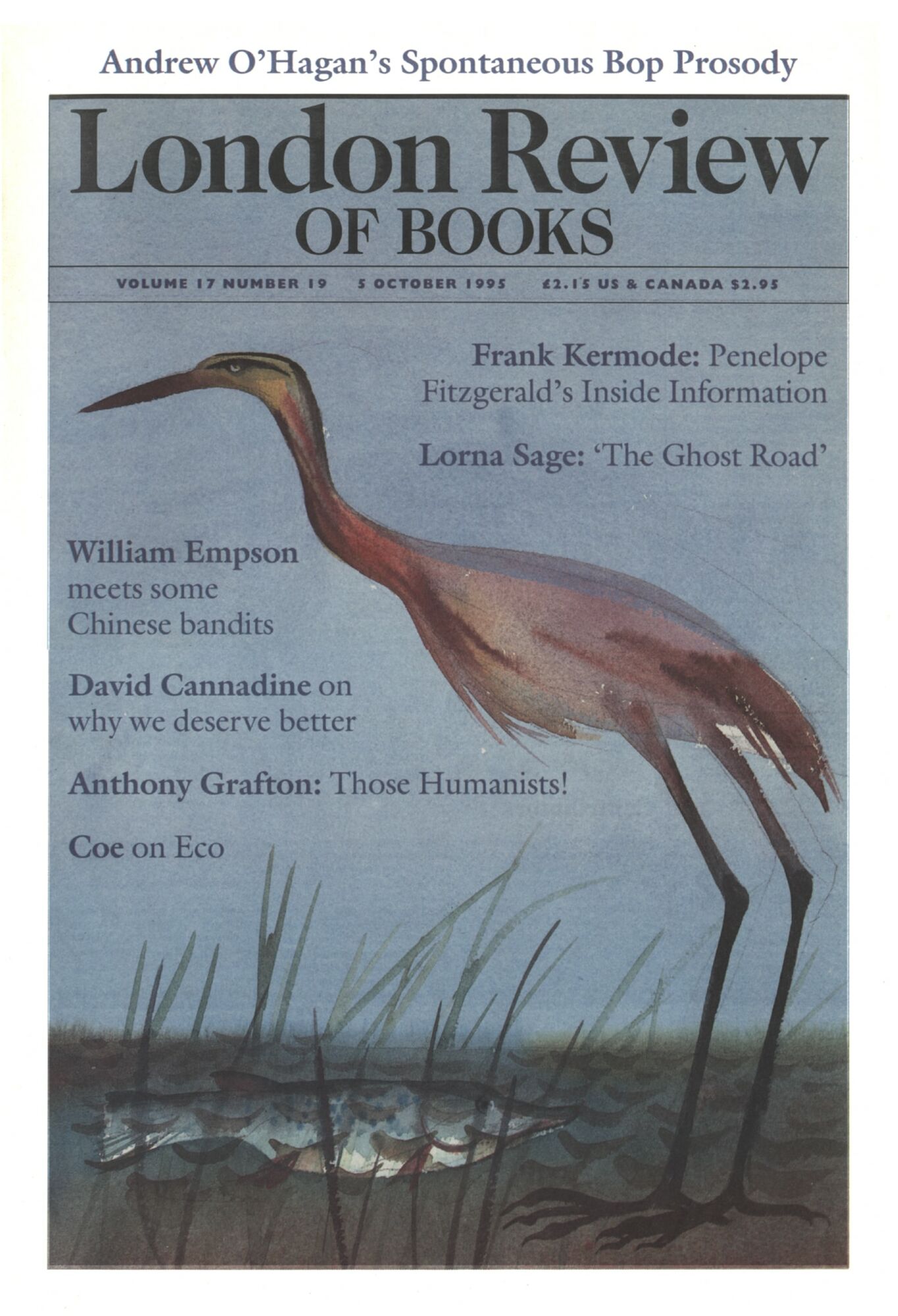
The present novel completes Pat Barker’s First World War trilogy. It ends just before the war itself ends, with the attempted crossing of the Sambre-Oise canal in which Wilfred Owen was killed. You can read it without having read Regeneration or The Eye in the Door, because these are novels that cover the same ground again, and again, like the battles their characters replay in memory and nightmares. This produces a powerfully ironic sense of imprisonment in the moment. Barker’s strategy is pointedly different from that of most historical novels exploring the processes of change. Sequence and progress and narrative line have largely given way here to a palimpsest history. You cut rapidly from document to dream to memory to dialogue. Historical figures – Owen, Graves, Sassoon, the psychologist Rivers – mingle with invented ones like Prior, the working-class officer who is a kind of exemplary figure, with what one might call a palimpsest personality. The effect is of spread, not sequence. Nonetheless, revisiting the same material from book to book is a compulsive experience. In The Ghost Road the return to the front line gathers intensity from the fact that we’ve been here so often before in Rivers’s patients’ recovered memories of its horrors.
Rivers’s methods as a psychologist, probing the memory, bringing the past back, have an obvious affinity with Barker’s methods as a novelist – which is doubtless why she picked him out for a central role. It’s Rivers who speculates that the reason the war has produced in men the hysterical symptoms thought to belong to women is the enforced passivity of mechanised, trench warfare. Barker also sees Rivers, with his stammer and his own damaged memory, as someone who can turn the doctor-patient hierarchy back on itself, turn the tables. Rivers was himself changed and divided by the ‘neurasthenic’ men he set out to make whole. In this novel, helped out by fever and Spanish flu, he is recovering his own memories of his pre-war expedition to the Solomon Islands – when he realised for a dizzy moment, then promptly forgot, that cultural standards were all relative. He saw Europe and European assumptions from the ‘wrong’ side. In Regeneration he recaptured that insight for the first time – ‘a moment of the most amazing freedom ... we weren’t the measure of all things ... there was no measure.’ And in this novel it’s replayed: ‘the whole frame of social and moral rules that keeps individuals imprisoned – and sane – collapsed, and for a moment he was in the same position as these drifting, dispossessed people. A condition of absolute free fall.’ This is how the palimpsest effect works, recalling and repeating such ‘moments’, bringing far-flung and scattered materials into a level present-tense focus.
In The Ghost Road Barker, a note tells us, is using material from Rivers’s unpublished notebooks on the Solomons – case-histories from the other side of the world. Rivers’s mental homelessness is, it turns out, what makes him such a good therapist – ‘his power over people, the power to heal, if you like, springs directly from some wound or deformity in him.’ These words come from an invented document – Billy Prior’s journal of his return to the Front – which is intercut and juxtaposed with the accounts of the doomed Solomon Islanders. Fact and fiction collude with one another. Prior, indeed, has now openly become what he quietly was all along, the author’s surrogate. Sassoon, Graves, Owen, can’t say for her what she wants, by definition, since what she wants is the point of view of those whose words didn’t get into print. Prior is on both sides of nearly everything: working-class but an officer, bisexual, and sick-but-well, since living such divisions is the most honest option. Wilfred Owen is glimpsed out of the corner of Prior’s eye. Sassoon and Graves, who can live to tell the tale, have been left behind. Solomon Islanders and unhistoric soldiers acquire a borrowed reality by existing in the same plane of vision as those ‘real’ people. Barker has often written, and does again here, about class conflict. But it’s her assault on the class distinction between real and unreal that’s most striking and disconcerting. Superficially, the effect is ‘realistic’. Actually, though, there’s a more insidious suggestion of creeping unreality which is almost gothic, certainly uncanny. Prior is distrusted by both his brother officers and his old radical friends, one of whom, in The Eye in the Door, accuses him (probably rightly, we never quite know) of betraying him to the authorities: ‘It strikes me you’d be a bloody good recruit, for them ... Officers’ mess one night, back streets of Salford the next. Equally at home or ... equally not at home, in both.’ Prior is a kind of class-traitor, but he’s also from another angle, in his element, a native of no man’s land:
One of the ways in which he felt different from his brother officers, one of the many, was that their England was a pastoral place: fields, streams, wooded valleys ... They couldn’t grasp that for him, and for the vast majority of the men, the Front, with its mechanisation, its reduction of the individual to a cog in the machine, its blasted landscape, was not a contrast with the life they’d known at home in Birmingham or Manchester ... but a nightmarish culmination. Equally at home in either.
Prior’s ability to step outside himself this way sometimes slips over into full-blown alienation, Jekyll-and-Hyde style. But that doubleness is not Barker’s point. It wasn’t really Robert Louis Stevenson’s either, perhaps – for poor old Jekyll speculates that the real horror he’s discovered is not that he is two, but that he is legion, many, the anonymous masses are living inside him. Ugh! This is what Barker wants Prior to be, the one and the many.
In other words, she makes use of his equivocal status – a fictional character rubbing shoulders with real, historical people – to rub in a bitter message about the invisibility of most people’s lives and deaths. Rivers’s Solomon Islanders were perfectly real, but nothing more is known of them than what he chose to record (and never got around to publishing). His Melanesian opposite number, the witch doctor and shaman Njiru, who foresees the death of his beliefs, tells Rivers his secrets so that they can be carried off in words, and survive. The first-person written account that Prior is given in The Ghost Road had to be invented, because none of the natives of no man’s land wrote about it in this spirit. Prior is her go-between, bridging fiction and non-fiction, the individual and the masses, the living and the dead. Like Jekyll he secretes multitudes, he is forever decomposing as a character, and that is why he is at the last only ‘at home’ at the Front.
Another officer, Manning, describes him as ‘neither fish nor fowl nor good red herring. Socially. Sexually too.’ Manning should know – he is one of Prior’s pick-ups, a middle-class paterfamilias who just happens to have this masochistic thing about working-class men on the side. Prior lives with many more of his selves than men such as Manning can manage, and this means (again echoes of Stevenson) that he presages the death of a certain kind of solid individual. Not that he writes in a stream of consciousness, or psychobabble, or anything like that; his manner is rather stoic and ‘factual’. But we’re meant, I think, to understand that this sanity in the midst of the war’s insanity is a sign of Prior’s disintegration. He has left behind him the other story that might have put him back together: his love for Sarah, the prospect of children. Instead in this novel his sexual encounters – just as graphically and exactly and lovingly described as those with Sarah – are casual and anonymous. There’s an odd and telling thread of sexual imagery that captures the effect. Sarah’s mother in a fit of folk wisdom early on warned her that she should be harder to get, because promiscuity in women disgusts men. ‘No man likes to think he’s sliding in on another’s leavings.’ But this, it turns out, is just what Prior does like to think. In Scarborough, waiting to embark, he goes home with a prostitute, and finds himself lying in a wet patch on the bed:
Dotted here and there on the sheet were tiny coils of pubic hair. He wondered whose spunk he was lying in, whether he knew him, how carefully she’d washed afterwards. He groped in his mind for the appropriate feeling of disgust, and found excitement instead, no, more than that, the sober certainty of power.
All the men who’d passed through, passed through Scarborough, through her, on their way to the Front ... And how many of them dead?
This gives an additional frisson of suggestion to the title. The ghost road of wartime sex doesn’t – as Prior’s relation with Sarah might have done, in another world – enhance and fix your sense of who you are. Instead it is yet another route to dissolution. Later on Prior sodomises an available youth in recaptured territory, and savours the sense that German soldiers have been there before.
Prior’s bisexuality is, he’s come to realise, his family heritage, the result in part of his identification with his mother’s ambitions for him, and his rejection of his violent father. His father lives on in him, too, though, and it’s tempting to imagine that somehow he has reconciled them in himself. But that is not what Barker thinks happens.
Obviously his present attempt to understand his parents’ marriage was more mature, more adult, more perceptive ... it was also a lie: a way of claiming to be ‘above the cattle’. And he was not above it, he was its product. He and She – elemental forces, almost devoid of personal characteristics – clawed each other in every cell of his body, and would do so until he died.
Putting yourself together (‘more mature, more adult’) is in this context a kind of offence against the others. Rivers’s doubts about his own work in ‘curing’ neurasthenic casualties of the war run along the same lines. In persuading the mute to speak he’s really silencing their protests. This seems to connect, for Barker, with the need to invent the disintegrated character of Prior: to have a figure who speaks in fiction, but didn’t in fact, the kind of character born of the war, and largely lost and denied at its end. Speaking through Prior you call up ghosts, rather than exorcising them as psychiatry tried to do.
Death isn’t final in the way it’s usually made out to be. The novels dwell in memorably terrible detail on bodily mutilation (there’s a chilling continuity between the tone in which sexual encounters are described, and that employed for bodies blown apart). In one flashback there’s a bizarre and telling scene in which soldiers inured to death, and to the company of the dead, find themselves in a churchyard that’s been shelled, so that bodies in the vaults are exposed. They find these bodies eerily fascinating – ‘as if these people were really dead, and the corpses by the road weren’t. Any more than we were really alive.’ Those reborn in the war feel, it’s suggested, unable ever to return home – whether because they expect to be killed in the next battle, or because to go back will mean erasing what they knew. ‘We’ve all been home on leave and found home so foreign that we couldn’t fit in.’ The last and most strange permutation of Prior as fiction is Prior as ghost, the voice of the dead. The Solomon Islanders, Rivers recalls, were familiar with ghosts, they thought of the moribund as already dead, and of the dead as still in some ways living – and this is very much the territory this concluding book of the trilogy covers, eroding the boundary between death and life.
Indeed there’s a real haunting to prove it. You realise how very misleading Barker’s documentary strategy can be. She looks as though she’s modestly immersing herself in the sources, whereas actually she is using them as a point of departure, to mark the boundaries she’ll transgress. Though she hides her own narrative voice, the use of echoes and repetitions is ruthless and savagely consistent. She is one of fiction’s most dedicated levellers – not the one but the many, and the many in one. (This is why – though you can indeed read each novel separately – you need all three to get the full effect.) There is a kind of horror or obscenity lurking in the way she breeds facts with fictions, rather like the scene in The Ghost Road where Prior, watching his men undress to bathe, is reminded of one of his favourite fantasies, ‘being fully dressed with a naked lover’: ‘what I feel (apart from the obvious) is a great tenderness – the sort of tenderness that depends on being more powerful, and that is really, I suppose, just the acceptable face of sadism.’ Barker suggests that what makes Rivers a healer is his own deformity; his Solomon Islands opposite number actually has a hump. Prior is qualified for his role precisely by his lack of moral coherence. He’s a way of displacing the power of hindsight, and the authorial power of the overview – a way of dissolving the one of the writer into the many of the written-about, in the end. But it’s nothing to do with passivity, or reverence for the traditional real.
Send Letters To:
The Editor
London Review of Books,
28 Little Russell Street
London, WC1A 2HN
letters@lrb.co.uk
Please include name, address, and a telephone number.
