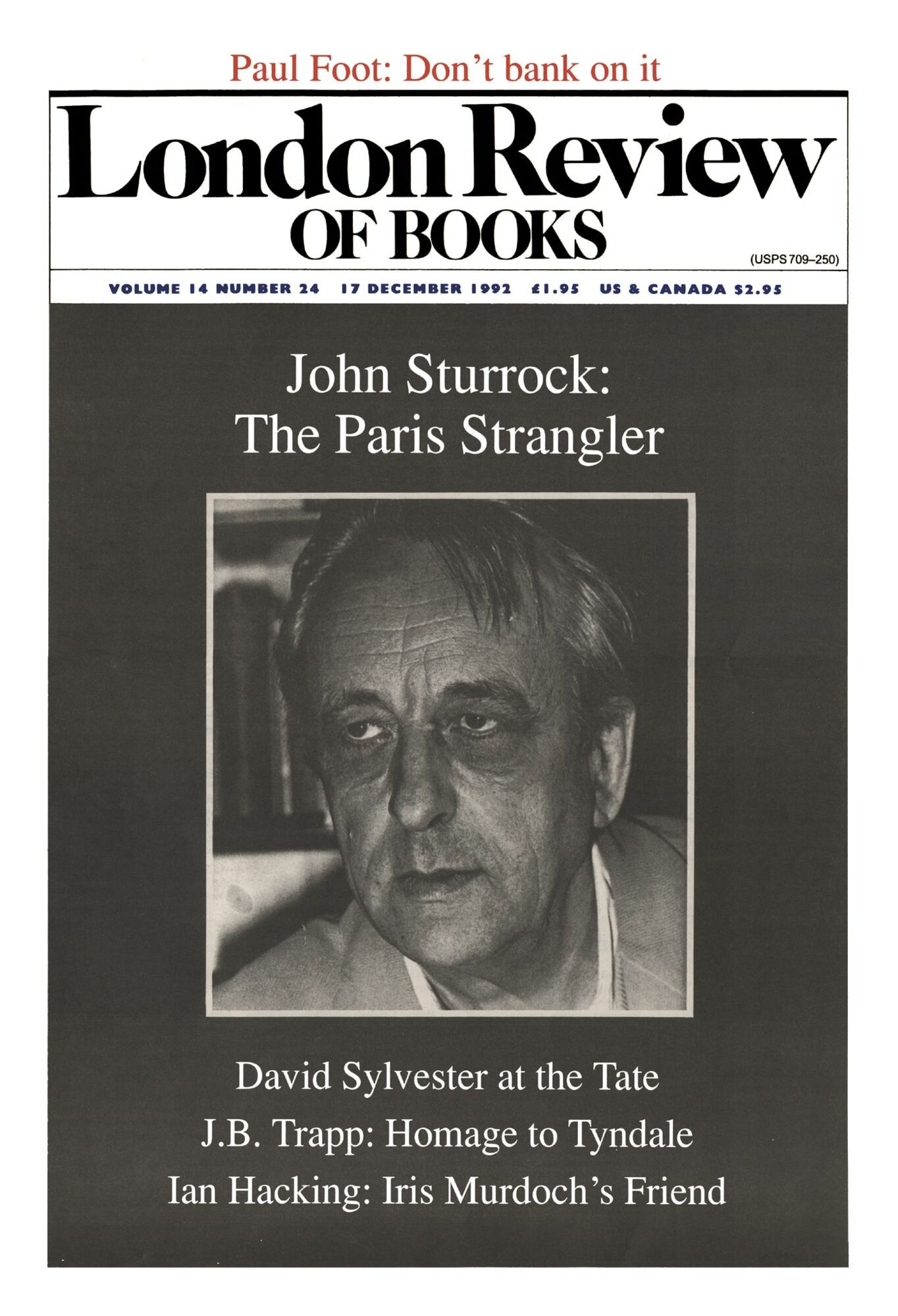
The historian of madness Michel Foucault found and published in 1974 an upbeat first-person account of his crime written by a 19th-century French murderer: Moi Pierre Rivière ayant égorgé ma mère, ma soeur et monfrère ..., a statement precious, in Foucauldian terms, as a rare public instance of the normally suppressed discourse of madness. Now, from the man who coached Foucault in philosophy, we have another bold and engrossing first-person work which could have borne the title ‘Moi Louis Althusser ayant étranglé ma femme ... ’, for L’Avenir dure longtemps is the garlanded Marxist philosopher’s long essay in explanation of how he came to strangle his wife late in 1980. Pierre Rivière’s was the extrovert testimony of a rube, a deranged Norman farmboy and literary simpleton: Althusser’s is infinitely more adroit, the manipulative product of a theoretical intelligence turned lovingly in on itself, and a pre-emptive exercise in the discourse more on than of madness.
Pierre Rivière wrote his apologia on the orders of the judge at his trial, though boasting that he had meant to write one before carrying out his murders, so as to secure for himself a double glory, as author first of a swingeing crime and then of a memorable item of literature. This double glory is now Althusser’s and there are signs in L’Avenir dure longtemps that he is chronically uneasy about the ambiguity of his intentions, since to confess in style like this is also to add to his celebrity, as a uniquely perceptive and articulate felon. But Althusser is at pains to reassure us that what he is making is no more than the statement in his own defence which he wasn’t allowed to make at the time, because no charge was laid against him Instead, he was discreetly diagnosed as being in too chaotic a mental state to answer for his act, and consigned to what he calls the ‘tombstone of silence’, of psychiatric restraint. Coming from a man who, unlike his irrevocably muted victim, is now free to break his silence, this metaphorical ‘tombstone’ is hard to take.
Althusser is determined to be known to have suffered, in this as in other ways. His time under the tombstone most would see as a merciful imposition, compared with the much more severe things that might have happened to him, but for Althusser it is cause for prolonged complaint, against the legal and medical rules that stop an accused person from speaking out in the event of a non-suit. He has suffered from having others speak out in his place, and so trespass on the autonomy he takes to be his right. L’Avenir dure longtemps was written in 1985, five years after the ‘drama’, and that he should have been made to wait is his founding grievance in an impenitently complaining book.
Althusser’s is autobiography as hard-luck story. It expresses no simple guilt or regret for what he did, it comes to no unequivocal conclusion about why he did it. Rather, it ushers the murdered Hélène away towards the margin of his life and enables Althusser himself to usurp her place as a victim. La vedette, c’est le coupable was an angry comment made by Claude Sarraute in Le Monde about the original reporting of the affair in France, the guilty man is the star. Then, this was the fault not of Althusser but of his fame: but the guilty man who later turns autobiographer is bound to be the star of his own story and to compel everyone else who appears in it to serve his own rhetorical ends.
Althusser’s most blatant end is the exculpation of himself. As an autobiographical event, the strangling of Hélène Rytmann is a pure contingency, for which motives may be and are found but no one sovereign motive that might resolve and classify the crime as the understandable dénouement of a long and tortured relationship. Between motives and act Althusser preserves that enigmatic gap beloved of the Existentialists of old, so that the murder survives the book more or less intact as an opaque act of will. Opaque, and utterly out of character insofar as willing never came easily to this massively self-doubting man. The great revelation for most of us reading L’Avenir dure longtemps, and the first volume of Yann Moulier Boutang’s accompanying biography, must be the depth and regularity of the mental crises from which Althusser suffered all through his adult life. In 1980 I fancy that this was hardly if at all known, so that his rapid post hoc disappearance into care instead of prison made it look likely that a special and objectionable leniency had been shown because of this murderer’s high intellectual prestige.
That we now know was unfair. Althusser had in fact endured up to 1980 a bleak thirty-year history of invincible manic depression, to an extent which makes it remarkable that he should have had a public life at all. Boutang calculates that he had to be taken into a hospital on an average of once every three years and that he was ‘immobilised’ by depression for perhaps half his working time. He was treated by ECT and by drugs, and was permanently in psychoanalysis. At one time, early in their life together, it was only Hélène’s blind hatred for institutions, according to Althusser, which saved him from being kept in hospital for good.
He has a partly orthodox, partly Althusserian explanation for his incurably fragile state. The family was to blame, his own family first of all and then the nuclear family as such, a form of social organisation demonised by him as ‘the terrible, the frightful, the most dreadful of all the ideological apparatuses of the state’. When, at the Communist millennium, the state finally withers away, the family will wither with it, and amity will prevail domestically as well as politically. Althusser has so arranged matters in L’Avenir dure longtemps as to make his desperately utopian politics appear to follow from his own miserable experiences as an unloved child and insecure man. His mother and father come badly out of the book, they have let him down (as well as his sister, another sufferer). Set against them, however, are his maternal grandparents, who come out of it a little too well. The parents were townspeople, the father a bank manager whose work took him from Algiers to Marseille to Lyon; the grandparents, on the other hand, were out-and-out country people, with a family name to prove it: Berger. Grandfather Berger was a forester who retired to a village in the Morvan and there inducted the boy Althusser into a savingly physical, anachronistic way of life quite contrary to the life he led in the dystopia of his urban home.
This stark pitting of the generations one against the other surely owes more to Hegel than it does to the reality; the dialectic has here entered into the fabric of Althusser’s family. He claims, and how typically, never to have read a word either by or about Freud, but to be writing without benefit of theory out of his own experience. His Freudianism shows, however, in the determination with which he recreates his childhood to his own best advantage. He casts himself in the pathetic role of a vicarious being, a boy robbed from birth of any sense of his own existence – there are uncomfortable echoes in this of Sartre’s family romance as told in Les Mots. Sartre found the cure for the inauthenticity settled on him by his hateful bourgeois family in a furious identification with the proletariat: Althusser, too, became adoring of a proletariat of which he knew just as little as Sartre, but in his case to no avail, his sense of alienation wouldn’t go away.
There was a peculiar reason why he should have felt it so. When he was born (in 1918) he was given the name of an idealised uncle Louis, to whom his mother had been engaged but who had been killed at Verdun before they could marry. The mother had instead married Louis’s older brother, Georges. Althusser requires this to have been a joyless, a ‘horrible’ marriage, and his prudish, timid mother to have become a ‘martyr’ to a boorishly sensual, unfatherly father. Little Louis, literally nominated to take the place of the dead uncle, is launched on a profound mission of oblation: he will be the one to ‘save’ his mother, as later he was to ‘save’ the martyred Hélène. And to save his mother he must ‘seduce’ her, be for her what the other Louis Althusser was to have been. He has been ‘reduced in order to exist to making myself loved, and, in order to love (because loving governs being loved) reduced ... to artifices of seduction and imposture’. Both in private and in his academic profession, Althusser has fulfilled the appointed role of ‘impostor’, outwardly plausible and a high achiever, yet secretly void. The Marxist philosopher who knows that he has been listened to by his students and readers and has followers both in France and internationally, will show in his autobiography that all this attention and influence were based on a misapprehension, that he is not at all the man he has been thought to be.
We can take it that Althusser’s family life was not as he presents it. Boutang surely has it right, in the grindingly slow but sensible first volume of his biography, when he says that ‘the suspicion occurs that a happy, too ordinary childhood has been transmuted into a mythic catastrophe.’ But Althusser himself invites correction by the incoherence of what he asserts in L’Avenir dure longtemps, a self-deconstructing text if ever there was one, in which the major premise that his parents failed him is belied by his admissions of his father’s humour and intelligence, and of his mother’s concerned affection for himself. Nor do Althusser’s attempts to make us believe that as a philosopher he was a fraud, having read far too little of Marx to be entitled to have theories about him, carry more conviction. They will be taken at face value only by those keen for whatever reason to see this acclaimed left-wing theorist unmasked or diminished and who are willing to misread what he writes as a compulsive disclosure of the truth about himself rather than the devious pleading of someone set on courting sympathy by the magnification of his failings. Such ill-wishers would do well to attend to what Althusser has to say about Machiavelli, the strategic genius who allegedly made Freud redundant centuries before he was born and from whom Althusser has learnt that artifice and imposture are the standard means by which we handle other people and not such a gloomy inheritance after all. Machiavelli is the political thinker whom the autobiographical Althusser esteems the most, above Marx even, and for strikingly personal reasons. It is because Machiavelli’s thought is the most purely abstract of all, a salutary theory visited on an abject world from outside as it were, or from that immaculate vantagepoint which Althusser has himself been in lifelong search of.
L’Avenir dure longtemps was apparently written in a very few weeks, but it contains more evidence of a Machiavellian savoir-écrire than it does of haste. A less calculating autobiographer might have hung back, for example, from placing a description of the murder itself at the head of the book, or even from giving one at all. Althusser doesn’t hang back: he starts with it, describing not the act of strangulation, of which he has no memory, but his coming to consciousness early on a November morning with his thumbs massaging the hollows in his wife’s neck, and with aching muscles in his forearms. There is something of the anatomy lesson in his punctilious setting of the scene, and something as well of the playwright anxious for the most telling disposition of his props:
I am suddenly standing, in a dressing-gown, at the foot of my bed in my apartment in the Ecole Normale. The light of a grey November day – it was Sunday the 16th, around nine in the morning – came from the left, from the very tall window, framed for a very long time past by some very old red Empire curtains tattered with age and scorched by the sun, to light the foot of my bed.
In front of me: Hélène, lying on her back, also in a dressing-gown.
Her pelvis is resting on the edge of the bed, her legs splayed on the moquette on the floor.
The clarity of this, immediately following on the unconsciousness of the crime, is unnerving, as if Althusser were here enacting the too familiar swing from depression into mania. But the lurid discovery of the body, once briefly invoked, is left in suspense as he turns back to narrate and comment on the pitiful story of his life.
The Ecole Normale is an anomalous, a crime-writer’s setting for a murder, a cerebral and ascetic place unfitted for such morbid spontaneities of the flesh. It was where Althusser worked, where he had long lived and, most important, the one place in the world where he belonged: ‘a true maternal “cocoon”, the place where I was in the warm and at home, protected against the outside, which I had no need to leave to meet people, because they came past or called in, especially when I became well-known, in short it, too, the substitute for a maternal environment, for the amniotic fluid.’ He had passed sixth into the School, the hardest to get into of all in France, in 1939, but became a student there only at the end of the war, at the late age of 27. He never had to leave it, because after having achieved a brilliant agrégation he stayed on as the caïman or tutor in philosophy. He taught in the rue d’Ulm, very conscientiously by all accounts, and he lived there, at first alone, eventually with a companion more than somewhat unsuited by her stormy and abrasive nature to share its uterine comforts with him.
Althusser met Hélène Rytmann when he was still a student, at a loss in post-war Paris, shy, friendless and hypochondriacal. He was sexually retarded, by his mother’s fault he insists, the script he had been given by her asking that he permanently represent the ‘wisdom, purity, virtue, pure intellect, disincarnation, academic success’ which Uncle Louis had had so little chance to display. His purity was extreme: Althusser only masturbated for the first time in his mid-twenties, and swooned at the experience, whether from delight or from shame he doesn’t say. Hélène was the first sexual partner he had had, at 29, but afterwards, or alternating with Hélène, there were by the sound of it many others, some serious, some transient, drawn not least by his philosophical fame. She was ten years older than Althusser and much that he was not: unhappy like him, un peu folle, but also brash, and experienced. He tells a terrible story of how, as a young girl, she had been raped by the doctor treating her parents and then forced, when they were dying of cancer, to give them lethal injections, one after the other – a story that I think we have to list among the hallucinations, the ‘imaginary memories’ in his own term, which he admits he has incorporated into the text of his ‘traumabiography’.
Before the war Hélène had been a militant on the far left, impatient of all political organisations but seized by ‘a true passion, total, demanding’ for the working class. During the war she had been with the Resistance in Lyon and had met some of the great names of the literary Left at that time, Camus, the poet Paul Eluard, and the creepy ménage of Aragon and Elsa Triolet. (One story, retailed by Althusser and disbelieved by Boutang, was that the Aragons broke with Hélène after she agreed to smuggle some silk stockings for Elsa from Switzerland and brought the wrong shade.) She had in short received what in Pour Marx Althusser called ‘the terrible education by facts’, even if the facts of her past as he gives them here are by no means certain. Althusser’s own past had been much less exposed or exciting. He, too, had been political before the war but, after a short-lived flirtation with the royalists in Lyon where he was then at school, in the genteel youth movements of the Catholic Left; the war years, after the surrender, he had spent as a prisoner in Northern Germany, safe, frankly grateful to be so, and highly receptive to the regime of manual work he was obliged to follow there and to the monkish fraternity of the camp. Liberation indeed cast him adrift, until Hélène Rytmann came to be his belated opening onto the world.
The received wisdom is that she was a disturbed and unpleasant woman who did Althusser nothing but harm; and, among the heartless, that he took his time over murdering her. He has both good things and bad to say about her in L’Avenir dure longtemps, but the bad are frankly easier to credit than the good, they being what was said of her by others rather than what is now being said by him. Her reputation was of a mégère, or fury, a reputation borne out more than once by the anecdotes he includes of her rages and caprices when she was with him. But she raged, he explains, because she was terrified of not being loved, and at times could be both paranoid and suicidal, so that one reason he floats for his having killed her is that she wanted him to do so, his last oblatory act having been to end her martyrdom for her. When he defends her, Althusser goes instantly too far, presenting her as the most magnanimously loving of women, and gifted, though she wrote almost nothing, with a verbal inventiveness greater than that of James Joyce. This is to demean by overstatement, as John Stuart Mill famously demeaned Harriet Taylor in his Autobiography by his reckless eulogising of her.
Hélène was also accused by those who had known the pre-war Althusser as a decorous lycéen and good Catholic of having turned him after 1946 into an adamantine Stalinist. But Althusser was incapable of being an adamantine anything, and proves a closet softy even in his Marxism. He denies in L’Avenir dure longtemps that it was Hélène who brought him to Marxism. It is true that he joined the Party in 1948, some two years after taking up with her, but that can be convincingly seen as the logical end-point of his leftwards evolution through the late Thirties and of his experiences in the POW camp – a process exhaustively traced by Boutang. Nor did he give up being a Catholic when he joined the PCF; he remained in the Church until 1952, even past the time when all Catholics who were also Party members were excommunicated by the Vatican.
Ironically, it is unclear whether Hélène herself was ever a Party member. She claimed to have been, but the Party denied it and refused after the war to have her. It went further: it told its promising new member, Louis Althusser, that she was no reliable companion for him and that he should leave her – there were stories that she had worked for British Intelligence or even collaborated during the war. Althusser wouldn’t give her up because he couldn’t; he maintained the liaison, though without publicising it. Such muffled disobedience was typical of the 32 years he spent as an internal dissident in the Party. He didn’t like its leaders or its cynical policies, and he knew it was corrupt; but he stayed on, through all the thousand shocks that Communism was heir to in those years, the Rajk and Slansky trials, Budapest, Prague, which drove so many other thoughtful members out. Althusser, however, continued to believe in the PCF as the one means of ‘acting politically – that is, in actuality – on the course of history’. ‘Today,’ he adds (writing in 1985), ‘things have changed very obviously.’
The Party served Althusser as the POW camp and the Ecole Normale served him. All three sustained him by conferring a soothing measure of anonymity on his activities as an individualist who was forever fearful of the price an individualist may end up paying in terms of social or intellectual isolation. All three were surrogate homes for one of nature’s asylum-seekers. To be in but not fully of an institution was always Althusser’s need. As a wartime prisoner ashamed at his own weakness in finding satisfaction in captivity, he fantasised a mode of ‘escape’ from the camp which involved not actually leaving it, but hiding for several weeks within the perimeter, until the guards called off the hunt. But that was only to defer the risk of escaping, not to avoid it, and Althusser knew that his scheme was no more than an idle scheme. He didn’t have the courage to escape.
The word ‘courage’ leads, by a suggestive Lacanian glissade, to the name of the man whom Althusser extols as the person most responsible for his political conversion, his fellow-prisoner, Pierre Courrèges. Courrèges was a pre-war Communist whose impact on the camp when he arrived there was that of a thaumaturge: ‘Without a mandate from anyone, simply in his own name and in the name of honesty and fraternity, Courrèges took a hand and the effect was incredible. He was simple, direct, warm, natural, acting and speaking apparently without effort. His mere presence transformed the camp.’ In this one grand, alchemical moment there is to be found concentrated all of the nebulous millenarianism of Althusser’s political project; it prefigures his own conversion from Catholicism to Marxism. The impossible Courrèges is at once lone saviour and collective promise, the omega point where a Christian humanism and the Communist revolution converge. It’s said that Althusser received Communion before he died in 1990, and no one will be surprised by that who has read his autobiography.
By the end of L’Avenir dure longtemps, he may be outside the Party, but he still has the faith, and the perverse hope of a distraught individualist that mass action by those of goodwill – the German Greens, liberation theologians – may yet save the world. The ‘one possible definition of Communism’ to which he clings ‘is the absence of market relations, thus of relations of class exploitation and domination by the state’. As an abstraction, that might just do, a fantastic but honourable vision. But then the eschatological gives way to the scatological, and Althusser offers a crassly figurative version of this same future. ‘Socialism’ now becomes ‘shit’, or to be exact the ‘immense river of shit’ which society has to cross and which it can only cross once the proletariat is running the state. It is well worth crossing because on the far side ‘is the shore, the wind and sunshine of a young spring. Everyone alights, there is no more struggle between men and interest groups since there are no longer any market relations but a profusion of flowers and fruits that all may pick for their delight.’ What Althusser’s serious adepts may think of this embarrassing passage from capitalism to a pastoral cornutopia I have no idea, but it sheds a weirdly naive posthumous glow over his scholastic Marxological essays of the Sixties.
And just as he has stayed a frantically impractical Communist, so he has also stayed a materialist, though here again Althusser’s materialism is not quite as other materialisms. His materialist is someone who ‘gets on a moving train without knowing where it has come from or where it is going’. Only by apostasy from what he once wrote of as ‘the gods of origins and ends’ can we become true materialists, attending wholly to the present and to what is, rather than to what was or will be. As a theorist of Marx, Althusser took issue with the ‘analytico-teleogical’ method by which the writings of the young Marx have been falsely interpreted as merely a necessary preparation for the writings of the mature Marx, urging on the contrary that Marx be restored to the reality of his life in the body and in historical time, as a creative thinker responsive to the shifts in the champ idéologique in which he found himself and not simply realising some inevitable scheme. Marx’s heroic evolution was out of the mists of ‘ideology’ into the daylight of ‘science’, the same categorical advance that Althusser has wanted to make in L’Avenir dure longtemps in coming to understand his own lived experience. He prizes his version of materialism because to adopt it was, he says, to ‘stop telling myself stories’, to see things as they inescapably were – which is a sad claim to meet with in a work as patently fabulous as this one. By writing an autobiography, however, Althusser hoped finally to find refuge as the aloof theorist of his distressed historical self, as he was before the theorist of the historical Marx, for in the lucidity of the theoretical intelligence there lies, he would say, the one cure for a diseased reality, whether the reality be that of capitalism, the Communist Party or Louis Althusser’s own ruinous past.
Send Letters To:
The Editor
London Review of Books,
28 Little Russell Street
London, WC1A 2HN
letters@lrb.co.uk
Please include name, address, and a telephone number.
