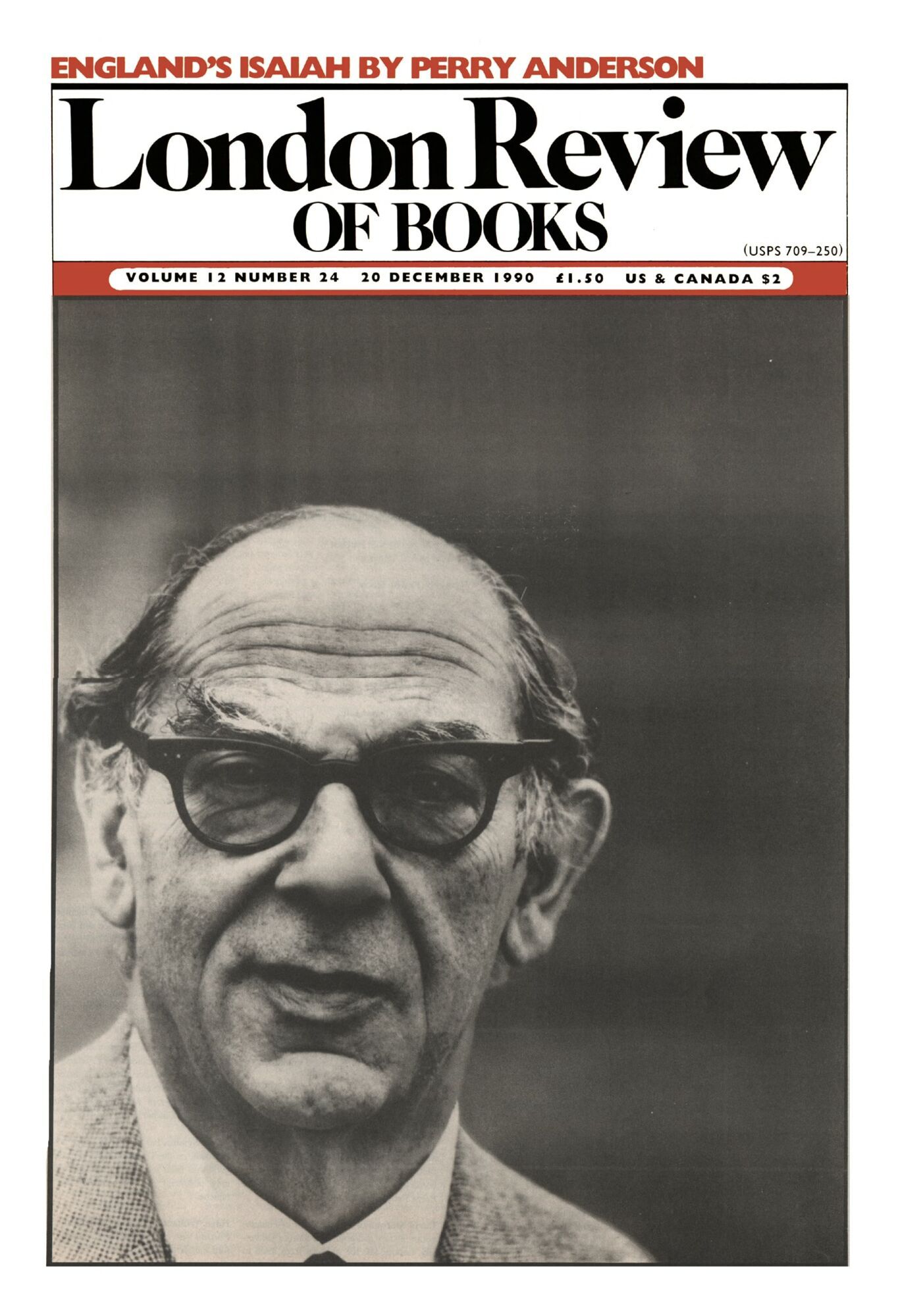
Intellectual hero to Noel Annan, whose political heroine is Margaret Thatcher, should Isaiah Berlin be left to the – ‘unfashionable’ – enthusiasms of Our Age? Or consigned to the plaudits that have broken out for his latest volume from the Spectator to the New Statesman? He himself strikes a more modest note. ‘I talk about other people. I examine their views. But what about me?’ he said recently. His opinions were just local currency. ‘My ideas are very English. I’ve thrown in my lot with England. It’s the best country in the world.’ Such loyal self-deprecation is scarcely less suspect.
The Crooked Timber of Humanity is more an elegant restatement than a substantial addition to his characteristic themes. Three quarters of the book consists of essays from the same fund of texts out of which the four volumes of his Selected Writings were assembled at the end of the Seventies, and their topics for the most part retrace familiar ground – Machiavelli, Vico, Herder, Pluralism, Romanticism, Utopianism. Even the longest piece, on Joseph de Maistre, is the enlargement of a portrait already sketched in an earlier comparison with Tolstoy. In a sense, however, this is the interest of the collection: it serves to bring the unity of Berlin’s thought sharply into focus.
A philosopher by training, his main work has lain in the history of ideas – a field which, he maintains, has traditionally been neglected in England. Between the time of Leslie Stephen and, say, Quentin Skinner, that was certainly true. Even today, this branch of studies has far less elbow-room in English than in American universities. Since the Seventies, however, the situation has been changing, and the rise of a new kind of intellectual history, originated at Cambridge, provides the appropriate background for assessing Berlin’s contribution to the field. No other living practitioner has his European zest and range, encompassing Russian and German, Italian and French, not to speak of Ancient literatures, or his capacity to throw out bold generalisations across them. There are two poles to this imagination. On the one hand, Berlin is fascinated by individual – often idiosyncratic – personalities, men like Belinsky or Moses Hess, whom he has depicted in a series of inimitable cameos. On the other hand, he constructs and pursues very general notions, broad idées maîtresses like monism or positive freedom, through swooping pedigrees down time. Perhaps these were the natural units of attention for an analytic philosopher of strong humanistic bent. The contrast, at any rate, with the practice of current historians is marked.
Berlin believes that the specific arguments of a theorist are less important than their general outlook, and the origins of ideas less interesting than their echoes. As much as statement of a method, this is the expression of a temperament. Its fruit is an approach best suited to unsystematic, intuitive thinkers who do not require, and perhaps resist, close conceptual reconstruction. Berlin’s most memorable essays deal with writers like Sorel or Tolstoy, rather than with the major political philosophers of the modern period. The sympathy they reveal for the informal and undoctrinal is one of the attractive features of his work – but it has its costs. Where there are elements in a particular corpus of ideas which for one reason or another are uncongenial to Berlin, his characteristic procedure can free him from the need to accord them proportionate attention. The risks of selective emphasis exist in even the most systematic of treatments, as the controversies in recent Harrington or Locke scholarship demonstrate. But they are greatly enhanced once specific arguments are discounted for general outlooks, documented origins for presumed effects. Berlin’s accounts of, for example, Tolstoy’s view of history, or Herzen’s brand of politics, or Mill’s conception of value, understate central aspects of each: the simple chauvinism of War and Peace, the mysticism in Anna Karenina, the agrarian socialism of the Bell, the declared utilitarianism of On Liberty. The result is to make each sound somewhat closer to their commentator than it really is. His readings of Vico and Herder, the major subjects of his later work, show the same proprietary impulse. Seeing them essentially as precursors of cultural pluralism, the tradition in which he situates himself, Berlin is disinclined to pay much attention to the themes of mental identity and emergent universality in their respective writings, which point in another direction. Machiavelli plays a rather similar role in Berlin’s vision, becoming the stepping-stone to a tolerant liberalism. In this interpretation, the scandal his work provoked lay not in Machiavelli’s counsels of princely crime, but in his equable observation of contrasting civic and Christian virtues. The only evidence for this claim, abundantly disproved by centuries of polemic, is the autobiographical illumination Berlin reports in these pages – the intellectual discovery he himself made on reading Machiavelli. In such annexations, philosophical advocacy visibly takes precedence over historical balance.
The title of this volume provides a graphic illustration of the point. ‘Out of the crooked timber of humanity no straight thing was ever made’: Immanuel Kant dixit. By dint of repetition – the statement is cited once in Russian Thinkers, twice in Against the Current, three times in Four Essays on Liberty, and twice more in The Crooked Timber itself – Berlin has virtually made of it a saw. Here, we are given to understand, is a signal expression of that rejection of all perfectionist utopias which defines a humane pluralism. But what was the actual force of the text from which the sentence is taken? The ‘Idea for a General History in a Cosmopolitan Perspective’ is a terse, incandescent manifesto for a world order still to be constructed, and a world history yet to be written.
If there is a single prophetic vision of the political agenda now apparently unfolding before us two centuries later, it is this. Fukuyama might have done better to appeal to Kant rather than Hegel. The message of the ‘Idea’ is not the diversity of values, the imperfectibility of institutions or the contingency of history. What Kant celebrates is the driving force of competition – the mutual ‘antagonism’ implanted in the human species by nature, as the motor of social progress. It is the dynamic of the rivalry for honour, riches and power that has generated every step of civilisation. Social advance, Kant argues, has at length reached the point where the task for humanity can be the realisation of a civil society under the rule of law, guaranteeing freedom for all. But this can only be complete when external relations between states obey the same principles of peaceful union as the internal relations between their members. Humanity will have to endure many devastations and upheavals before such a league of peoples comes to pass. But the natural laws which govern the development of our species, engendering a productive common order out of colliding individual wills in the form of a competitive economy which strengthens the state, should in the end also lead to the formation of a world society out of the conflicting states, in which the full potential of the human race would come to fruition.
Meanwhile, the greatest difficulty in achieving civic union within a state derives from the fact that ‘man is an animal that needs a master,’ to ‘break his own will and oblige him to obey a generally valid will whereby each may be free’ – but can only find such a master among other men, who are also animals that need to be mastered in their turn. It is this problem, of the unruliness of the ruler, that occasions the comment Berlin has taken for his motto. Kant, however, is referring not to humanity as a whole, as unfittable into any symmetrical scheme, but to the fallibility of any individual as sovereign. ‘The highest magistrate should be just in himself and yet be a man.’ It is this task, as Kant puts it, that is beyond fulfilment. He makes the distinction immediately clear, in a way that brings home sharply the distance between Kant’s argument and Berlin’s inference. The inhabitants of other planets may be able to perfect themselves in their individual lives: ‘with us it is otherwise; only the species can hope for this’ – ‘but if we accomplish nature’s mission well, we can certainly flatter ourselves that we may occupy no mean rank among our neighbours in the cosmic order.’
In other words, the collective destiny of humanity, working through the deficiencies of its individual members, reveals what Kant calls ‘the hidden plan of nature to bring into existence an internally and externally perfected political constitution.’ The naturalism and finalism of this vision are at the antipodes of Berlin’s outlook. So far from Kant insisting on the irremediable crookedness of humanity in general, he uses the self-same term – krumm – to describe the kind of timber humanity need not become in a well-ordered civic union, where something straight – gerade – is just what can indeed be made. ‘Only in such an enclosure as civil unification offers can our inclinations achieve their best effects; as trees in a wood which seek to deprive each other of air and sunlight are forced to strive upwards and so achieve a beautiful straight growth; while those that spread their branches at will in isolated freedom grow stunted, tilted and crooked.’ The imagery of the bent and the straight, in other words, tells the opposite story from its proverbialisation.
However often invoked, only a catchword is at stake here. But it pinpoints a procedure whose dangers become more acute in the vast genealogies of leading ideas that make up the other side of Berlin’s oeuvre. The famous contrast between positive and negative freedom in Four Essays on Liberty derives, of course, above all from Benjamin Constant’s lecture under the Restoration comparing Ancient and Modern Liberty. But where Constant sought to ground the difference between the two in a comparative sociology of the Classical and contemporary worlds, Berlin treats them largely as normative conceptions floating free from determinate social contexts. Constant’s portrait of Greek democracy as a society of martial conformists, contrasting with the peaceful and commercial individualists of modern liberty, is one-sided and polemical: ignoring the extent to which it included ideals of diversity within the community – ‘liberty in’, rather than either ‘from’ or ‘to’, in Pocock’s phrase. But it is more worked through than Berlin’s chain of associations, which links the most disparate figures – Locke momentarily cheek by jowl with Fichte, Burke arm in arm with Robespierre – into rapidly constructed alignments for the purposes of contrasting his two concepts, in which paradoxically even Constant himself, who in his fashion hoped to combine them, is scarcely done justice. The textual basis of the enterprise is very scanty: citations of a sentence or two from most of the roll-call and stylised utterances in an anonymous first person illustrate the argument. The risks of mistreating individual thinkers with this method are obvious, even if substantiation of each case might in principle still be possible in some larger compass. But it is the general upshot of the procedure that is often most disconcerting. In Berlin’s conjuring of ideas, they appear at times to lose any specific gravity as they hurtle towards the most unexpected and perverse destinations, or shuttle back again with scarcely less ease. Kant’s ‘severe individualism’ issues into virtually ‘pure totalitarian doctrine’, and the combined efforts of – at one time or another – Locke, Spinoza, Montesquieu, Rousseau, Fichte, Hegel, Comte, Marx, Green, Bradley and Bosanquet pave the way for the ‘great, disciplined, authoritarian structures’ in which positive freedom eventually came to be pursued. The evidence for these connections is essentially circular: modern despotism proves the dangers of the ideal of positive liberty, so that ideal must have contributed to the rise of despotism.
However captious this claim may be in the case of particular thinkers – or exaggerated in the general importance it confers on philosophy in history – it is straightforward. The trajectory it postulates has one direction, pointing downwards. In The Crooked Timber of Humanity still larger claims of historical consequence are tacitly entered for the ideals of romanticism, which is credited with ‘breaking the foundation-stone’ of millenial belief in one objective truth by which men should live, and thereby ‘creating the modern outlook’ – that is, the acceptance of a pluralism of values. For Berlin this represents the crucial emancipation from the past, permitting the ultimate advent of a liberal society. But although this romanticism born in Germany liberated Europe by proclaiming the free creation of values, its cult of subjective will later fostered autocrats bent on suppressing liberty when its aesthetic ideals were transferred to politics under Napoleon, reinterpreted by Hegel and Marx, and eventually instigated the furies of fascism and communism. But the unconquerable spirit of resistance to totalitarianism has also been inspired by ‘this same untamed German spirit’, the ‘conception of man inherited from the romantic movement’. It is not uncommon to believe in the power of ideas as prime causes of political change; what is striking here is their alarming volatility – the same doctrines exercising diametrically opposite effects in sequence, or even concurrently. On occasion, Berlin speaks of the kind of connections he draws between concepts and consequences as not logical, but historical and psychological. The evidence for these, however, is missing, and in its absence, any number of speculative moves become possible. In an earlier text, the sources of totalitarianism are found not in the ideals of positive liberty or the values of romanticism, but in the arrival of sociologies of knowledge, undercutting faith in the possibility of rational argument. The compatibility of the culprits is not pursued.
Talking about the ideas of other people, then, Berlin can be a wayward raconteur. What of his own – are they really English commonplaces? There is a clear sense in which the avowal of adoptive identity is relevant and valid. Politically, Berlin has in many ways been a liberal of a specifically English stamp – socially humane, empirical, sceptical. If we-compare him with the two other great liberal thinkers of émigré background who left their mark on this country in the period of the Cold War, Hayek and Popper, these traits stand out. The Austrian duo have their own important differences, as Ralf Dahrendorf has recently suggested. But the common features are plain. The specialised work of each, in the fields of economics and philosophy of science, has been radically original and systematic in a way Berlin’s contribution to the history of ideas is not. Their ideological record, on the other hand, has been marked by a stridency and imbalance foreign to Berlin. Unlike Hayek, he never saw Attlee as involuntary cousin to Goering, or felt, like Popper, soiled at the mental touch of Hegel. Mill, object of lurking suspicion or overt rebuke for them, receives his unqualified admiration. Equality was an ideal for him, as well as liberty, and might on occasion take precedence over it – for example, by the abolition of private education, anathema to such as Hayek. Berlin’s oblique description of himself as a man of the moderate Left is ratified by the sniping he has drawn from the radical Right.
Differing backgrounds in East and Central Europe may have had something to do with this. The Habsburg Empire, autocratic though it in many ways remained to the end, was not a repressive despotism: legal procedures, civic liberties, freedom of the press and political organisation, if not effective assemblies or responsible government, existed. After the Metternich epoch, opposition was rarely driven to revolutionary responses. On the other hand, politics in the later Empire were always more national or social than constitutional, and when it fell, the Austrian Republic divided between the Catholic and socialist traditions that dominate the country to the present. Paradoxically, the society which has produced the most powerful school of modern theoretical liberalism has less tradition of Liberal politics than virtually any other democracy in Europe. Even today, the principal alternative to the Grand Coalition in Vienna is a party rooted in Germanic nationalism (some would argue, national-socialism), rather than liberalism. Behind Popper or Hayek is a background gone dully, or eerily, blank.
The Tsarist Empire, by contrast, remained an unregenerate absolutism throughout the 19th century, a police regime that suffocated any space for legal opposition, engendering a revolutionary tradition like none other on the Continent: one that extended from its original centre in the intelligentsia to the working class and the peasantry, and in the end even affected – what is often forgotten – significant sections of the liberal bourgeoisie. After two great upheavals against the Ancien Régime, bureaucratic dictatorship followed in the 20th century, plunging the best of the Russian intelligentsia, after the briefest of intervals, back into persecution and moral opposition. The continuity of this background sets off Berlin’s liberalism from the Viennese variants. Democracy installed, Hayek could brood on its dangers. Corporatism, eroding the freedom of the market, and flourishing (so it happened) as nowhere else in post-war Austria, became the main enemy. Tyranny renewed, Berlin’s concern was for political and intellectual liberties, in the setting of a tradition where their greatest historical champion had been a revolutionary socialist. Russian Thinkers, whose central hero is Herzen, gives touching testimony on every page of this engagement with his culture of origin. The warmth of Berlin’s accounts of the Russian radicals of the last century, recreating the historical context of their lives in Moscow or St Petersburg in a way unique in his work, the delicacy and wit of his portrait of their troubled observer Turgenev, the controlled intensity of his memories of Pasternak and Akhmatova, make this writing his Hauptwerk. It is good to think of its appearance in Russia today.
There was a second allegiance that distinguished Berlin as well. From boyhood onwards, he was committed to the creation of a Jewish homeland in Palestine. Many of the intellectuals from Eastern or Central Europe who had such an impact on English culture in this century were of Jewish origin, but few assumed it as a primary identity (Wittgenstein was an extreme example of dissociation, to a point of anti-semitic aberration); convinced and articulate Zionism was still rarer. Berlin and Namier were the two great exceptions. A generation older, Namier was the more active, but Berlin was to be no less eloquent. Reviewing his current collection, John Dunn has wondered whether Berlin was not always in some ways a deeply unpolitical person, only driven into politics by the threats of Nazism and Communism. The suggestion cannot survive a reading of his essay on Weizmann and the foundation of Israel, the most powerful and personal of all his éloges; or his reflections on Einstein in Jerusalem. The World Zionist Congress certainly possessed for him an earlier and probably a greater value than the Congress for Cultural Freedom. His attachment to Zionism is central to an understanding of his outlook. It was not a separate compartment; it crossed over into his Russian world, where it formed what he tactfully records as his one point of tension with Pasternak. For, in Berlin’s view, it was only from the Russian Empire that the historical chance of Israel sprang. ‘The more rational, but more exhausted – the thinner-blooded – Jews of the West’ (included here are German and Danubian lands) were ‘not the stuff from which a new society could be moulded overnight. If the Jews of Russia had not existed, neither the case for, nor the possibility of realising, Zionism could have arisen in any serious form.’ There is some shorthand here: there were Jews in Galicia and the Bukovina, outside Tsarist frontiers, who played a part too – Namier was one of them. But in a curious way, the loyalties of Berlin and Namier reflect the reality of the regional distinction he was making: of the major Jewish émigrés in English intellectual life, they were the two who did not come from Central Europe, however broadly defined. But whereas Namier put a detested Germanic world and all its works behind him, the Russian and the Jewish sides of Berlin’s imagination, responding to historically-nested situations of oppression, have gone naturally together.
The specific character of Berlin’s philosophy has emerged out of these conditions. It is less reassuringly English than it appears. At first sight, it looks like a classical liberalism centred on the defence of individual freedoms – the negative liberty of non-interference from the state. This was certainly the polemical force of the Two Concepts of 1958. But it is noticeable how ready Berlin was to correct over-interpretations of it. In the altered climate of 1969, he found no difficulty in conceding that positive freedom was, after all, a ‘valid universal goal’, and that the ideal of negative freedom, too, could foster ‘great and lasting social evils’, among them ‘the blood-stained story of economic individualism and unrestrained capitalist competition’. Simply, the dangers from ideological misuse of the former were now much greater than of the latter: ‘liberal ultra-individualism could scarcely be said to be a rising force at present’.
The mise au point, which underlines his distance from the vision of a beneficently spontaneous economic order that soon became a rising force, involved no lessening of his personal preference. Negative freedom remained the superior value for Berlin. Significantly, however, it has never become the focus of a constitutionalist philosophy. Berlin is quite unlike Constant in this regard. He has not shown much interest in the juridical framework for the safeguard of negative liberty, the classical object of much liberal thinking – rather a certain indifference towards the machineries of law and government. In Great Britain, he remarks, ‘legal power is, of course, constitutionally vested in the absolute sovereign – the King in Parliament. What makes this country comparatively free, therefore, is the fact that this theoretically omnipotent entity is restrained by custom or opinion from behaving as such. It is clear that what matters is not the form of these restraints on power – whether legal, or moral, or constitutional – but their effectiveness.’ Such pragmatic insouciance is the specifically English element in Berlin’s liberalism. But by the same token, it indicates why this is in a sense a secondary feature of it. The patriotic conviction that Britain is ‘the best country in the world’ is also a kind of exoneration. If our island story is so satisfactory, what more is there theoretically to add? So indeed, Berlin has not had all that much to say about the politics or thought of his adopted country. A tribute to Churchill and a lecture on Mill – each impressive in its own way – are virtually the sum of it. Relieved of major duties at home, his imagination has essentially been drawn elsewhere.
The theme which Berlin has really made his own is, famously, pluralism. The term, of course, has more than one meaning in current usage. Berlin’s conception, concerned with values rather than interests, owes nothing to American political science. Its thesis is that Western thought from Antiquity to the Enlightenment was dominated by the belief that a single ideal way of living existed, in which all ultimate ends achieved harmony – an assumption still informing every kind of utopian or totalitarian thought. Pluralism is the break with this superstition: the acknowledgment that human values are inherently multiple and conflictual, rendering any attempt to model society on one goal alone, capable of synthesising them, a path to despotism. This general case is all-pervasive in Berlin’s work. The contrast between positive and negative freedom is in the end resolved into the opposition of monism and pluralism, in which Two Concepts of Liberty culminates. The plea for moral judgment in ‘Historical Inevitability’ insists on the need for awareness of pluralism. The gallery of historical portraits is selected and arranged for the contributions of its subjects to the advent of pluralism. The importance of Machiavelli, Montesquieu, Vico, Herder, Herzen – every one of Berlin’s favoured theorists, even such a disfavoured figure as Maistre – lies primarily in their rejection, to one extent or another, of the assumptions of monism. With unstaunched eloquence, The Crooked Timber of Humanity once again addresses the theme. In a celebrated judgment, Berlin described Tolstoy as a fox, which knows many things, who took himself for a hedgehog, knowing only one big thing. Ironically, the reverse might be said of Berlin. Behind the guise of the fox, the darting variety of his gifts and interests, lies the gaze of a hedgehog, staring at a single all-absorbing verity.
What is the nature of this truth? Berlin’s accounts of pluralism involve a stark before and after. Up to a given historical moment – whose precise location can vary, but which roughly falls between Machiavelli and Fichte – monism prevailed: the existence of a single normative standard was affirmed by all traditions, however much they disagreed over what it was. Beyond this time, understanding of the diversity of legitimate values gradually dawned. However often this contrast is repeated, there remains something puzzling about it. Can Ancient, or Medieval, or Early Modern society really have been so ideologically monolithic that the possibility of alternative conceptions of a good life was never seriously entertained? At the very outset of his story, Berlin seems to have mislaid Mount Olympus. What was Classical polytheism but the personification of many and contrary values? Constant himself noted that Antiquity allowed for more than one ideal – the practice of philosophy demanded virtues other than those of war, of equal dignity. Medieval society confessed a range of values too – according to the most established doctrine, fighting, praying and working were separate vocations, each blessed in the eyes of God. Chaucer hardly conveys the sense of a single type of human value. As for the Renaissance – Montaigne, Shakespeare ...
There is no mystery about all this. What Berlin has overlooked is the simple sociological fact that any society with a moderate division of labour is virtually bound to develop discourses justifying different roles within it. Out of them, literary or moral conceptions of the world, of greater or less sophistication, will emerge – normally, however, continuous with the common wisdom of the society. Popular lore has long incorporated the insights of pluralism, to the point of sententious parody. It was the school master Le Bas who instructed Anthony Powell’s Nicholas Jenkins in the adage ‘It takes all sorts to make a world,’ about the time Berlin was going up to Oxford. A few years later, Wittgenstein found it ‘a very beautiful saying’. Unlike him, the author of Personal Impressions and Against the Current has made an imaginative reality of it. Berlin’s sympathy for the most dissimilar figures, going well beyond the conventional English liking for the mildly unconventional, has a Russian largeness, capable of responding equally to the most powerful and the least assuming, Roosevelt or Moses Hess. But this gift leaves the intellectual problem intact. Can such familiar evidence as the variety of commendable lives explain the construction of an entire philosophy of civil existence? Is this the sufficient motivation of the doctrine of pluralism?
Plainly not. In principle, individual lives might embody widely differing values, yet each life contributes to an overall social harmony. That, after all, is the claim of the traditional adage: the world is a mosaic of complementary temperaments. This is just the kind of conclusion Berlin’s philosophy sets out to deny. Although it appeals to our intuitive sense of the rewards of human difference for much of its persuasive force, it is actually not a theory of individual identity at all, but of social choice. Valid human goals are indeed diverse, but they do not admit of collective composition. Berlin again and again emphasises that the ends of life are often irreconcilable and indeed incommensurable. No arrangement of society can satisfy all of them. The kick in his pluralism comes from this equation. What is different is conflictual, and what is conflictual is unrelatable. Logically there is no reason why the identification of the first two – diversity with incompatibility of values – should not hold for individual existences, but be tractable in social structures. Berlin never directly addresses this possibility, no doubt assuming it to be empirically implausible. But it is the elision of the second two – the incompatible with the incommensurable – that is the weakest link in his position. His own writings make it clear that he cannot sustain it.
The one political experience of reform of which he has written with real admiration – significantly no British episode, but the New Deal in America – he extols precisely for demonstrating the reconcilability of apparently opposing public values. ‘Roosevelt’s greatest service to mankind consists in the fact that he showed that it is possible to be politically effective and yet benevolent and human ... that the promotion of social justice and individual liberty does not necessarily mean the end of all efficient government; that power and order are not identical with a straitjacket of doctrine, whether economic or political; that it is possible to reconcile individual liberty – a loose texture of society – with the indispensable minimum of organising and authority; and in this belief lies what Roosevelt’s greatest predecessor once described as “the last, best hope of earth”.’ This is not an isolated outburst of enthusiasm. In this latest volume, he writes that ‘claims can be balanced, compromises can be reached ... priorities, never final and absolute, must be established’ – ‘we must engage in what are called trade-offs.’ In other words, the major goods are commensurable after all: how else can claims between them be weighed?
Beneath the surface radicalism of Berlin’s assertion of irreducibly discrepant norms lies a tacit ecumenicism willing to compound them. The unspoken value that arbitrates between them is happiness – or rather its shadow, as Berlin speaks more reticently of avoidance of suffering. Utilitarian calculation, disavowed in Mill, discreetly reappears in its negative form as the best broker available. Berlin’s pluralism is not ultimately agonistic. The difference is very clear if we compare him with the great theorist of modern polytheism, Max Weber. In Weber, the gods that have risen from their graves in a disenchanted world are truly warring – there is no common standard of value, no conceivable truce, among them, any more than in the world of the great powers. The hope of a eudaimonist mediation between rival deities was the paltriest illusion of all. This Nietzschean note is wholly missing in Berlin. It is no accident that he should scarcely ever have alluded to Weber’s work, for all its absolute centrality to his theme. According to Annan, such silence bespeaks a dismissal even he finds ill-judged. It is more likely to have been discomfort.
If pluralism is simple byword between individuals, and sensible compromise in society, what explains the distinctive intensity of Berlin’s concern with it – his manifest conviction that at stake here are no anodyne truths but a novel and controversial doctrine? The answer can readily be seen from the focus of his historical work. The pluralism that matters, which differentiates Berlin’s thought from other kinds of liberalism, is the one that obtains not within but between societies. What Vico and Herder, the magnet of his philosophical interests, essentially stand for is the exploration of contrasting cultures, understood in a holistic sense that Berlin paradoxically commends. The multiplicity of such cultures is the real proving-ground of pluralism: it is here that the notion of incommensurability cuts deep. How is one collective form of life to be historically judged against another? The logic of a pluralist anthropology appears to point to a relativist ethics.
Neapolitan scholar and Prussian pastor alike, in Berlin’s account of them, move towards the frontier of just such a relativism. They do so because, in tendency if not in letter, their thought (as does Mill’s) denies the existence of any permanent human nature. Variable cultures so shape the different needs and dispositions of their members that no common moral standard is applicable to the species. But after affirming – even applauding – the intransigence of this rejection of ‘the central concept of the Western tradition from the Greeks to Aquinas, from the Renaissance to Grotius, Spinoza, Locke’, Berlin then typically mitigates or retracts it. If The Crooked Timber of Humanity strikes one new note, in fact, it is in the strength of its assurance that Vico or Herder were not after all relativists: ‘this idée reçue seems to me now to be a widespread error, which, I must admit, I have in the past perpetrated myself.’ The reason, Berlin explains, is that however diverse or incompatible cultures may be, ‘their variety cannot be unlimited, for the nature of men, however various and subject to change, must possess some generic nature if it is to be called human at all.’ Values can thus be plural and conflictual, yet at the same time perfectly objective, because, despite everything, a common human nature does exist, in which they all ultimately come to rest.
The intention of this solution is clear – to bar the path from the liberal notion of pluralism to the nihilist consequences of relativism. But it falls short of accomplishing it. The human species could exhibit a range of common characteristics, including a capacity for mutual communication (on which Berlin lays special stress), without these necessarily having any moral import; and if the social codes it develops conflict, value-choices between them will on any definition be subjective. In one of his most acute essays, Berlin taxed Montesquieu with a central inconsistency. On the one hand, De l’Esprit des Lois showed that human laws and morals vary according to material and cultural circumstances, while on the other it upheld the existence of an absolute justice independent of time and place. Berlin comments that ‘the only link between the two doctrines is their common libertarian purpose.’ This is a good description of his own construction. For the best of motives, Berlin wishes to defend cultural pluralism without renouncing moral universalism. It is a more demanding task than he appears to believe.
He tries to meet it in two ways. Ontologically, he maintains, ‘a minimum of common moral ground is intrinsic to human communication’ – anyone who rejects it ceases to belong to the species. The claim has a Habermasian ring. But it confuses sharing with comprehending: the Allies and the Axis had no difficulty following each other’s communiqués. The facts of language will not yield the morals of the race, however minimally conceived. More historically, Berlin speaks of returning to ‘the ancient notion of natural law, in empiricist dress’ – founded on the factual ubiquity of certain basic principles, ‘long and widely recognised’ which may be reckoned ‘universal ethical laws’. But that universe regularly turns out to be smaller than it seems. ‘The central human values conveyed are those which are common to human beings as such, that is, for practical purposes to the great majority of men in most places and times.’ The specification can be refined further, in time and place: ‘There does exist a scale of values by which the majority of mankind – and in particular Western Europeans – in fact live.’ Indeed, when ‘I say “our” conduct; I mean by this the habits and outlook of the Western world.’ The universal shrinks with every step back to the local. The more empirical, the less natural the law within reach. There are other ways of trying to untie this knot: Hayek or Popper, for example, could square the facts of historical variety with the needs of moral unity by evolutionary theories of cultural progress towards common standards. This kind of route Berlin has always declined.
The result is curiously a modern reprise of the original contradictions in Vico and Herder themselves. The burden of The New Science was actually an amalgam of historicism and innatism: the cultural diversity on which Vico insisted was also the expression of an underlying mental uniformity, of which his work set out to provide the dictionary. Whatever the variety of local customs, providence had ordained a natural law for all nations in the three universal principles of religion, marriage and burial: ‘uniform ideas originating among entire peoples unknown to each other must have a common ground of truth.’ But Vico, too, showed himself less than completely confident in the scope of this moral code, with an equivocation nicely prefiguring that of his commentator. ‘Since the criterion it uses is that what is felt to be just by all men or by the majority must be the rule of social life, these must be the bounds of human reason. Let him who would transgress them beware lest he transgress all humanity.’ Herder’s theory of cultural particularism was much stronger than Vico’s; it was not just an intellectual tenet, but a political commitment to ethnic difference as a value in its own right. Radically egalitarian, Herder attacked Kant not only for his claim that man was an animal that needs a master – ‘say rather: the man who needs a master is an animal’ – but also for his belief in the racial inferiority of blacks and others to Europeans. Yet after declaring in the most emphatic terms that every nation has its own cognitive, moral, and aesthetic standards, valid for its habitat – ‘each nation bears within itself the symmetry of its perfection, incomparable with that of others’ – he held out the prospect of each developing the potential of a common humanity, lodged in the original dispositions of the species. ‘Reason and justice rest upon one and the same law of nature, in which the stability of our being also has its ground.’ That law would find its accomplished form in the ‘beautiful dream of a future life’ incorporating the cultures of the past as well as the present: a league of humanity gathering all the treasures of time and space. But the vision of a ‘universal conformation of all ranks and nations’ also sobers into something more prosaic, as the measure of progress towards it proves, after all, to be the advances of just one civilisation.
Berlin’s pluralism reproduces these oscillations rather than resolving them. The result is that even on the plane where value-conflicts look most intractable, the doctrine seems on inspection to lose its sting, as the challenge of cultural diversity is neutralised by the insurance clauses of human identity. Here, too, radical premises appear to yield reassuring conclusions. The classical charge against pluralism as a theory of competing interests was always that it was less plural than met the eye, since political power was exercised within structural constraints set by one ultimate interest. However unlike it in other ways, pluralism as a theory of values is open to a similar kind of objection: in effect, that it is rather more discreetly monist than it suggests.
What is the explanation of this paradox? In part, it clearly stems from a general difficulty. Where is the dividing-line between a stress on the multiplicity of cultures that enlarges our sense of humanity, and one that dissolves it? For entirely honourable motives, Berlin wants to check any slide towards an agnosticism of values, on ethical grounds. This is the function of a semi-occidental human nature. The danger his pluralism seeks to avoid can be seen from another version which forms the most instructive contrast with it, Michael Walzer’s Spheres of Justice. Unlike Berlin’s, Walzer’s pluralism is designed to reconcile differing values within any society by allocating separate regions of jurisdiction to each – consumption, welfare, office-holding, art – in a normative division of labour which in principle allows for a reasonably harmonious demarcation of the spheres. Although there will always be border frictions, ‘good fences make just societies.’ On the other hand, each society makes up an autonomous form of life that can be judged only by its own standards – a caste system is just to those who live within its traditions. Internally, values are complementary; externally, they are incommunicable. This is just the combination, with corrosively relativist consequences, that Berlin rejects.
Yet, however different their solutions, it may be significant that these should be the two principal philosophers of pluralism. For one particular commitment unites them. The first focus of Berlin’s political interests was Palestine. He subsequently often sought to distinguish between legitimate national sentiment, to be cherished, and nationalism as an ideology, to be condemned. To separate the two, however, would be difficult enough over much of the world in the 20th century, and certainly impossible in the case of Israel: as Weizmann said, ‘Zionism is built on one and only one fundamental conception and that is Jewish nationalism.’ In practice, Berlin knows this. It is fitting that his major move beyond the history of ideas towards history tout court should have been two striking essays on nationalism. In these, he may overstate the degree of its neglect in the prophecies of the previous century, but what stays in the memory is the depth and intimacy of his insight into it in this one. Reading them, one can easily see why he should have been more interested in the culturally-driven Herder than in the juridically-minded Constant, whom even his contemporaries found somewhat stateless. National sentiment, indeed, is the point of turbulence in which the clear-cut oppositions of negative and positive freedom buckle and dissolve, towards the end of Two Concepts. At one moment not to be confused with either kind of liberty, at another representing a hybrid form of freedom with elements of both, national self-determination visibly undermines the stability of their meanings. If anything, it tends to rehabilitate the positive sense put under suspicion. When Berlin describes Chaim Weizmann as ‘the first totally free Jew in the modern world’, we can be sure he is not referring to the absence of civic constraints in Britain, or to the position of the presidency in Israel. Emancipation can release a higher self after all.
The attractive force of national identity, the tug of belonging about which Berlin has written so acutely, is the joker in his pack of freedoms. It may also provide another clue to the specific character of his pluralism, its liveliness and its limits. For the universe of nationalism is by nature always a dialectic of the other and the same. The rationale of every nationalism is cultural difference, but the nationalist ideologies exalting it tend to be remarkably alike: few rhetorics have been more repetitively general in this century than claims for the ethnically particular. The structure of Berlin’s pluralism has an affinity with this formal scheme. Values, like nations, are diverse; conflicts between them are inevitable: but in the end nations, like values, share a common discursive universe.
The realities of the international arena have always, of course, been very different. Berlin often sombrely evokes them. But they still do not figure with the force they should, as a special problem for his theory. Within the nation-state, he has an answer to the conflict of ideals: competing values can be traded off into principled outcomes in the framework of a liberal constitution. But between nation-states, there is no authorised trader: when objectives conflict, the stand-off has historically been the rule. It was just this problem that prompted the composition of the ‘Idea for a General History’. Rather than raiding Kant for a phrase, Berlin would have done better to address himself to the theme. The disasters of the 20th century began, not, as Berlin has sometimes suggested, with obscure eddies in tiny circles of socialist émigrés, but in the blaze and carnage of the Great War, when a liberal civilisation broke Europe into modern barbarism. They look like ending with the collapse of the last empire of the time in national strife and communal violence. Russian and Jewish fates are criss-crossing once again, amidst many echoes of the past. In London, Brodsky denounces Solzhenitsyn; in Moscow, a Duma is promised and black-white-gold colours fly again; in Jerusalem, generals debate where best along the Jordan to plant the forthcoming exodus. This is the world from which Berlin’s most original impulses came, and to which they remain most relevant – not that of the Reform Club or the British Academy. Berlin may seem as much of an ornament of the British Establishment as his panegyrist – and Mrs Thatcher’s – but it is in this other setting that his work merits greatest critical respect.
Send Letters To:
The Editor
London Review of Books,
28 Little Russell Street
London, WC1A 2HN
letters@lrb.co.uk
Please include name, address, and a telephone number.
