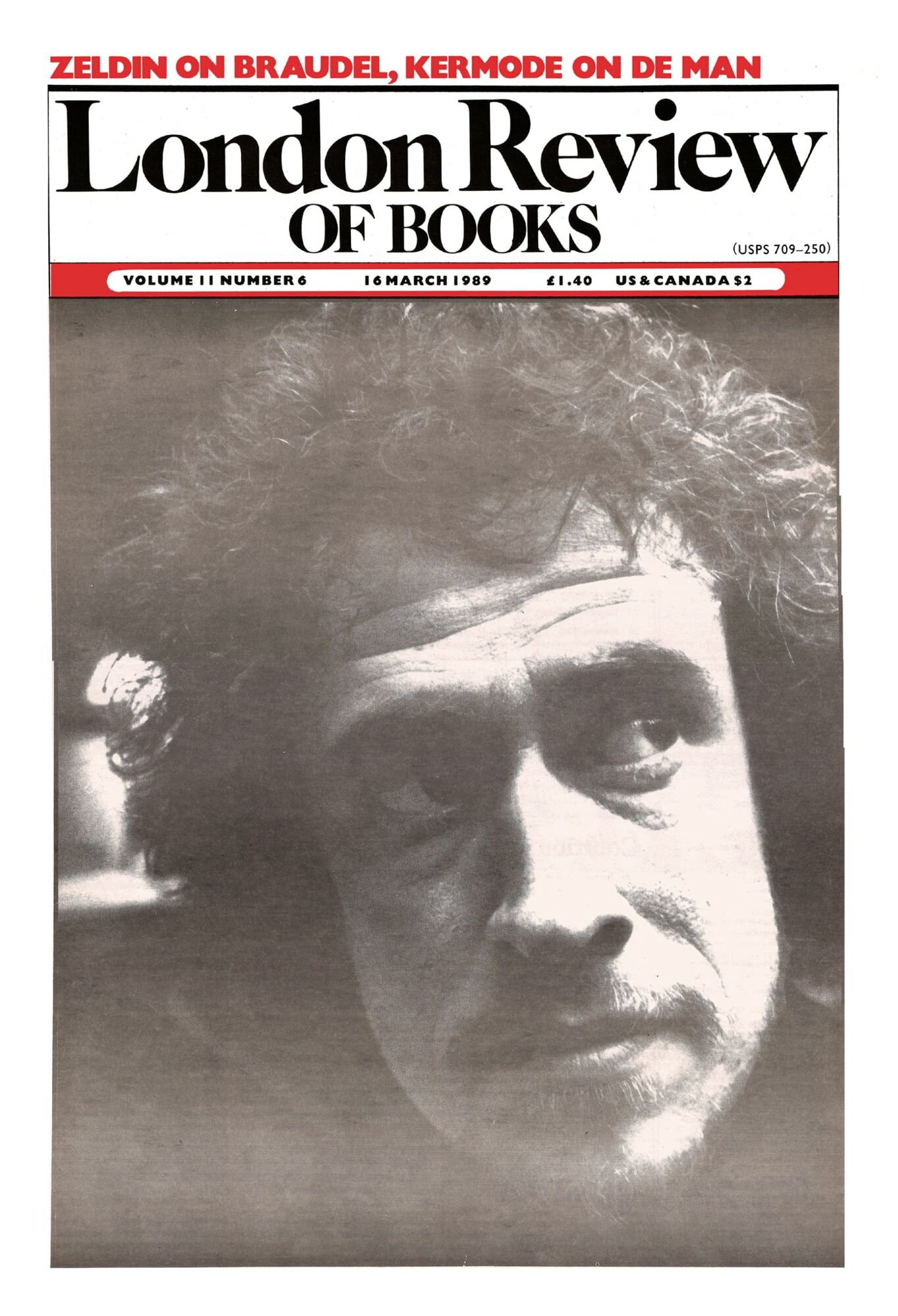
First, the necessary caveat. If anyone killed Salman Rushdie, it would be an evil act, a murder that should be condemned by all sane and law-abiding people. It would be a devastating blow at freedom of speech, a disgraceful manifestation of bigotry and fanaticism. May it never happen.
Now some less dramatic thoughts about Mr Rushdie’s predicament. His situation is not unique. It is, sadly, shared by many others. His life has been threatened, he has been ‘sentenced to death’ – although the word ‘sentence’ has too judicial a flavour for the Ayatollah’s court – but more to the point, he has been demonised. This is a frightening prospect but it is not peculiar to Rushdie.
Demons seem to be necessary to us all, whether they are home-grown – Edwina Currie, Ian Paisley and Gerry Adams come to mind – or on a more exalted, international scale. Unfortunately for him, Mr Rushdie falls into the latter category although the credentials are the same: you have to be loathed by a particular class, group, religion or nation, and you have to represent a cause which your opponents do not acknowledge. In the Middle East, for example, Moammar Gaddafi, Saddam Hussein and Ayatollah Khomeini himself have been demonised. Gaddafi (Arab unity, Arab freedom from colonialism, etc) became, for the Americans, the ‘mad dog of the Middle East’, a description which was, interestingly enough, first used by George Bush. Saddam (Arab victory over foreigners, vanguard of the Arab people, etc) was, in the Ayatollah’s eyes, the aggressive and satanic invader of Iran. Khomeini (Imam, pan-Islamic revolutionary, reviver of Muslim purity, etc) was, according to the White House, the head of a ‘terrorist state’.
Now Mr Rushdie (freedom of speech etc) has for many thousands of Muslims become a blasphemer against God, worthy only of death. It matters not, in this argument, whether the accusations are true or false – and, of course, some of those above have more in common with real demons than others. All you need is someone who wishes, for largely political reasons, to identify a demon, and the willing assistance of newspapers and television to propagate the relevant death sentence. The American networks are usually – although not always – essential in order for this process to be completed.
The case of Gaddafi is instructive. Here was a man who had clearly dabbled in ‘revolutionary activities’ (to use his own generous curriculum vitae), who was despised in the Arab world but who had consistently demanded the unity of the ‘Arab nation’. By 1986, he was being held directly or indirectly responsible for the murder of airline passengers, off-duty American soldiers, British troops in Northern Ireland and others. The Americans, who were still smarting from their debacle in Lebanon, pointed the finger at Gaddafi.
Enter the American networks. Reagan said Gaddafi was a mad dog. Gaddafi was delighted. Here was fame indeed. He was the only Arab leader prepared to confront the world’s most powerful nation. The television crews were invited to Tripoli. Reagan, Gaddafi announced, was trying to start a third world war. What did Mr Reagan think? Simple. Gaddafi, Reagan announced, was ‘flakey’. And so it went on.
‘Colonel Gaddafi,’ I heard a television journalist ask the bemused Colonel in Tripoli one afternoon, ‘President Reagan has described you as “flakey”. Do you know what that means?’ No, the Colonel did not know. It was explained to him. ‘President Reagan,’ the enlightened Gaddafi announced, ‘is a senile film actor.’ The more preposterous the insult, the more the White House felt constrained to reply. What Gaddafi had said about Reagan, White House spokesmen claimed, was an insult to the American people. The television teams became messenger boys for these lunatic exchanges.
Is there something faintly similar about all this? Sure enough. Gaddafi was mad, we were told. He was a threat to the civilised world, an evil man. So the Americans condemned him to death. Quite literally. The death sentence was not pronounced by President Reagan in the way that it was uttered by Khomeini about Rushdie. But it was a death sentence. For somewhere in the United States, someone wrote that death sentence down as a map coordinate in the city of Tripoli: the 400 squareyard area of Gaddafi’s headquarters in which the leader of the Libyan Jamahariya lived in his Bedouin tent. The US Air Force tried to execute the sentence; but they missed.
The case of Saddam Hussein is almost equally interesting. For here is a man who was demonised by the Americans – for ‘state-supported terrorism’ and for giving a home to the notorious Abu Nidal and his gang – but who was quickly forgiven when he chucked Abu Nidal out of Baghdad and invaded Iran. Saddam then became the embodiment of evil for Iran. Khomeini condemned him to death. Indeed, Iran’s war aims included the overthrow and ‘just punishment’ (murder) of ‘the war criminal Saddam’. This particular rallying-cry lasted for eight years. Unlike the Americans, the Iranians did not miss: they just lost the war. And this of course, is a clue to Mr Rushdie’s current problems.
For the expert in demonisation is Khomeini himself. After his revolution, the Ayatollah turned the Shah into a demon. Quite literally. Cut-out cardboard face-masks of the deposed King of Kings went on sale outside the gates of Tehran University. His eyes – which could be popped out if you wished to wear the mask yourself – were consumed with orange fires. There were horns on his head. Posters showed that he also dragged a long brown devil’s tail behind him. Khomeini condemned him to death. The television networks, God bless them, reported every word. The Shah, dying in exile, was asked what he thought of the sentence. Hit-teams, we were told, had been sent after the Shah. But before these mysterious groups ever made contact with the man, he uncharitably died of cancer. God had struck first.
Khomeini, of course, has long been America’s demon. If anyone is in doubt, take a look at American newspaper cartoons of the Iranian leader. But look hard at the real man as he appears before the crowds of supporters in Tehran, and you will see an old shrewd figure who, like many Iranians, possesses an acute understanding of human nature. And of the television networks. One of the most consistent characteristics of his press conferences – once he had taken power – was his knowledge and sure grasp of the workings of the American media. Sadeq Qotbzadeh, who was later to be liquidated, used to brief the Ayatollah on television satellite transmission times. New threats against the Shah – and then against Carter or Reagan – would usually coincide with the prime-time American news shows.
The leader of the Islamic Republic knew how to handle the television people. When he wanted to be on the air, he was on the air. After losing the Gulf War – which is what happened to Iran last year – Khomeini’s moral authority appeared to diminish. Certainly, his opponents used the catastrophe of the war’s end to re-open serious relations with the West. It did not take the Ayatollah long to grasp the significance of the drama over Mr Rushdie’s book. Muslims in uproar over blashemy. Death sentence. Rushdie goes into hiding. Rushdie apologises. Khomeini says no forgiveness. Are hit-teams on their way? Iranian hit-teams never reached the Shah. They never touched Abolhassan Bani-Sadr, former President of Iran. They never killed the Shah’s last prime minister, Shahpour Bakhtiar, although they tried, killing his neighbour and a French policeman. All of which suggests that international death sentences are not quite what they are cracked up to be. But no matter. Having been forced to ‘eat poison’ – his words – at the end of the Gulf War, Khomeini is back on familiar territory, demanding a just punishment for the devil and all his works.
The Ayatollah need have no fear, of course, that the world will understand this reality. The West and Iran share one common characteristic which neither will admit: the need for demon-figures, for people who can be personified as evil without any recourse to their thoughts, motives, background or opinions. The Iranians create these personae because it helps to simplify their long and humiliating history at the hands of outside powers. The West needs these symbols because they obviate the need to deal with the complexities of foreign policy. They justify actions which might otherwise be inexcusable.
Television makes these hate figures manifest. But while the various ‘demons’ of the Middle East have caused many thousands of deaths, there is no evidence that they have ever succeeded in ‘executing’ any of their principal enemies. Even President Sadat of Egypt was the victim of a local Egyptian plot: he was not murdered by a pan-Islamic hit team. But why worry about this when the Ayatollah can return to the big screen in the battle against world evil?
The real issue, therefore, is not free speech or European support for Mrs Thatcher’s tardy stand. It has nothing to do with Harold Pinter or Norman Mailer or any of Rushdie’s most fervent readers. It has not much to do with Mr Rushdie, although he might be forgiven for thinking otherwise. For the reality is this: that the man who just ten years ago shook the Middle East, whose pan-Islamic earthquake made the Arab states tremble and even America look to its defences, is now reduced to threatening an author. It has come to this. One of the great historical figures of the 20th century, a titan who shifted the geo-political pattern of the Middle East and the Muslim world, now wants to pulp a paperback.
Send Letters To:
The Editor
London Review of Books,
28 Little Russell Street
London, WC1A 2HN
letters@lrb.co.uk
Please include name, address, and a telephone number.
