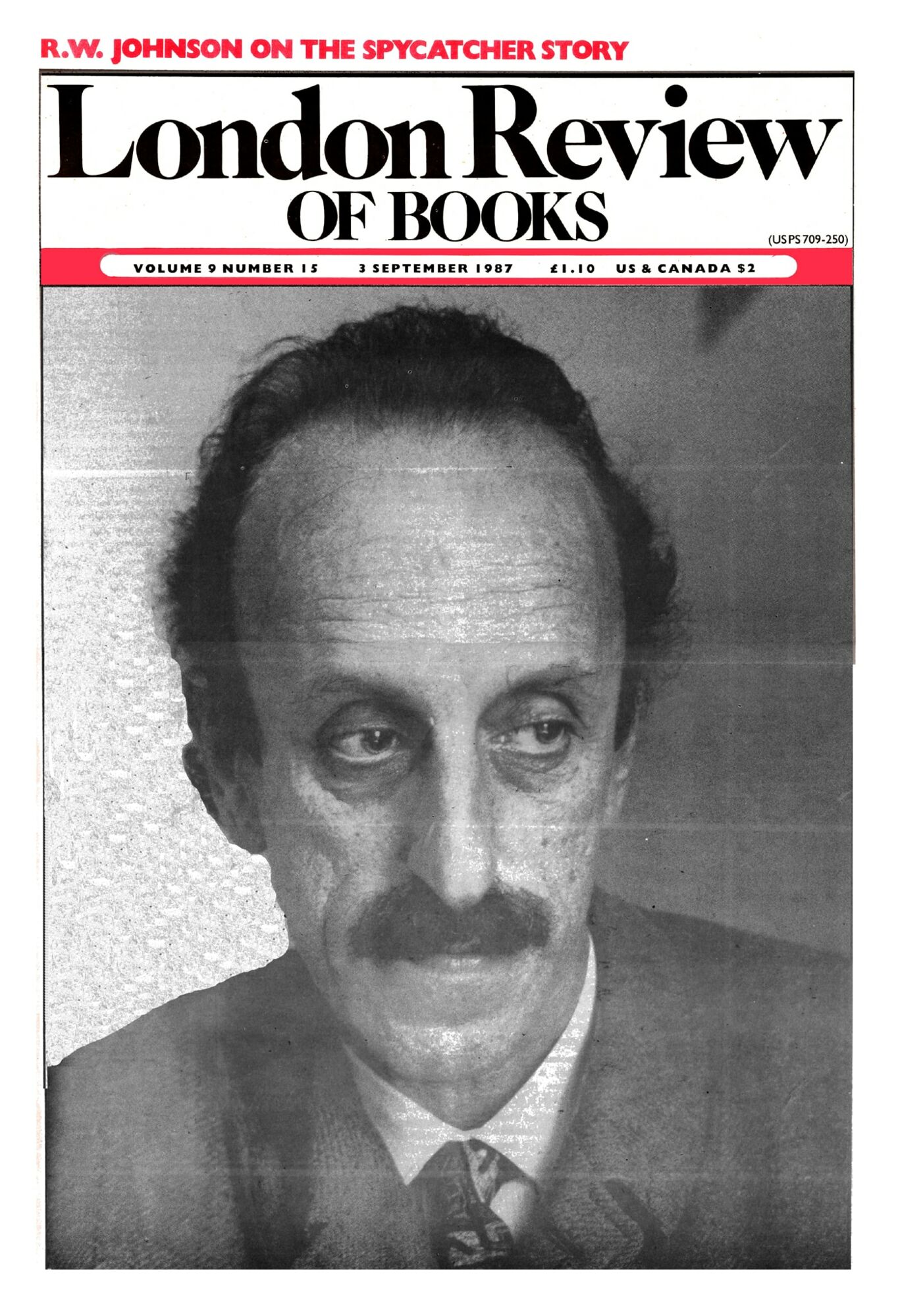
A third-rate critic of an original philosopher usually attacks him (or her) for frivolous irresponsibility, or corrupting the youth, or for having (by underhand ‘rhetorical’ means) briefly made the worse appear the better cause. By contrast, a second-rate critic will spot lacunae in the philosopher’s arguments, ambiguities in her use of terms, and vagueness in her conclusions. Such a critic defends the conventional wisdom which the radical philosopher criticised, and does so by detailed examination of the ipsissima verba of those criticisms, pointing out how often they either missed the point or begged the question.
A first-rate critic will think his way so thoroughly into the hopes and fears of the philosopher he is criticising that he is able to shrug off, on that philosopher’s behalf, the strictures of such lesser critics. First-rate critics delight in the originality of those they criticise, and they criticise them only when they are at their best. They attack an optimal version of the philosopher’s position – one in which the holes in the arguments are plugged or politely ignored, and the unfortunate side-effects of his work, or the side-issues she discussed, are trimmed away. This sort of criticism is robustly external. It consists in showing the inability of the philosopher under study, even at his best, to do what the critic thinks needs to be done. It says: this philosopher has invented a marvellously ingenious device, but it is one for which we have, or should have, no use.
The most effective form of such criticism is the one which Hegel perfected – a dramatic narrative which displays the historical situation in which the philosopher being criticised worked, the contemporary historical situation in which the critic himself is working, the connecting links between these two situations, and the inefficacy of the philosopher’s means to achieve the goals which the critic (and, by the time they have finished reading the narrative, his readers) are trying to achieve. At their best, such narratives convince us that the philosopher has not understood the pattern of the past and the needs of the present as well as, thanks to the critic, we now do. Viewed as formal arguments, such narrative accounts are, to be sure, circular and question-begging. They are often decisive, however, because they revise, subtly but convincingly, the terms in which we describe and judge the philosopher’s work – the terms in which we describe the utility of philosophy, what philosophies are supposed to do for us. Such narratives typically tell us that the tradition has exhausted its alternatives, and that it is time to start afresh – to achieve new ends with new means.
Thus, to those who have read Kant’s first Critique, Hume and Leibniz will always look a bit primitive in their understanding of the philosopher’s task. Hegel never quite recovered from Marx’s description of his social and historical role. Nietzsche is still reeling from Heidegger’s description of him as ‘the last metaphysician’. If Habermas has his way, we shall, from now on, have to think of Heidegger, Derrida and Foucault as philosophers who tried and failed to achieve something which they were doomed never to achieve, warped as they were by a fatal genetic inheritance – what Habermas calls ‘the philosophy of subjectivity’.1 Habermas wants to convince us that the needs of modernity can only be achieved by the means which he himself develops: the grounding of critical social theory on the ‘normatively-binding theory of intersubjective communication’ which he offered in his huge Theory of Communicative Action. On his view, Heidegger, Derrida and Foucault are ‘symptoms of exhaustion’ – the exhaustion of ‘the philosophy of consciousness’.
Habermas may be the best critic these philosophers have yet had – the most understanding and imaginative, if also the most implacable. Further, the drama Habermas unfolds in this richly-textured and vibrantly polemical book is likely, for accidental reasons, to become the standard story recited in British and American universities about what these three philosophers wanted, what they said, and where they went wrong. For the book offers an Anglo-Saxon audience features not previously found within a single volume. It is an insider’s book, in the sense that the young Habermas cut his philosophical teeth on Heidegger – just as the young Derrida and the young Foucault did. But it is also a debunking book, in the sense that it comes out on the side to which sceptical Anglo-Saxon readers already incline.
Habermas thinks that there is such a thing as ‘reason’, that it needs to be defended against irresponsible ‘irrationalist’ critics, and that there are universal, ahistorical norms which are fundamental to a democratic society. He agrees with lots of Popper’s strictures against Hegel. He thinks that Heidegger’s enthusiastic Nazism was not just a philosophically insignificant misstep, and that Heidegger’s later philosophy is just as vacuous as it first sounds. He thinks Derrida’s literarisation of philosophy and philosophication of literature a complete mistake. He thinks Foucault a brilliant failure: that Foucault’s talk of ‘power’ is, in the end, as empty as Heidegger’s talk of ‘Being’. So he is likely to be read as confirming the opinions of blimpish know-nothings. The Philosophical Discourse of Modernity will be cited as evidence that we can safely ignore all those mystical Germans and frivolous French who are being read by the gullible, corruptible, thrill-seeking youth.
Such misuse of the book is, I suspect, inevitable but unimportant. But it is important to notice that Habermas does not think of himself as debunking, but as arguing with his peers: with the people who have thought hardest about how to answer the ‘question of modernity’, about how to handle the problem which European philosophers have had to face since the time of Hegel. He is not appealing to sound common sense against the fantasies of the philosophers. He is taking for granted that the figures whom he discusses asked a hard and important question, and arguing that they failed to answer it.
At a first approximation, Habermas’s ‘question of modernity’ is: how can we live with the thought that we create our own nature, our own values, our own purposes? Modernity, as he puts it, ‘has to create its normativity out of itself’. ‘Only at the end of the 18th century,’ he says later, ‘did the problem of modernity’s self-reassurance come to a head in such a way that Hegel could grasp this question as a philosophical problem, and indeed as the fundamental problem of his own philosophy.’ Given this definition of what makes us moderns modern, Habermas is quite justified in saying that it is folly to talk about post-modernity.
One way of seeing the people whom Habermas calls ‘posties’ (post-modern, post-structuralist, post-phenomenological, post-analytic – even, God save the mark, post-contemporary) as just the latest batch of moderns is to notice that one mark of the modern is the Hegelian dramaturgical technique I described earlier: one-upping one’s philosophical predecessors by placing them within a narrative which makes their out-of-dateness evident. As Habermas says, since Hegel we philosophers have been playing ‘the game of mutually outdoing’: the game in which we continually try to trump each other by a. being more modern than our predecessors, because more radically and profoundly aware of the fact that we have to set our own purposes, and b. detecting and rejecting the common presupposition of everything that has been called ‘philosophy’, thereby enabling us to announce ‘the end of philosophy’. Habermas says, acutely, that ‘the discourse of modernity, which we are still conducting down to our own day, is also marked by the consciousness that philosophy is over,’ but that in this respect we merely ‘remain contemporaries of the Young Hegelians’.
The big difference between Habermas and those he is criticising in this book is that they have different candidates for a common presupposition, and so different candidates for what has, or should be, ended. From Hegel’s historicising criticism of Kant’s categorical imperative right down to Foucault’s story about discontinuous epistemai, the standard ‘modern’ account of what was wrong with philosophy is that, ever since Plato, it has aimed at universal, ahistorical norms: that it has been self-deceptively hunting for God-surrogates. Everybody has been trying to outdo his predecessors by distancing himself still further from Kant’s attempt to ‘ground’ things – and, in particular, to ground the liberal institutions of the constitutional democracies.
By contrast, Habermas thinks Kant was right in his aims, but wrong in his strategy. He thinks we can still get what Kant hoped for, so long as we give up the ‘philosophy of subjectivity’ which Kant and Hegel shared, and instead develop a ‘philosophy of intersubjectivity’. Habermas is urging a return to good old-fashioned universalistic Kant-style philosophy. He thinks that what was wrong with Kant was not – as all us Young Hegelians have been taking for granted for the last hundred and fifty years – his Enlightenment rationalism, but rather what all the rest of us had thought was just German philosophy’s special, funny little God-surrogate ‘The Subject’ (a quasi-person which constitutes the phenomenal world, gives itself the moral law, gradually becomes identical with The Object, continually overcomes itself, shepherds Being, deconstructs itself etc, as required). Habermas thinks we can revive Enlightenment rationalism as long as we use inter-subjectivity instead of subjectivity as our philosophical starting-point.
So, unlike Nietzsche and all his followers, he thinks that it is not philosophy since Plato which has exhausted its possibilities, but only philosophy since Hegel – only ‘the philosophical discourse of modernity’. A particular philosophical tradition is ending, not philosophy itself. A century and a half ago, philosophy jumped the track which democratic society has continued on down, heading (if only in fits and starts) in the direction of domination-free political and economic institutions, institutions which would ensure what Habermas calls ‘undistorted communication’. But it is not too late for philosophy to get back.
Habermas spots two earlier occasions on which we might have got back on track. The young Hegel might have avoided seeing world-history as the developmental history of a great big quasi-person called ‘Spirit’ if he had realised (as Kant, dimly, did) that democratic societies were going to develop a different, better sort of ‘ethical totality’ than the sort which he attributed to ‘idealised forms of historical communities, such as the primitive Christian community and the Greek polis’. Hegel took the Cartesian self (which had been transformed into a transcendental world-constituter by Kant) and blew it up to global size. He identified its coming-of-age, its full self-consciousness, with the institutions of a strong monarchical central government. The upshot was, as Habermas says, ‘the primacy of the higher-level subjectivity of the state over the subjective freedom of the individual’.
The nostalgia for an imaginary polis and for a community united by agape recurs in Marx, thus causing him, too, to miss the chance for philosophy to go intersubjective and democratic. ‘Like Hegel, Marx is weighted down by the basic conceptual necessities of the philosophy of the subject.’ Marx founds what Habermas calls ‘praxis philosophy’ – a ‘variant of the philosophy of the subject that locates reason in the purposive rationality of the acting subject instead of in the reflection of the knowing subject’. The besetting sin of praxis philosophy is that it still tries to hang onto a great big subject: for example, ‘the working class’ – a group about whose self-development the philosophers of ‘revolutionary praxis’ have advance information. But ‘if society as a whole is no longer thought of as a higher-level subject that knows itself, determines itself, and realises itself, there are no paths of relation-to-self upon which the revolutionaries could enter in order to work with, for and on the crippled macrosubject ... As soon as the higher-level intersubjectivity of public processes of opinion and consensus formation takes the place of the higher-level subject of society as a whole, relationships-to-self as a whole lose their meaning.’
Habermas distrusts the nostalgic communitarianism common to Marxists and Straussians, as well as to such recent writers as Wolin, Bellah and Sandel. He stands with Popper, Berlin, Rawls and Dewey in his devotion to old-fashioned social-democratic liberalism. But he still calls himself a Marxist, and still believes that democratic hopes have been frustrated by the tendencies within capitalism which embody ‘the hegemony of cognitive-instrumental interests’. For twenty-five years, ever since he began writing Knowledge and Human Interests, he has been trying to disentangle what is living in Marxist criticisms of the institutions and culture of the capitalist democracies from what is dead. In particular, he has been trying to find the right blend of Kantian universalism and Marxist topicality, of Enlightenment rationalism and counter-Enlightenment historicism. The question of whether he has succeeded in this constructive task rests on one’s judgment of A Theory of Communicative Action. By contrast, one’s opinion of The Philosophical Discourse of Modernity will depend on how well one thinks he has succeeded in a destructive task: showing that the great neo-Nietzscheans – Heidegger, Derrida and Foucault – are merely stages on a journey to nowhere, the last stops along intellectual side-tracks onto which Hegel and Marx helped to shunt us. The chapters on these figures are the heart of the book, as well as being the most powerfully and vividly written.
By the time of Nietzsche, the strains which had been put on ‘the subject’ – the transcendental-ego-cum-noumenal-self – by being blown up from human to global size were making themselves felt. What Popper was to call ‘the poverty of historicism’ was becoming obvious. So Nietzsche simply dropped both the search for an ‘ethical totality’ and the attempt to realise Enlightenment hopes by political means. As Habermas says, ‘with Nietzsche, the criticism of modernity dispenses for the first time with its retention of an emancipatory content. Subject-centred reason is confronted with reason’s absolute other. And as a counterauthority to reason, Nietzsche appeals to experiences that are displaced back into the archaic realm – experiences of self-disclosure of a decentred subjectivity, liberated from all constraints of cognition and purposive activity, all imperatives of utility and morality.’
Nietzsche functioned, Habermas says, as a turntable. He gave 20th-century philosophy a choice of two tracks (a choice avoided – as Habermas does not say, but might have said – by phenomenology and analytic philosophy, which scuttled back to Kant as soon as the options left open by Nietzsche became clear). Habermas describes the first as ‘an artistic contemplation of the world carried out with scholarly tools but in an anti-metaphysical, anti-romantic, pessimistic and sceptical attitude’, and thinks of Bataille, Lacan and Foucault as having taken this route. The second is to ‘assert the possibility of a critique of metaphysics that digs up the roots of metaphysical thought without, however, itself giving up philosophy’. This is the assignment taken on by Heidegger and Derrida.
Officially, Habermas thinks both tracks equally bad. In fact, it is clear that he has a grudging sympathy for the first, and not much sympathy at all for the second. He obviously admires Foucault (who shared Habermas’s own omnivorous reading habits, his curiosity about particular social and historical details, and his desire to be of political use) more than he does either Heidegger, the lost leader of his youth, 2 or Derrida, who he thinks has swallowed too much of Heidegger ever to be able to cough it up again. Habermas and Foucault had, early on, wrenched themselves free of the same temptation – Heidegger’s attempt at a historicised Ursprungsphilosophie. Habermas’s own criticism of ‘the philosophy of subjectivity’ parallels Foucault’s criticism of the idea of ‘man and his doubles’. He admires Foucault’s ability to be historicist without being transcendentalist: to think about history without postulating a global subject (‘Spirit’, ‘Being’) whose self-development that history is, to ‘historicise and be at the same time nominalist, materialist and empiricist’. But Habermas the decent social democrat is troubled by Foucault’s cold-bloodedness: ‘under the incorruptible gaze of [Foucauldian] genealogy, discourses emerge and pop like glittering bubbles from a swamp of anonymous processes of subjugation.’ Habermas the universalist wants an answer to the question: ‘Why ought domination to be resisted?’ He thinks that Foucault’s ‘linking of a positivist attitude with a critical claim’ is ‘paradoxical’. He condemns the relativism of ‘an analysis related to the present that can only understand itself as a context-dependent practical enterprise’. He (rightly, surely) dismisses Foucault’s vague appeal to ‘the implicit knowledge of “the people” who form the bedrock in a system of power, who are the first to experience a technology of power with their own bodies’ as just a last-minute attempt to resurrect Lukacs’s idea that the working class – the Marxist version of the transcendental subject – is in an epistemically-privileged position. So, in the end, he regretfully decides that ‘Foucault did not think through the aporias of his own approach well enough to see how his theory of power was overtaken by a fate similar to that of the human sciences rooted in the philosophy of the subject. His theory tries to rise above those pseudo-sciences to a more rigorous objectivity, and in doing so it gets caught all the more hopelessly in the trap of a presentist historiography, which sees itself compelled to a relativist self-denial and can give no account of the normative foundations of its own rhetoric.’
One might paraphrase Habermas’s point as follows: to the incorruptible gaze of the Foucauldian genealogist, before which everything turns into one more ‘technology of power’, there is no difference between good power and bad power – the power of a democratic electorate and that of a tyrant, for example. This gaze is one more version of what Putnam calls a ‘God’s-eye view’, as is the perspective attained when Spirit has become perfectly self-conscious, or when the Heideggerian Thinker has harkened back to metaphysics’ Ursprung. We are going to be stuck in this attempt to find a God’s-eye view, Habermas thinks, until we finally drop the notion of the philosopher as the educator, biographer, psychoanalyst and public-relations agent of ‘man’. Even Foucault’s and Heidegger’s attempts to bury ‘man’ did not work, for a mortician is just another kind of public-relations agent.
As long as we identify the philosopher with humanity’s representative to itself – its better, more clear-headed, truer self – we are going to be stuck with philosophies which are of no political use to social democrats: philosophies which have no relevance to the point to which history has brought us, the point at which the growth and spread of democratic institutions might just conceivably bring about Habermas’s dream of ‘undistorted, domination-free, communication’. We are also going to have an endless series of philosophers who are stuck in self-referential difficulties – the difficulty of explaining their own privileged, relatively God-like position. What we need are philosophers who are willing to let democratic societies sort things out as history goes along, without giving them a ‘philosophical framework’ of concepts within which to do it. All that philosophers can or should give them is what Habermas calls a ‘procedural’ framework by explicating a ‘procedural concept of rationality’ – the ground-rules of the communication game, rules which are built into the ‘life world of communicative action’. Only by restricting themselves to illuminating this lifeworld can philosophers avoid the condescension which accounts for the family resemblance between Plato, Hegel, Marx, Nietzsche, Heidegger, Foucault and the ‘Posties’.
Suppose one is (as I am) convinced by this claim, and agrees with Habermas that what, for public purposes, we want out of philosophy is something procedural rather than substantive. There remains the question about whether the relevant procedures are those of our historical situation or have some sort of universal import. As far as I can see, one can go along with Habermas up to the point at which he opts for universalism, and then swerve off. One can say that we want philosophy to put itself in the service of democracy, without expecting it to ground democracy on universal norms. That way, one could have the advantages of historicism without risking the condescension characteristic of the philosophers of subjectivity. This route is, roughly, what Habermas calls ‘the linguistic turn of praxis philosophy’ – a line of thought whose most important contemporary representative is Castoriadis (but which is also found in some of Rawls’s recent writings).
Having offered my own version of this turn to the readers of the LRB only last year (in a three-part series on ‘Contingency’),3 I shall not try their and the editors’ patience by trying to insert a potted version of it into this review. I shall merely remark that it is one thing to go intersubjective and another to go universalist. One can do the former without doing the latter if one is willing to split most of philosophy off from politics. Then one will say: Young Hegelian attempts at self-reassurance are very important for the private purposes of us philosophers (roughly, those of us who were impressed, when young, by the texts of the Plato-Kant tradition), just as similar theological attempts are terribly important for Christian intellectuals (roughly, the people who were impressed by the Gospels, or one of the Christian Churches, in their youth, and whose subsequent Doubts have not yet been resolved). But they may not be very important to anybody else. On this view, people like Nietzsche, Heidegger, Derrida and Foucault are relevant to the private spiritual life of a certain kind of intellectual (an intellectual who has been turned on by a particular kind of book), but not to politics – or, at least, not to democratic politics. As for the kind of procedures which Rawls and Habermas formulate as an ideal for democratic societies, the formulation of such ideals is – once the attempt at universality is set aside – no more a specifically philosophical matter than it is a legal, sociological or literary one. There is no longer a discipline called ‘philosophy’ which has special relevance to envisaging such ideals, and no longer a topic called ‘rationality’ with which that discipline concerns itself.
The idea that philosophy, if it is any good, must be relevant to politics, has made it seem as if we must say either that Nietzsche, Heidegger, Foucault etc are no good, or that they have shown why democratic politics is no good. The same idea suggests that, if we choose the former alternative, we should look for some specifically philosophical way of reassuring ourselves that will be immune to their criticisms. From that angle, Habermas’s universalistic philosophy of intersubjectivity looks like a good bet. But one can also drop this idea, privatise philosophy, and say that when it comes to the communal self-reassurance of the modern democratic societies, most of the work gets done not by deep thinkers (e.g. people attracted by Plato and Kant) but by superficial dreamers – people like Edward Bellamy, Henry George, H.G. Wells, Michael Harrington, Martin Luther King. These are the people who dangle carrots before democratic societies by suggesting concrete ways in which things might get better – become more democratic, fairer, more open, more egalitarian, more decent. They supply local hope, not universal knowledge.
From Plato through Kant down to the Posties, most philosophers have tried to fuse sublimity and decency, to fuse social hope with knowledge of something big. Universalism of the sort Habermas insists on still suggests the possibility of such a fusion. Maybe this is possible, but we linguistified praxis philosophers doubt it. My own hunch is that we have to separate individual and social reassurance, and make both sublimity and agape (though not tolerance) a private, optional matter. That means conceding to Nietzsche that democratic societies have no higher aim than what he called ‘the last men’ – the people who have ‘their little pleasures for the day and their little pleasures for the night’. But maybe we should just make that concession, and also concede that democratic societies do not embody anything, and cannot be reassured by anything, larger than themselves (e.g. by ‘rationality’). Such societies should not aim at the creation of a new breed of human being, or at anything less banal than evening out people’s chances of getting a little pleasure out of their lives. This means that citizens of those societies who have a taste for sublimity will have to pursue it in their own time, and within the limits set by On Liberty. But such opportunities might be quite enough. Further, all those footnotes to Plato – stretching right down through the philosophical discourse of modernity all the way to the Posties – will still come in handy, for there will always be people whose subjectivity is bound up with the urge to write new footnotes.
Send Letters To:
The Editor
London Review of Books,
28 Little Russell Street
London, WC1A 2HN
letters@lrb.co.uk
Please include name, address, and a telephone number.
