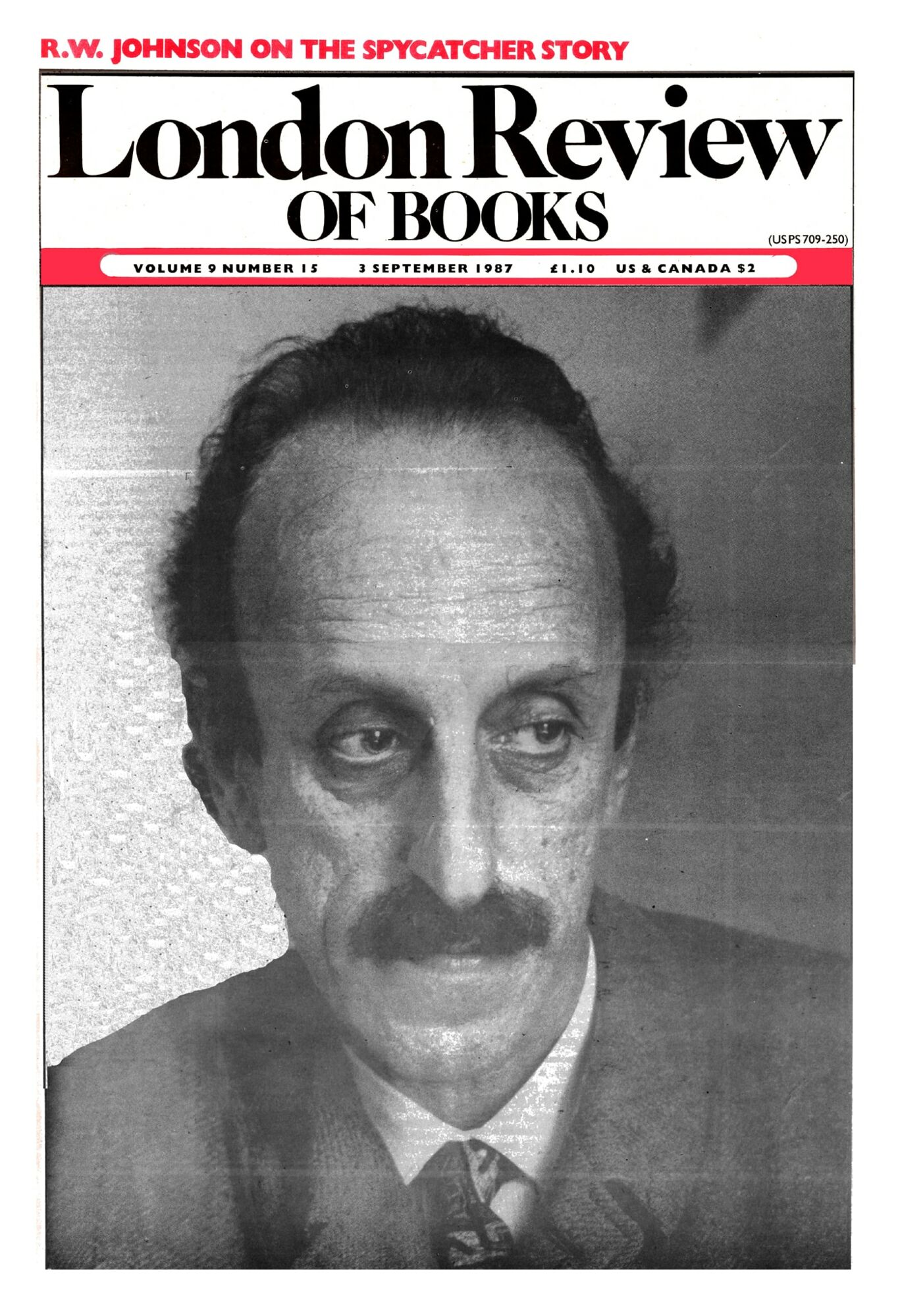
Of the initial meeting between Robert Katz, investigative hack and would-be screenwriter, and the late film director Rainer Werner Fassbinder, the former now records that the latter ‘seemed terribly annoyed’. To be honest, admits Katz, Fassbinder was in something of a bate throughout their brief acquaintance: his abiding image of the director is of someone ‘irascible, whining’. As this sloppy, pompous and tawdrily wart-popping biography plods on, the writer’s assessment of the director’s temperament begins to seem increasingly suspect. Irascible and whining, was he? Well, wouldn’t you whine a little with this guy on your case? Before we dismiss Fassbinder as a career grump, I think we need to know something: what was he like when this jerk wasn’t there?
Love is colder than death is a classic slob biography – to be compared with Bob Woodward’s Wired, about the grossed-out comic John Belushi, and almost any book about Elvis Presley – and Mr Katz is a first-rank slob biographer. A vital element in such a project is the contrast between subject and biographer: the dull, ascetic and probably jogging yuppy sees in the fluid-spilling and abuse-fluent wreck his own antithesis and is fascinated by it. ‘He’d do what with the gherkins? ... sure, sure ... and you say one part mayonnaise to two parts baby lotion,’ you imagine the coroner-Boswell saying, as another member of the inner circle spills the half-baked beans of the latest monster maudit myth. So here is Fassbinder, chartering planes whose only passenger is cocaine to movie sets where sausages spit and beer swills in cauldrons to sustain the great director until the unit’s ‘second breakfast break’ of Sachertorte. And here is Katz, with the smug good sense to live to spin a book from it. Three pages in, the author writes: ‘I couldn’t keep pace with the group, with the sleepless, orgiastic abuses of the body.’ Wimp, you think, so clearly has his pale sensibility imposed itself on a book meant to be about someone else.
Two authors are credited: ‘by Robert Katz’ is coupled with, in smaller type, ‘and Peter Berling’. The latter is a German film producer, who, says Katz, ‘cannot be called a Fassbinder person’. This formula is used throughout the book (sometimes reduced to FPs) to designate a groupie. Berling, however, is said to possess impressive ‘credentials as a Fassbinder watcher’. It is, apparently, him we must blame for the book’s incessant drip of uncalled-for information. Katz notes of Berling: ‘An inveterate archivist by nature, he has a file on the Fassbinder years that ranges from taxi receipts and restaurant menus (including what everyone ate) dating back to 1965 to diaries and memoirs bristling with both insight and minutiae.’ The nature of the arrangement remains unclear but Berling seems – in a formula which recalls Lawrence Schiller’s involvement with Norman Mailer on The Executioner’s Song – to have been the man with the brass facts, willing to relinquish his load (Katz, typically, prefers the word ‘lode’) to a writer. But the top-billed author expresses a willingness to be blamed for the completed volume and the reviewer should surely observe that request.
The first word of the book is ‘I’, frequently an alarm bell in a biography, and there is a strong pong in the early pages of the Rainer Werner Fassbinder I Knew school. In fact, in respect of the biographer-subject relationship, there is one excellent joke which the author doesn’t intend and almost certainly won’t get. At Cannes, Katz is trying to persuade Fassbinder to let him script a film: ‘I’d taken the red-eye express train to arrive not too late for a brunch given by the German film industry at the Majestic, a money-man’s hotel across the street from the old casino.’ Alternately drunk and on the phone to Jane Fonda, RWF declines to capitulate to the journalist’s wishes and Katz returns to his Tuscany home: ‘I was not going to win him over and was less sure by the hour that I wanted to.’ The phone rings. Fassbinder wants Katz to do his next movie. Yippee. Except that RWF breaks the contract in a bout of typically idiosyncratic anarchism. He dies. It was an extreme sort of v-sign but the reader may come to feel Katz deserved it.
The author’s certainty of his own importance to the Fassbinder story is such that he forces us to witness his book’s moment of creative inspiration. You would tend not to ask a biographer where he got the idea for a project – it’s kind of obvious – but Katz insists on telling us. ‘Tall and severe’ Juliane Lorenx, the director’s sort-of-widow, comes to Tuscany. The author pours her ‘a glass of chilled white wine’. That ‘chilled’ is chilling, a detail of characteristically smug redundancy: the biographer requires us to know that he’s the kind of guy who would always have a bottle on ice in good time for guests. Later, ‘when the wine and the sun had finally warmed her’, Juliane sweet-talks her host into producing the rubbish now under review.
‘They’re all betraying him now,’ said Juliane, ‘now that he can’t get them work. All his “friends”, telling lies and gossip to the highest bidder.’ I knew she was referring to books being written and interviews given by Fassbinder’s ex-lovers. ‘You should write a book,’ she said, more or less out of the blue. ‘You didn’t know him enough to hate him, certainly not enough to love him.’ She eased back in her deck chair and closed her eyes. She ran the rim of the wine glass along her forehead. A smile crossed her lips.
Why does he mention the smile? Presumably for the same preening I-was-there reasons that he scatters dress and menu details from his encounters with every Fassbinder person he meets. He offers no guess as to the impetus of the grin. What was Juliane thinking? I think it was this: ‘He’s going to write it. Good. Fassbinder deserves this prick.’
To his reputation. And so the Fassbinder People came to Tuscany – except for the actress Hanna Schygulla, the one major RWF groupie to give the chilled drink a miss – and the wine waiter took a few notes and wrote them up into Love is colder than death. ‘You didn’t know him enough to hate him, certainly not enough to love him’ – the line of Juliane’s is planted to suggest that Katz is uniquely poised to find a balance between kicking the Fassbinder backside and licking it, but the book merely mixes journalistic opportunism with critical misjudgments. Love is colder than death. And necrophilia is different from film criticism.
The book is extravagantly and spectacularly badly-written. The prose errs, variously and sometimes simultaneously, in tone, rhythm, syntax and vocabulary. The most charitable explanation you can offer is that something funny happened to the author’s American while in Tuscany. His writing commits a variety of crimes. Here is the author as gauche brown-noser, recalling his bar crawls with the Fassbinder set: ‘All I retain are scatterings of loose conversation, a dark feeling that lives we touched were in some way scuffed.’ And here is Katz the social analyst: ‘Rainer often played hooky, enhancing his consciousness on the street.’ His sentences have a tendency to lose their original direction, like a humiliated schoolboy sitting down in class. Here he is attempting to tell us about RWF’s youthful forays into drinking holes favoured by homosexuals: ‘Suddenly, at 15 and quite pimply-faced, he was going to gay bars, though in those days the word “gay” hadn’t yet crossed the Atlantic and no bar, at least in Cologne, favoured one sex over another.’
Too often, the published text shows the on-the-hoof improvements of casual chat: ‘Rainer was writing a script, more than one.’ And, as for Katz the phrase-maker, try this description of Irm, one of RWF’s early lovers: ‘a pussy-willow person, as thin as the branch, as soft as the catkins’. The book is made as mildly bearable as it is by the author’s capacity for unconscious comedy. He refers to a cabaret act which featured a close-up of ‘an old-fashioned hard-on’. Well, heavens above, you wonder, what is the new, the modish kind like?
Quintessential Katz crap – the ne plus ultra of his curious style – is the description of Fassbinder’s funeral. Some journalists are good at digging and thinking but cannot fizz stylistically; others hide a lack of ideas behind their style. There is something astonishing about lacking both qualities to the extent that Katz does. Reading his account of the director’s obsequies is like interviewing a non-agenarian hick who witnessed the burial of, say, Mark Twain. So, Mr Biographer sir, what was Fassbinder’s funeral like? ‘It was the damnedest funeral you ever saw.’ What do you remember about it? ‘It was tough on the feet.’ And the atmosphere? ‘There was no champagne and beluga. Fassbinder would have turned over in his grave if he’d had one.’ A sad occasion? ‘The mood was never sombre and by noon it was one helluva party.’ And your thoughts at the time? ‘What kind of star was this, I thought, that had burned out so young and so incandescently.’ Hard though it is to believe, all five of the old-man’s replies in the fantasy above are verbatim quotes from Katz’s short report on the Fassbinder funeral.
Style aside, what of the biography’s argument? What kind of star was this? Born in Bad Worishofen, a spa town rumoured to produce cures, RWF seems, by an irony, to have spent his life seeking diseases. He was named after Rilke, who was, readers are told, in one of Katz’s alarming fag-packet characterisations, a ‘giant of a poet who was brought up wearing dresses by a mother pretending he was her dead daughter’. But whatever the effect on the psyche of being given this signal patron saint, the lad rarely got Rainer, more often – in reference to the golf-course pocking of his features – Pickle Face. Katz drops juicy psycho-biographical details, presumably fuelled by the Berling collection. Here is Mama Fassbinder force-feeding unripe apples to the young RWF. ‘You tried to kill me when I was a kid!’ he would scream at her in later life. And here is Rainer, admitting, in adolescence, to his homosexuality, in this instance with a butcher’s apprentice. His father replies: ‘Well, if you want to go to bed with men, can’t it be someone from the university.’ The slob biography thrives on such theory-breeding anecdote and Katz is well-served by the film director Daniel Schmid, who tries to encapsulate and analyse Fassbinder’s madness in a wonderfully nutty nutshell: ‘Rainer Werner Fassbinder wanted to be Marilyn Monroe. No one else. He wanted to walk down a staircase wearing feathers and a gown.’ Some like it cheap.
Of the films, there is very little. Our biographer is a bad journalist but a worse critic. Of RWF’s debut piece The City Tramp (1965) he observes: ‘The story of a man down and out in the city who finds a gun in an alley and can’t get out of it. Rainer’s first filmic statement: life is not a bowl of cherries.’ Fassbinder spewed out movies like fluids – a picture every hundred days for 13 years – in violent, purgative bursts. He had no understanding of his talent and no ability to husband it. It is useless to mourn the shortness of a life always timed towards an early lights-out, towards the systematic ruin of whatever beauty it possessed. He said: ‘I want to be ugly on the cover of Time – it’ll happen and I’m glad about it and I admit it – when ugliness has finally reclaimed all beauty. That is luxury.’ In the end, his ultimate and hard-won ugliness met not the camera of Time but a mirror held up to test for breath. Dead at 37. The funeral was held without a body – the corpse was still in the hands of pathologists trawling for evidence of drugs. An unofficial death-mask did the rounds of Venice in a plastic carrier bag.
The remarkable achievement of Katz’s book is to make you feel sorry for Fassbinder, make you want to question this simplistic parroting of his surface reputation. This is the inevitable weakness of the slob biography – that it obsessively seeks corroboration for the slobbishness of those with a reputation for being slobs. A truly effective work in this genre would deal with, say, Julie Andrews. Perhaps old Pickle Face was a shit – there is substantial evidence to suggest this – but he deserves better. Most of the FPs are writing books about RWF or are engaged in litigation with his estate; the shabbiness and parasitism which marked his life pursue him beyond it. And Robert Katz is smug in Tuscany, nursing the secret of the one striking idea in the book: his patent, new-fashioned hard-on. I think its innovation is probably its limpness.
Send Letters To:
The Editor
London Review of Books,
28 Little Russell Street
London, WC1A 2HN
letters@lrb.co.uk
Please include name, address, and a telephone number.
