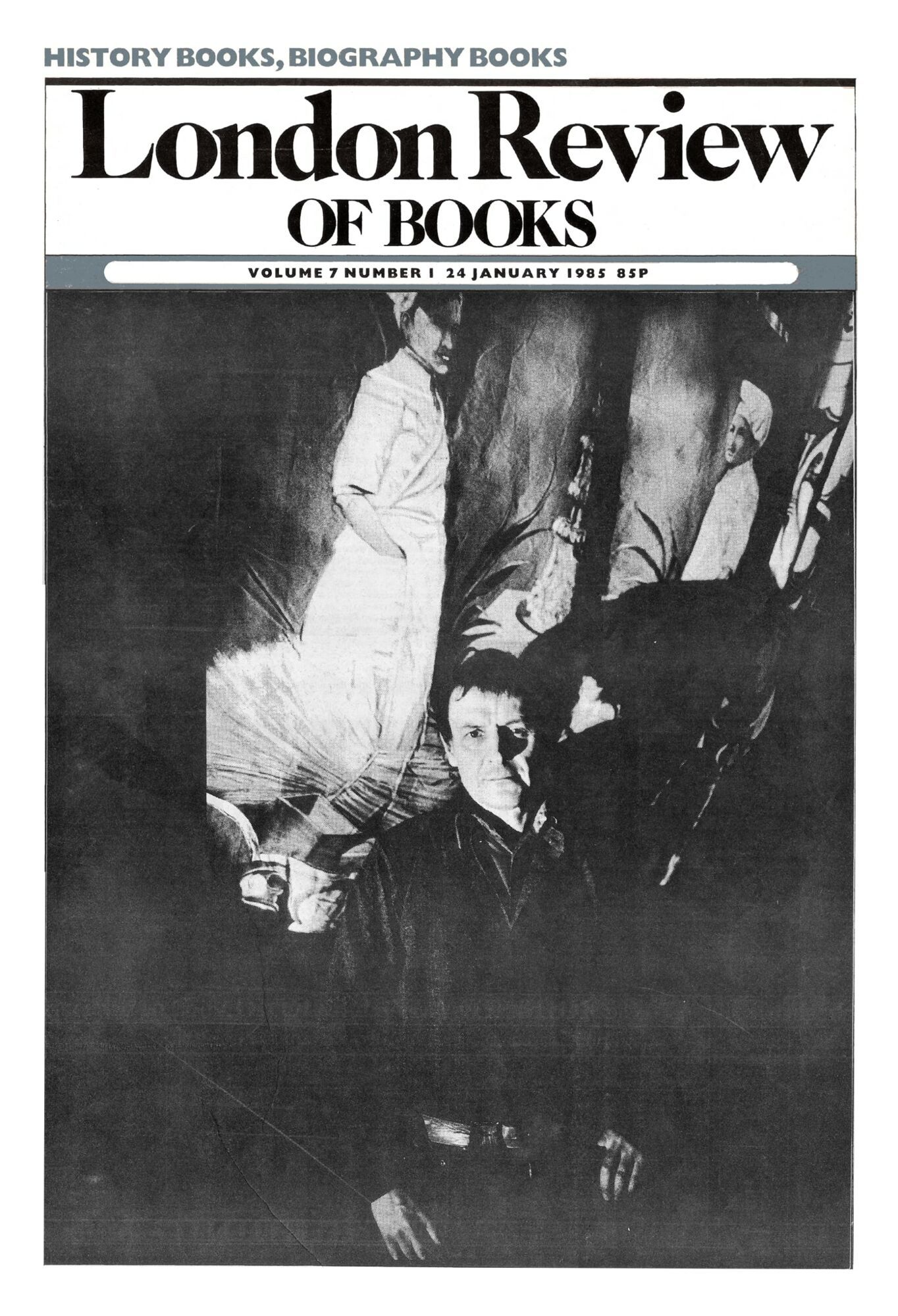
The astonishing importance of Leavis in the English academic consciousness does not seem to be a passing fad. The scandal-maker of the 1930s became, by a kind of self-fulfilling prophecy, part of the saving remnant on which the future of reading would depend. The photo on the cover of Denys Thompson’s The Leavises shows him in a jacket impermeable to the insults of time and with the open shirt of a Labour leader. He looks indeed, as his wife wrote of both of them, ‘grey-haired and worn down with battling for survival in a hostile environment’. Queenie Leavis stands beside him, also dressed simply, sharing his pursed lips and focused eyes that tilt only slightly towards a better world. Together they make a painful hendiadys, an icon of the threadbare, indomitable British intellectual. The snapshot catches something grim and mortal: an embattled uniformity, rather than their spirit active for half a century to save a culture that had lost, so Leavis wrote, ‘any sense of the difference between life and electricity’.
That phrase characterises the consistency of a career totally within the contracted sphere of the English university, and devoted to making it reflect a ‘human world’ instead of lusting after technological improvements that ‘promised to abstract the hopes of Man / Out of his feelings’ (Wordsworth). Cambridge was the right place for this pursuit: here the sciences were valued and – in Leavis’s eyes – over-valued; here the first School of English took hold.
One cannot separate Leavis from his university environment. The man found his lair, and never faltered in his attempt to conform it to a vision that was as simple in its outlines as it was complex in its outcome. He called for the ‘re-establishment of an educated reading public’, which implied that there had been, once, such a public; that education, especially through the agency of the university, might restore it; and that ‘reading’ English was both the means to reform and perhaps its best result. This concern for reading was drummed in relentlessly, and supported early on by Mrs Leavis, whose Fiction and the Reading Public (1932) provided an official version of the rise and fall of the class-integrated audience. It also pioneered a direction which social analysis was to take by focusing like I.A. Richards on problems of communication and reception.
Leavis himself wrote a PhD thesis on the emergence of magazines like the Spectator and the Tatler which inspired the ideal of the educated or ‘Common Reader’. Modern critical prose was founded by their periodical essays, which also prepared for the great English novel. Keeping up the pretence of a ‘correspondence’ between equals, Steele and Addison – and a few others like them – removed matters of taste from the heat of religious and political controversy. Art, as Schiller was to argue in his Letters on Aesthetic Education, was not simply a higher form of play that restored the illusion of wholeness to persons fragmented by the specialised demands of the modern world. Art mediated between two distinct tyrannies that always threatened human freedom: the tyranny of nature or instinct, and the tyranny of the state. It would not be an exaggeration to say that for Leavis the University institutionalised Schiller’s ideal of Aesthetic Education. If there could be an organisational arrangement to sustain rather than stifle the ‘organic community’, it was the university as Leavis envisaged it in Education and the University (1943).
While in the America of the 1920s and 30s the university became linked to democratic hopes for bringing literacy (both scientific and humanistic) to all classes, Leavis placed his trust in a small meritocracy of skilled readers. Whitehead and Dewey, who stressed the university’s contribution to the quality of life as much as he did, must have been anathema to him. Their optimism concerning the huddled masses was far removed from his fears about pseudo-literacy, the herd instinct, journalism, the application of technology to learning, and unfounded hopes as to the ‘culture’ of science. As Baldick writes in his fine The Social Mission of English Criticism, the educational model of the Leavises ‘revolves around the opposition between society at large and “society” in the 18th-century sense; between an unconscious mass and its conscious embodiment or guardian’.
Leavis’s sense of the 18th century was indeed crucial. His views were not very different from those of Establishment scholars, though more nuanced and critical, as his deft comparison of Dryden and Pope in Revaluation showed. Eighteenth-century journals, in creating the educated or Common reader, also laid the ground for what Leavis’s early tract (1930) would call ‘mass civilisation’ in contrast to ‘minority culture’. A plague of words, unleashed by Grub Street scribblers and the proliferating tribe of virtuosi (comparable perhaps to our dons), prompted Pope’s Dunciad with its climactic vision of the eclipse of culture and the triumph of an ‘uncreating word’. Eliot’s notion of a dissociation of sensibility from thought, accelerating after Donne and Shakespeare, seemed only to confirm Pope’s diagnosis.
The Augustan virtues of gentility, correctness and refinement were merely, in this context, ‘a sublime singerie’ – to quote Voltaire on the art of the French dancing-masters. Leavis could not forget how quickly the vernacular genius of English declined, after Shakespeare, into a mannered language. There was, however, nothing deterministic or fatalistic in his view of literary history: he held no overt thesis on the precise causes of that decline. He may have regretted that an independent peasantry (also Wordsworth’s desideratum) did not grow strong enough to survive the Industrial Revolution. But he relied less on social history than on his sense for the growth of an anti-word. The decline happened once, and perhaps happens always. Literature betrayed itself in Milton, Leavis’s favourite bogey, while prose, when not downright journalistic or crude, began to walk on Johnsonian stilts. ‘There is no Common Reader,’ Leavis declared in the 1960s. ‘The tradition is dead.’ Yet one wonders whether that tradition ever existed except as a compelling social fantasy.
It is strange that Leavis should seem so dogmatic, when he is merely didactic. With Shakespeare as the measure, he tests every writer, always looking for the emergence of a renewed vernacular energy, a canon of native classics. He begins by underestimating some Romantics and championing decisively the high Modernism of such poets as Hopkins, Pound and Eliot. Yet by the time he died he had considerably revised himself. After the ‘Line of Wit’ discussed in Revaluation (1936), a new achievement is said to have entered English letters, going from Blake through Dickens to D.H. Lawrence, and centring in the novel. The admission of Dickens into the canon overturns the verdict of Fiction and the Reading Public and goes beyond the rescue of Hard Times, the one Dickens novel treated in The Great Tradition (1948). That Dickens was a popular entertainer is not held against him in this case; Leavis’s increasing tolerance for ‘moral fable’, especially when it tackles the subject of education itself – Mr Gradgrind versus Sissy Jupe in Hard Times, or Blake versus the England of Locke and Newton – allows him to observe how a ‘poetically-creative’ prose takes over from Shakespeare’s dramatic gift. ‘Shakespeare,’ he wrote in The Living Principle (1975), ‘compels one to recognise that language is essentially heuristic’: what is intriguing is Leavis’s fidelity to that principle, and the gradual shift of allegiance towards Dickens and Blake. In the Critic as Anti-Philosopher it is Blake’s language – and Wordsworth’s – which is heuristic, while Eliot, a Urizen despite himself in his view of humanity as utterly abject, is championed only for his poetic creativity, for ‘doing “impossible” things with the English language’.
As is his wont, Leavis does not define ‘heuristic’ except by example, by singling out this or that passage and displaying its resourceful, even equivocal texture. ‘You can’t tell beforehand what liberties will justify themselves.’ Despite enormous differences in presentational method, Derrida’s emphasis on the aleatory or chancy character of language (based not only on Freud and Saussure but also on Mallarmé and Valéry) has the same, radical focus. As it turns out, Leavis’s insistence on judgment and revaluation is not the sign of a doctrinaire but of an open mind – with standards, to be sure, and lively prejudices, yet a mind for which excellence was never confined to a single writer, period or ‘total upshot’. His commitment goes beyond these to language, and in particular to English as the reservoir and result of the labours of genius – indeed, analogous to a biological acquisition. I don’t admire his aggressive taciturnity, but neither am I alarmed by the fact that he can only jab words at us, to describe an ‘English language in terms of which the writer lives his creative life’. The collective memory which anthropologists have tried to define at the level of pensée sauvage he locates at the level of high culture: and the result can be a jargon of authenticity as unpalatable as Heidegger’s. ‘The “living principle” itself is an apprehended totality of what, as registered in the language, has been won or established in immemorial human living.’
Did Leavis, then, escape the varicose veins of theory as it imposes a rigid or curious vocabulary? Once a sociolect establishes itself, only a mannered and idiosyncratic prose can achieve some distance from it. Such a sentence as ‘Essential or Blakean responsibility manifests itself in the full accepting recognition that the directing ahnung implicit in life and the nisus that has led to the achieving mind and anticipatory apprehension and initiative are to be thought of as, in the world we know (Los’s world), pre-eminently represented by humanity’ is hardly a well of English undefiled.
Many learned books are now placing Leavis in an ‘English’ line of social thought. Fred Inglis’s Radical Earnestness has an explicit section on the English Mind; and he gets away with it because of his zany, fast-paced, name-dropping style, which puts Collingwood, Keynes and Leavis together as ‘decent herbivores’ who shun a ‘man-eating rhetoric’, re-situate their ideas in literature, and make common cause against ‘ruling-class Oxford and Cambridge ... still deeply poisoned by the playboys of Brideshead’. The earnestness of English Inglis does not always extend to his prose. His book, a swarm of lively, stinging words, is as beleaguered as Leavis was, being written, we are told, ‘at a time when, in Britain, intellectual life is itself once more openly menaced by the interest groups of the time-servers and gangsters who live inside and outside the gates of the academies’. The desperate hope Leavis placed in the University has clearly become more desperate: but that ‘English’ sense of how to speak quietly yet forcefully amid the noise of political and journalistic sloganeering has vanished, despite Inglis’s claim that he ‘honours a line of men who kept up such language’, and his own driving intelligence that exposes the ‘blank at the heart of the moral sciences’.
Chris Baldick also deals with that blank or vacuum. He has written an important and clarifying work that traces the rise and rationale of English studies from Arnold to Leavis. To replace with ‘English’ such different, often competitive disciplines as moral philosophy, social history and political science entails ideological struggle, and loss rather than gain. Inglis enjoys the fray, and the energies released by it; Baldick analyses an impasse. He shows that the claims made by Leavis for the centrality of a literary education are just too large and untheoretical. In the wake of Arnold, the crucial question was what might substitute for religion in English life – insofar as religion had proved to be, culturally, a cohering symbolism, making for wholeness rather than division. Could a literature of imaginative reason replace religion’s unifying role? Could literary criticism, by renewing a scrupulous conversation between persons, and between the private and the public sector, retain at least the sensibility of the ‘organic community’?
This is the task insinuated by the word ‘practical’ in ‘practical criticism’ – a discipline which is obviously more than the exercise of a brilliant analytic technique. In Richards ‘practical’ scarcely conceals a wildly utopian and scientific hope, the possibility of engineering a substantial improvement in communications and so in world health. Leavis, contra Richards, adopts a sense of ‘practical’ which is opposed to ‘theoretical’ and directed always to the text and person at hand. He shrinks the mission of social criticism into a reform of literary studies. Baldick concludes his book with an indictment: ‘The title of “criticism” was usurped by a literary discourse whose entire attitude was at heart uncritical. Criticism in its most important and its most vital sense had been gutted and turned into its very opposite: an ideology.’
A leader in the TLS of 5 March 1970 (devoted to the Social Sciences) voices a similar complaint about the social conscience of the English critic. It compares English with French responses to Marxist thought. English empiricism, the anonymous writer claims, ‘by destroying potentially useful ideas before they could be applied to new situations, has left an uncomfortable legacy. The bias of empiricism was largely responsible for preventing a whole generation of English philosophers from becoming familiar with important aspects of Hegel ...’ And so, of course, with aspects of Marx. In France the challenge of Marxist thought was met by a typically national appropriation, much preferable to English neglect or Soviet orthodoxy. ‘A number of important French thinkers had the good sense to attempt to make the Hegelian-Marxist heritage relevant to their own problems. They thought of Marx as a western thinker, not in his eastern iconology.’
Leavis, in this light, carries too great a burden. He must substitute for, or new-create, the social conscience of English criticism. Baldick’s title-dates are ironic opposites: 1848 denotes the revolutionary turmoil to which Marx responds, and 1932 launches Leavis’s Scrutiny. Detaching criticism from any direct engagement with politics or theory, Leavis fosters a ‘culturalism’ that removes all intermediate categories like class, sex, creed and occupation, in order to focus exclusively on the genius of the language and the genius of the writer.
Unfortunately Baldick limits his view to the English scene, and so appears to confirm the existence of a separate ‘English Mind’. That exacerbates the problem by keeping it in the family. Inglis, too, despite his habit of breaking out in a rash of names, accepts the way English intellectuals have treated ideas by keeping them close to the tea-table or a ‘domestic idiom’. There is little ventilation: no reference (except nominally) to Lukacs, who sets theory against alienation and fragmentation; no acknowledgment of the Frankfurt School’s attempt to frame an ideology-critique; no mention of Ortega’s Revolt of the Masses; no comparison of English with Continental reactions to the upsurge of propaganda, stock responses and standardisation.
The family perspective of a book like Baldick’s is deceptively invigorating and contributes to the crisis it identifies. Yet it does begin to examine the question of ‘Englishness’. What is at stake is the strength of stereo-types or ‘vital prejudices’, their felt necessity in the active as well as the sluggish mind. They evade analysis, as if reflection were a hereditary enemy. Like role-playing, they have many useful functions (comic, cathartic, consolidating): yet when the Nazis add the concept of purity to that of race or genius, stereotyping becomes sinister and a carrier of hate rather than tolerant humour.
The omission, therefore, of intermediate ‘social’ categories – which throws all the emphasis on the relation of individual mind (talent) to race (tradition) – is a fatal simplification. In Eliot, certainly, Englishness functions as a mentality, a crucial pseudo-historical episteme. Englishness restrains a corrosive, out-of-control self-consciousness that destroys loyalties and produces rootless intellectuals. And what seemed innocent, or merely nostalgic, in the early publications of the Leavises, their wish for a national culture grounded in the soil and bearing with it ‘the accumulated religious associations of a race’ (Fiction and the Reading Public), cannot be read today without misgivings.
Leavis participated, as critic and educator, in a historical paradox. The very notion of a racial or vernacular genius, which had encouraged the rise of diversified national literatures in Europe, becomes conservative and constricting once these nation-states have consolidated themselves. The ‘organic community’ is then threatened by the continued momentum of a process of centralisation. For Leavis, the word ‘central’ is deliberately transferred to a university discipline; and English denotes, not an insular and insulated canon, but the destabilising genius of the Shakespearean heritage as it re-emerges in Bunyan or Blake, or in the great tradition of the novel, or (one could add) in a critic more like Empson than Leavis.
Denys Thompson’s collection, The Leavises, is not all that different from the ambitious historical placements of Inglis and Baldick. Together they amount to an extended family history in which Leavis plays a climactic role: the loner-hero, the irreplaceably honest person who charms us with his stubborn, archaic habits. Leavis sticks to the personal essay and the tutorial encounter. Muriel Bradbrook speaks of him as ‘pre-eminently a teacher by the direct method ... both orator and actor’, and recalls contemporaries who still hear his voice when turning to certain poems. For all his influence, he did not have charisma, as Raymond O’Malley notes. ‘He listened. In particular, he always searched for the sense behind a student’s seeming nonsense.’ O’Malley quotes one of Leavis’s favourite phrases from Hopkins to characterise the master: ‘the intolerable wrestle / With words and meanings’.
A fit hero indeed for lament and admiration in the media age of the great communicators. Why then do so few of these candid portraits reproduce the feel of Leavis’s supervisions and classes? Or simply record – reconstruct – his talk? One exception is Raymond Williams, who did not meet him till 1961. ‘I have never known a social situation in which a group seemed so obsessed by one man,’ he remarks of Cambridge. Even Williams can describe only Leavis’s behaviour in the Faculty. There is the time Leavis resisted having a set paper (for Part Two of the Tripos) on the novel in general rather than on the English novel exclusively. It would be a misdirection, he claimed, to have read Proust and Kafka. Since the majority were against him, he turned to Williams as chairman:
‘I put it directly to you, Mr Secretary. The coherent course would be the English novel from Dickens to Lawrence ...’
‘All right,’ I said, ‘I think it is a coherent course. But a majority of the committee want some foreign novelists included, and I think their arguments are strong. Part Two, after all, has that important extending dimension.’
‘No, I am putting it to you, directly.’
‘I could vote for either. They would be very different. But at the moment I’m an officer of the Faculty, trying to get the committee’s decision.’
‘To you,’ he repeated.
This ad hominem streak, opposing itself like a ‘conviction of genius’ to systems and structures and the pressure of the majority, is not theorisable. ‘If the fool would persist in his folly, he would become wise’ (Blake). Leavis was, as Williams concludes, ‘all intense concern and conviction, at levels inaccessible to separated argument.’
A century earlier he might have gone to a Utopian community on the banks of the Sus-quehanna or the Springs of Dove. A Leavisocracy might not have endured for long, yet Queenie would not have had to ‘cut’ so many dear acquaintances. The sensibility of those two is symptomatic and extraordinary. They remain, somehow, within the English class system, embodying its rigidity by their hurt and reverse élitism. Despite Leavis’s courtesy towards students, a talent for insult can emerge, which elaborately breaches the very code of manners it sustains, or loses itself in obsessive asides. The lectures collected under the title The Critic as Anti-Philosopher show much of that eccentric form.
The very first essay, ‘Justifying One’s Valuation of Blake’, is a peculiar piece of rhetoric more about Eliot than Blake while insisting that its use of Eliot is a ‘means of economy’. It is hard to concede that : yet the involution of the procedure adds a quasi-philosophical dimension under the guise of being anti-philosophic. The essay is basically a meditation on ‘genius’ in its opposition to ‘positive culture’, and seeks to expose Eliot’s inability, even in an early, brilliant piece on Blake (see The Sacred Wood), to value that crucial antagonism.
It is not the judgment or verdict, Lukacs remarked about the essay form, that is important, but the process of moving towards the verdict. Whereas a typical early piece by Leavis, in New Bearings or Revaluation, is almost purely gestural, a kind of flower-arrangement in which much is left to the eye of the reader, here a repetitively assertive element has entered, and the manoeuvring takes on a value of its own. It is as if Leavis envied Blake for ‘working creatively though unpossessed of any vision of an ultimate goal’. In Wordsworth, too, Leavis associates a ‘vital equivocalness’ with creativity.
Being a medley of public lectures from the final eight years of Leavis’s life, to which some early pieces from Scrutiny are added (the attack on Joyce is of special interest), the essays contain few surprises. Dismissive judgments and complex evaluations mingle. Milton is quietly denied any influence on early Blake in favour of ‘the traditional popular culture and Shakespeare’. Hardy makes ‘a style out of stylelessness’ in his poetry. ‘There is something extremely personal about the gauche unshrinking mismarriages – group-mismarriages – of his diction.’ Tennyson is ‘an Academy poet of genius’ who brought ‘English as near as possible to the Italian’. We savour the hyperbole of ‘Dickens was an incomparably greater poet than all the formal poets of the age put together,’ and the forthrightness of the Old Presbyter who claims that Coleridge’s ‘currency as an academic classic is something of a scandal’ or denounces Eliot’s ‘significantly non-sensical doctrine of impersonality’.
Yet it is less the particular judgments than the style one is now aware of. What other critic can marshal so many honorific adjectives, bolstered by appropriate adverbs? ‘If not with the Laurentian astonishingness, the clairvoyant, deep-striking and wide-ranging genius, [James] is, as critic, finely and strongly central.’ Some might find this bullying or hectoring; I, too, find it so in the abstract; yet it does keep alive a certain vocabulary, it makes us think again before discarding those words and trying for a less overt joining of the aesthetic and the moral. The late prose is, nevertheless, too mannered and qualified, too Jamesian in its self-allowance.
Only the pieces on Wordsworth and Wittgenstein are memorable. Since the critic presents himself as an anti-philosopher, let me dwell on his ‘Memories of Wittgenstein’. This is a concise portrait of the man who had peremptorily enjoined him to ‘give up literary criticism’. While making no excuses for Wittgenstein’s callous or disregarding behaviour, Leavis intuits him as his double: what he might have been had he read philosophy. Yet here the person is the text: Leavis does not engage with the philosopher’s written work. But the quality of consideration is exactly the same: ad textum, ad hominem, as Williams writes in his memoir of Leavis. For once, there is economy: what the essay shows is that Leavis was always thinking of being ‘just’. Not perhaps in the religious sense, though Williams talks of Leavis’s ‘true sense of mystery, and of very painful exposure to mystery, which was even harder to understand because this was the man of so many confident and well-known beliefs and opinions’. I mean rather Leavis’s attitude that greatness is greatness, whatever a democratic egalitarianism might allege as it infects and weakens judgment: and so on behalf of those he considered great, or who acted out of their conviction of genius (even if they did so offendingly), Leavis intervened in order to restore a sense of their basic humanity.
Yet he never forgave philosophy’s relation to language. His antipathy is related to his rejection of a non-English mode of talking and thinking. The intrusion of philosophy as a ‘subject’ was like taking up a foreign literature. It fostered a modern dead language under the guise of saving English studies from parochialism. It led away from what was at hand, and fostered, not a fuller human perspective, but a disguised solipsism, even solecism – a sin against English as ‘a discipline sui generis, a discipline of intelligence’ that fused with the language it kept up.
Leavis has become the prisoner of a context he helped to create. If we cannot free him from it, his work will increasingly appear to be a caricature of Englishness. For a time Coleridge suffered a similar fate. Yet Coleridge furnished us with the keys to his deliverance. His excursions into Continental philosophy (Kant, Fichte, Schelling) may have added nothing to an indigenous talent, one that absorbed Greek as easily as German, yet it allowed readers to spot the limits of the empiricism prevalent in England then as now. ‘Already in the time of Queen Elizabeth,’ Count Keyserling wrote in Europe (1928), ‘the German spirit ... was to the respectable Britisher a horrid spectre; even then intelligence as such was already regarded as an unhealthy product made in Germany.’ There we see the spirit of caricature at work, although in the service of making the ‘incomprehensible islanders’ understandable, so that they may be brought into a projected European Union.
Leavis’s relative neglect of European letters (though he read in them) may be less significant than his attitude toward the American scene. Is there another critic of his stature who has been content to stop with Eliot and Pound? These were early loves, of course; and Henry James, a third expatriate, comes often into his thoughts. But what Baldick chiefly holds against Leavis – that he drops out all mediations except language in order to gain the sharpest picture of ‘the creative conditions’ – is peculiarly American. It is there in Thoreau, it is there in Melville, and it is certainly in Emerson, who cannot get away from defining and redefining genius, from brooding on its ‘original’ relation to nature or national character.
Such comparisons, it may be said, are unfruitful: they merely prove the wisdom of Leavis’s nativism. If he discovers Emerson’s subject or for that matter Dante’s (the illustrious vernacular) from within his own tradition; if he replicates Herder’s view of Shakespeare (that integration of popular and learned elements which prevented a class-oriented separation of levels of style, as in French Neoclassicism); if his ideas on wholeness and harmony seem to repeat a dialectic worked out by Schiller and Hegel – is that not a corroboration of the vitality and virtue of English?
The comparatist in me is silenced, yet not completely so. There remains a nagging question: does American literature count for Leavis, importantly, centrally? ‘America has a classical literature,’ he writes in The Critic as Anti-Philosopher – but he then throws a curve ball. Though distinctly American, it is also ‘part of the greatest of all literatures’. Cooper, Hawthorne, Melville, Henry James – yes, even Mark Twain – ‘may be said to be the distinctive American way back to (or away from) Shakespeare ...’
This is a moment of self-caricature, worthy of Scrooge. There is no awareness of Ameri-canness as a different type of contextual thinking, one that might see America as a portion of Latin America (in the manner of Waldo Frank), or could allow such literature its own language-ethos – which, because it is so deliberate, even extravagant, drives us towards a new anatomy, to echo Hart Crane.
Nothing in Leavis’s ‘heuristico-creative’ stance compels such lack of generosity. His fear of America is the problem; it seems greater by far than his disinclination to take up European works – in this book there are two short pieces on Eugenio Montale that are sensitive and even, within bounds, comparative. The determining limitation shows up whenever Leavis suspects the presence of a ‘religion of equality’ enforced by an emphasis on ‘economic considerations’ or some other mode of standardised comparable worth. He rejects the America of Robert Hutchins’s ‘Great Conversation’ and all such abstract if marketable egalitarianisms. Leavis finds what difference he needs within his own tradition; and the only way to bring him out of that corner is to match him with the fact of another critic, a contemporary counter-example like Kenneth Burke.
When one reads Leavis’s last essays, it is easy to forget his supple early achievement which brought to poetry and then to the novel the most ‘tactical’ of literary-critical gifts. Though he rarely shows that gift in these essays, he can still describe it, and so restate a problem that was there from the beginning. How does a critic (but the question holds for any literary mind) get beyond ‘the mere assertion of personal conviction’? For someone imbued with a vision of decadence, and with salvational ideas about culture, this is a troubling and permanent concern. It explains in part why Leavis is so wary of theory, which he conceives to be rigid and assertive, incapable of discerning the intensely local life of words. His reticence when it comes to theory brings him closer to Keats’s ‘snail-horn perception’ when it comes to analysing poetry. Theory-making is already a symptom of ‘the blind drive onward of material and mechanical development’. Yet for a Kenneth Burke, unafraid of technical terms – which are a part, so to say, of the American vernacular, competitive in the marketplace of all verbal forms – theory is an interesting and inventive flowering of terminology, or a strategy against gentility. Leavis, with his penchant for vehement social prophecy, found it preferable to work like a mole, seeing through the skin, or, to leave him the last word, the fingers:
The process of ‘getting beyond’ [assertion] is tactical, and its nature is most clearly brought out in the ‘practical criticism’ of short poems. But what is brought out in this way is the essential critical process. Putting a finger on this and that in the text, and moving tactically from point to point, you make at each a critical observation that hardly anyone in whom the power of critical perception exists ... wouldn’t endorse ... When this tactical process has reached its final stage, there is no need for assertion; this ‘placing’ judgment is left as established.
Send Letters To:
The Editor
London Review of Books,
28 Little Russell Street
London, WC1A 2HN
letters@lrb.co.uk
Please include name, address, and a telephone number.
