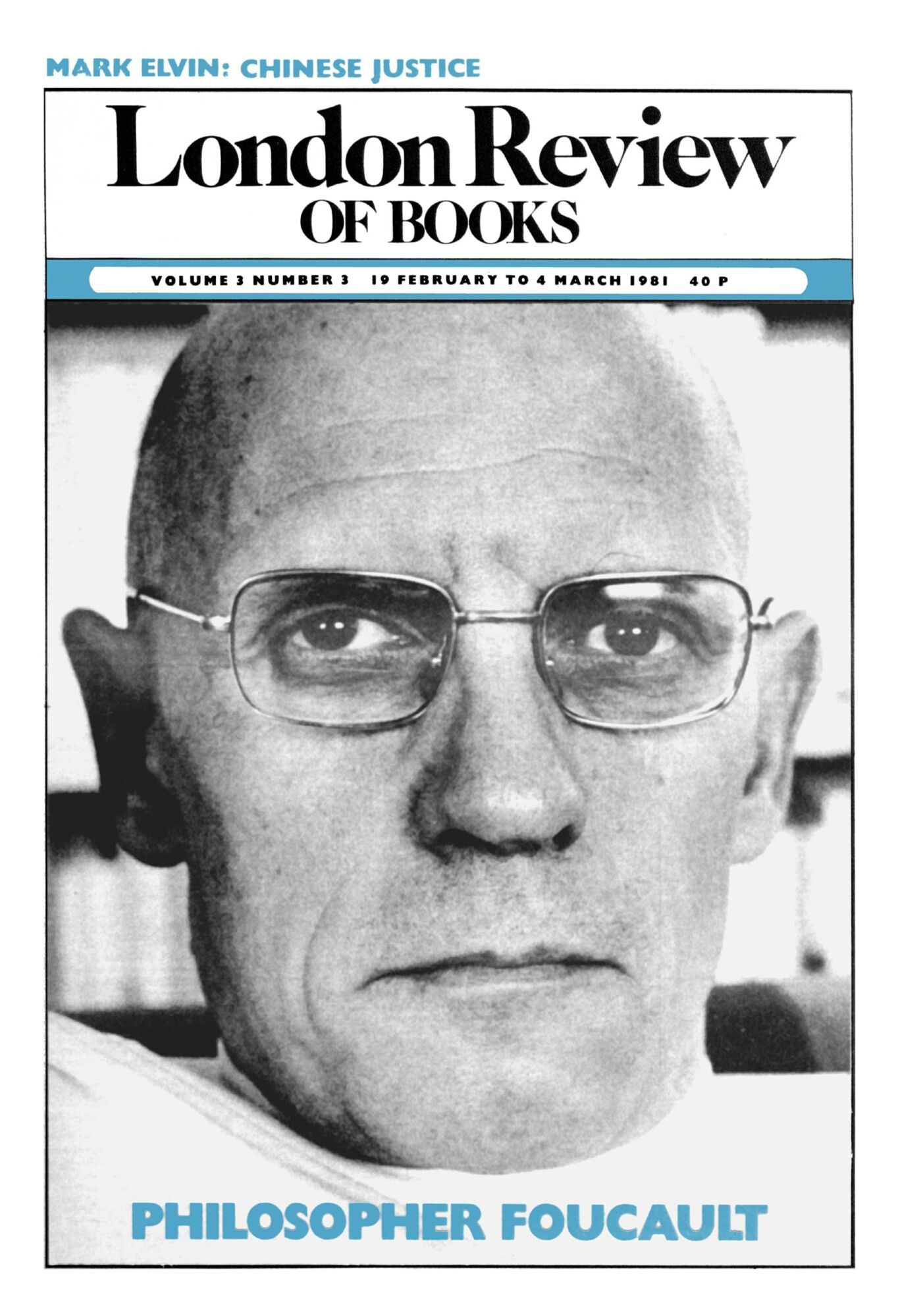
Russell and Wittgenstein and Heidegger and Sartre are dead, and it looks as if there are no great philosophers left alive. At the end of his book, Alan Sheridan hesitantly stakes a claim for Foucault: ‘It is difficult to conceive of any thinker having, in the last quarter of our century, the influence that Nietzsche exercised over its first quarter. Yet Foucault’s achievement so far makes him a more likely candidate than any other.’ This judgment is probably right. Foucault offers the two things which people want from a philosopher: a view about what values to place on current knowledge-claims, and hints about how to change the world. More specifically, he combines a sceptical judgment about the nature of science with concrete suggestions about how power might be taken from those who presently possess it. His view of knowledge derives from Nietzsche. His view of power derives from Marx. But he uses each of these men to criticise the other. The common complaint about Nietzsche is that he offers no social hope, no sense of human community. The common complaint about Marx is that he is in bondage to simple-minded 19th-century ideas about philosophy as ‘science’, that Marxist theory is a hindrance to Marxist practice. People who like Nietzsche on the subject of knowledge are embarrassed by Nietzsche on power. People who like Marx’s analysis of power-relations in modern society are embarrassed by his (not to mention Engels’s and Lenin’s) pretentions to methodological and epistemological theory. Foucault offers one a chance to be as sceptical about science and philosophy (and ‘theory’ generally) as Nietzsche, while being as socially concerned and politically-minded as Marx.
If Foucault can bring this off, he will have worked a combination which no other important philosopher of our century (except Dewey) has managed. Russell had both epistemological and social concerns, but the two had nothing in particular to do with each other. In this, he resembled most academic philosophers: e.g. Husserl and Quine. Wittgenstein and Heidegger resembled Nietzsche and Kierkegaard in thinking mostly about other philosophers. They spent their lives detecting the self-deceptions into which their predecessors had fallen, in diagnosing their spurious claims to philosophical knowledge. This left them little time, or inclination, to speak to, or about, society. Sartre tried to combine the kind of writing about other philosophers which exposes their self-deceptions with the kind of writing which mobilises men and women to create a better world. But his attempt failed. The more Sartre used themes from his early ‘existentialist’ writings to recast Marxist analyses in a new jargon, the better straightforward, old-fashioned Marxism looked. The more he tried to associate particular political initiatives with an over-all philosophical view, the more he seemed merely a knee-jerk revolutionary, able to offer a fast philosophical apology for anything which might hurt the French bourgeoisie.
Foucault’s attempt to get philosophy and politics together is much more wary, complicated and generally intelligent than Sartre’s. Sartre was a great writer who happened to be sucked into academic philosophy early on. He took it too seriously to be able to use it effectively (and thus produced, in Being and Nothingness, tedious neo-Husserlian ‘conditions for the possibility’ of this and that). Later he came to despise it, but by then it was too late for him to abandon it. I suspect that eventually we shall begin to neglect Sartre’s philosophical work, and remember instead short stories like ‘The Childhood of a Leader’, and some of the novels, plays and literary essays. If we drop ‘existentialism’ (not to mention ‘phenomenology’ and ‘structuralism’) from our vocabulary, we shall be able to see the mainstream of ‘Continental’ philosophical thought more clearly. We shall see it as an attempt to draw the consequences of Nietzsche’s claim that faith in ‘science’ is as hopeless as faith in God – that both are forms of ‘the longest lie’. The two most powerful of such attempts are those of Heidegger and Foucault.
Heidegger shrugged off Husserl and academic philosophy fairly quickly, and Foucault seems never to have taken either seriously – nor, for that matter, to have paid much attention to Heidegger. Like Heidegger’s, however, his work divides into a pre-Nietzschean and post-Nietzschean period – or, more exactly, an early period in which Nietzsche is not an important figure, and a later one in which finding the right response to Nietzsche becomes all-important. Foucault’s early writings – including the 1967 book which made him famous, The Order of Things – were histories of institutions, disciplines and vocabularies. They pointed a philosophical moral: that what counts as ‘science’ and as ‘rationality’ is a matter of rather suddenly formed ‘grids’, ways of ordering things. In these books, he showed us how what counted as ‘medicine’, ‘disease’, ‘madness’, ‘logic’, ‘history’, and the like, changed in startling ways at various periods. He was trying to exhibit the radical contingency of the concepts used at a given time, the looseness of fit between what went on and what people said and did about it.
Foucault thus made concrete and dramatic considerations which had been presented more schematically by Wittgensteinian philosophers of science such as Hanson, Toulmin, Kuhn and Feyerabend. The positivist idolators of ‘scientific method’ whom these latter men criticised were the last remnants – the rearguard – of the great army of thinkers who, from the Enlightenment onwards, had hoped to secularise culture by substituting for religious ideals ‘the quest for scientific truth’. Wittgenstein’s insistence that one cannot get outside language-games so as to compare our language with reality was used by Kuhn and others to construct a picture of science as a matter of working with (and using up) tools, rather than of seeing reality more clearly. Such Wittgensteinian criticisms of Enlightenment notions of ‘truth’ and ‘science’ will seem more paradox-mongering, however, as long as we retain the 19th-century picture of continuous, asymptotic, scientific progress – of knowledge as evolving and spreading in a continuously rational way. Foucault’s histories helped us see the discontinuities, the sudden twists and turns. His notion of an episteme, ‘the “apparatus” which makes possible the separation, not of the true from the false, but of what may be from what may not be characterised as “scientific” ’, and his illustrations of how such an apparatus can suddenly be cast aside, helps flesh out Kuhn’s notion of ‘paradigm’.
One difference between Kuhn and Foucault, however, is that Kuhn talks mostly about relatively ‘hard’ sciences (physics, chemistry), and Foucault about relatively ‘soft’ ones (sociology, psychiatry). From the abstract epistemological standpoint, there is no interesting difference between them: the theories and vocabularies of either are (on a Wittgensteinian view) to be seen as tools rather than representations. But from the point of view of power the difference is important. Our will to power is mostly a will to dominate other people. The way in which a scientific vocabulary defines what counts as rational doesn’t stretch far beyond assertions in the case of physics, but in the case of psychiatry it stretches to actions, institutions, permissible modes of life. So if one formulates a rejection of traditional representationalist epistemology in Nietzsche’s terms rather than Wittgenstein’s, one will concentrate on ‘the sciences of man’. Tools for doing things with people are better illustrations of Nietzsche’s point than tools for doing things which include balances and microscopes.
Foucault says that he was moved by the events of 1968 in France to begin thinking of himself as having been talking about power all the time. Demurring at the compliment that he was ‘the first person to pose the question of power regarding discourse’, he says in Power/Knowledge:
I don’t think I was the first to pose the question. On the contrary, I’m struck by the difficulty I had in formulating it. When I think back now, I ask myself what else it was that I was talking about, in Madness and Civilisation or The Birth of the Clinic, but power? Yet I’m perfectly aware that I scarcely ever used the word ...
When the events of 1968 turned him, as he says in the same book, toward ‘daily struggles at the grass roots level, among those whose fight was located in the fine meshes of the webs of power’, Foucault began to be less concerned with the specifically epistemological attempt (common to Nietzsche, Dewey, Wittgenstein and early Heidegger) to erase the traditional picture of knowledge as a relation between subject and object, words and things. He came to see his earlier self as having been bemused by ‘phenomenological’ talk about ‘meaning’, whereas ‘the history that bears and determines us has the form of a war rather than that of a language; relations of power, not relations of meaning.’ He now tries to say why the previous great attempt – Marx’s – to make this break, to get at the ‘materiality and contingency’ at the roots of the ways institutions have constituted what shall count as ‘rationality’, did not work. Whereas earlier he had made implicit use of Nietzschean arguments to criticise Cartesianism and Hegelianism, he now uses Nietzsche explicitly to criticise Marx: ‘It was Nietzsche who specified the power relation as the general focus, shall we say, of philosophical discourse – whereas for Marx it was the production relation. Nietzsche is the philosopher of power, a philosopher who managed to think of power without having to confine himself within a political theory to do so.’ This last phrase exactly expresses Foucault’s own present ambition, and it explains why he now has to make Marxist theory an explicit topic of reflection.
From the Marxist point of view, as Colin Gordon says here, ‘the trouble with Foucault’s [early] work was that its originality was in inverse proportion to its utility for Marxism.’ The problem Gordon is talking about is better described by Sheridan, who says: ‘The prospect of Marxist critics trying to get a grip on Les Mots et les Choses [The Order of Things] was rather like that of a policeman attempting to arrest a particularly outrageous drag-queen.’ Marxists found The Order of Things frivolous and fantastical. It not only failed to connect changes in conceptual superstructures with changes in the power-relations in society, but it treated Marx himself as simply one more, not terribly important, symptom of a peculiarly 19th-century way of seeing things. Eight years later, however, Foucault is saying that he would more or less accept that suggestion that the term ‘Marxist historian’ is a pleonasm, but he now wants Marxist history without Marxist philosophy – indeed, without a philosophical theory about the nature either of knowledge or of society. He sees Marx as still afflicted with the ‘will to truth’, and thus as driven to build a theory. He thinks that Marxists and liberal ‘behavioural scientists’ share the hope of finding ‘the secure path of a science’, and that ‘it is surely necessary to question ourselves about our aspirations to the kind of power that is presumed to accompany such a science.’ Whereas Foucault’s early work had been accused of being ‘pre-Marxist’, he now accuses the Marxists of being pre-Nietzschean. They are answering what he calls ‘the traditional question of political philosophy’: ‘how is the discourse of truth, or quite simply, philosophy as that discourse which par excellence is concerned with truth, able to fix limits to the rights of power?’ Rather, Foucault says, we should ask a question which is ‘much more down to earth and concrete’: ‘what rules of right are implemented by the relations of power in the production of discourses of truth? ... There can be no possible exercise of power without a certain economy of discourses of truth which operates through and on the basis of this association. We are subjected to the production of truth through power and we cannot exercise power except through the production of truth.’ If we take this latter claim seriously, we shall not expect to have a ‘theory’ about the ‘nature’ of either knowledge or power, because anything recognisable as a theory would be already part of the apparatus of social control which forms our society.
But then what does Foucault hope to give us, if not a theory? A history? Roughly, yes. But not a dialectical and eschatological history of the Hegel-Marx-Acton type which illustrates universal tendencies and places our own period half-way along a sequence. Rather, Foucault wants a ‘genealogy’, a ‘history of the present’ which explains to us why we are taking for granted what we think obvious (e.g. that lunatics should not be thrown in with criminals, that prisons are necessary for public safety, etc). Such genealogies would be ‘Marxist history’ in the sense that they would debunk contemporary liberal institutions. But they would be non-Marxist in that they would not assume that ‘power is essentially that which represses.’ That assumption is a corollary of the pre-Nietzschean assumption that man has a true self which ought not to be repressed, something which exists prior to being shaped by power. To dispense with this assumption is to free oneself from the temptation to bring all genealogies together in a ‘unitary discourse’, a science: ‘to all these demands of “Is it or is it not a science?” the genealogies or the genealogists would reply: “If you really want to know, the fault lies in your very determination to make a science out of Marxism or psychoanalysis or this or that study.” If we have any objection against Marxism, it lies in the fact that it could effectively be a science.’ Instead of a unitary science, we want lots of little ‘fragmentary’ genealogies – genealogies that will be usable by those caught ‘in the fine meshes of the webs of power’.
Power/Knowledge (and an earlier collection of translations of his essays and interviews, Language, Counter-Memory, Practice) can be read as cancelling and replacing Foucault’s earlier attempt to state the method and goal of his historical writing: The Archaeology of Knowledge, his stuffiest, most obscure and worst book. Especially in the interviews. Power/Knowledge is remarkably un-gurulike, very honest, and about as clear as an attempt to say something genuinely new can be. It ends with a helpful concluding essay by Colin Gordon, who offers the following admirable summary of Foucault’s new account of his aim and method: ‘the historical matrix of conditions of possibility for the modern human sciences must be understood in relation to the elaboration of a whole range of techniques and practices for the discipline, surveillance, administration and formation of populations of human individuals ... In order for a genealogy of this relationship to be possible, two complementary shifts of philosophical perspective are necessary: firstly, the discarding of that ethical polarisation of the subject-object relationship which privileges subjectivity as the form of moral autonomy, in favour of a conception of domination as able to take the form of a subjectivication as well as of an objectivication: and secondly, the rejection of the assumption that domination falsifies the essence of human subjectivity, and the assertion that power regularly promotes and utilises a ‘true’ knowledge of subjects and indeed in a certain manner constitutes the very field of that truth.’
In other words, Foucault is hoping finally to debunk the everrecurring Rousseauistic notion that once we get the nasty old social pressures off our backs we shall be good and wise and brave. He agrees with Hegel that there is nothing much to us without those pressures. There is no truth to be known about us except the truth which is ‘constituted’ by the vocabulary which some society lets us use. Nor is there ever going to be a society which dispenses with power, nor with a linkage between the theories which count as rational and the institutions which keep the population under control. We are never going to come out on the other side of language, nor is language ever going to be anything except something shaped by power. ‘Science’ does not free us from power, for science is just carrying out procedures which the language tells you to carry out. There is, in short, no hope at all for a grand break-through from Opinion into Knowledge, from Prejudice into Rationality.
This is as philosophically exciting as it is spiritually depressing. The reader who wants to get the philosophical implications clearly laid out without ploughing through Foucault’s corpus will find just what he needs in Michel Foucault: The Will to Truth. Sheridan – Foucault’s principal translator into English – has written a lucid but very sophisticated account of the trajectory of Foucault’s thinking so far. Devoting a chapter to each of Foucault’s major books, he organises his account around Foucault’s switch from ‘archaeology’ to ‘genealogy’. He tells us just enough about the events of Foucault’s career, and about the last few decades of Parisian intellectual life, to let one understand Foucault’s motives and allusions. Though quite free of any slavish devotion to the master, he deliberately refrains from criticism and writes a transparent, self-effacing prose – one which mercifully, and unlike a lot of English-language writing on Foucault, does not read like a translation from the French.
The third of the books under review, however, was a mistake. Herculine Barbin comprises the memoirs of a hermaphrodite who committed suicide, a nasty little fictionalisation of her life (‘A Scandal at the Convent’) by a psychiatrist named Panizza, and a very lightweight ten-page introduction by Foucault. Foucault is currently in the middle of writing a long work on sexuality, and these memoirs are one of the things he came across in his research. But they were not worth reprinting, much less translating. They do not help to answer, nor even help to ask, the question with which Foucault begins his introduction: ‘Do we truly need a true sex?’ About the memoirs, Foucault says: ‘one has the impression ... that everything takes place in a world of the feelings – enthusiasm, pleasure, sorrow, warmth, sweetness, bitterness – where the identity of the partners and above all the enigmatic character around whom everything centred, had no importance ... what she evokes in her past is the happy limbo of a non-identity ...’ But this is not borne out by the text. The memoirs convey very little. They read so much like soft porn that it is almost impossible to remember that they really are a desolate attempt at self-description.
Foucault urges that the structures of power have made life pretty well impossible for somebody whose sexual organs are intermediate. So they have: but that seems like saying that they have made life almost impossible for somebody who is deaf and blind. One is not going to feel the force of either remark unless one can think up some structures which wouldn’t have this effect. Foucault does not speculate about possible future utopias, either in connection with sexuality or with anything else. His suggestions about reform remain hints. But one wishes he would speculate. His obviously sincere attempt to make philosophical thinking be of some use, do some good, help people, is not going to get anywhere until he condescends to do a bit of dreaming about the future, rather than stopping dead after genealogising the present. His attempt to combine the practical utility of Marx with the stark intellectual purity of Nietzsche will not be much more than an ingenious dialectical manoevre, a brilliant philosophical ploy, unless he can join the bourgeois liberals he despises in speculating about where we go from here. Like Sartre, Foucault seems to hate the bourgeoisie more than he loves anyone else.
This leads him into the same sort of tolerance for Maoist bloodthirstiness as Sartre had for Stalinist terror. In the first interview in Power/Knowledge, Foucault out-radicals some Maoists by objecting to ‘People’s Courts’ as perpetuating the ‘judicial and penal apparatus’ which the revolution must get rid of. It all sounds much too much like a Nazi ideologue suggesting that the administrative apparatus for carrying out the Nuremberg Laws betrays the spirit of the National Socialist revolution, and hinting that it would be better if Jews were beaten to death on the spot by their neighbours. It is hard to see how someone who claims no longer to believe in a good, pure, true self which has been repressed by society can seriously suggest that ‘the masses will discover a way of dealing with the problem of their enemies ... methods of retribution which will range from punishment to re-education, without involving the form of the court which – in any case in our society, I don’t know about China – is to be avoided.’
I said earlier that Dewey – one of the great bourgeois liberals – was also the only great philosopher of our century who had managed to combine a radically original view of knowledge with social action. Dewey, too, was good at genealogy, but he would not have let his enthusiasm for that pursuit lead him to suggest that we abandon the rule of law. Some day, perhaps, Foucault will notice the difference between the French and the Soviet versions of ‘the disciplinary society’ (e.g. the differences between the two judicial and penal systems), and ask himself, for once, what the French bourgeoisie did right. Foucault’s move beyond Marx and Nietzsche is a brilliant initiative by a philosopher of the first rank. But whether the attempt will come off depends upon whether this new focus on power provides us with something more than increasingly sophisticated expressions of resentment.
Send Letters To:
The Editor
London Review of Books,
28 Little Russell Street
London, WC1A 2HN
letters@lrb.co.uk
Please include name, address, and a telephone number.
