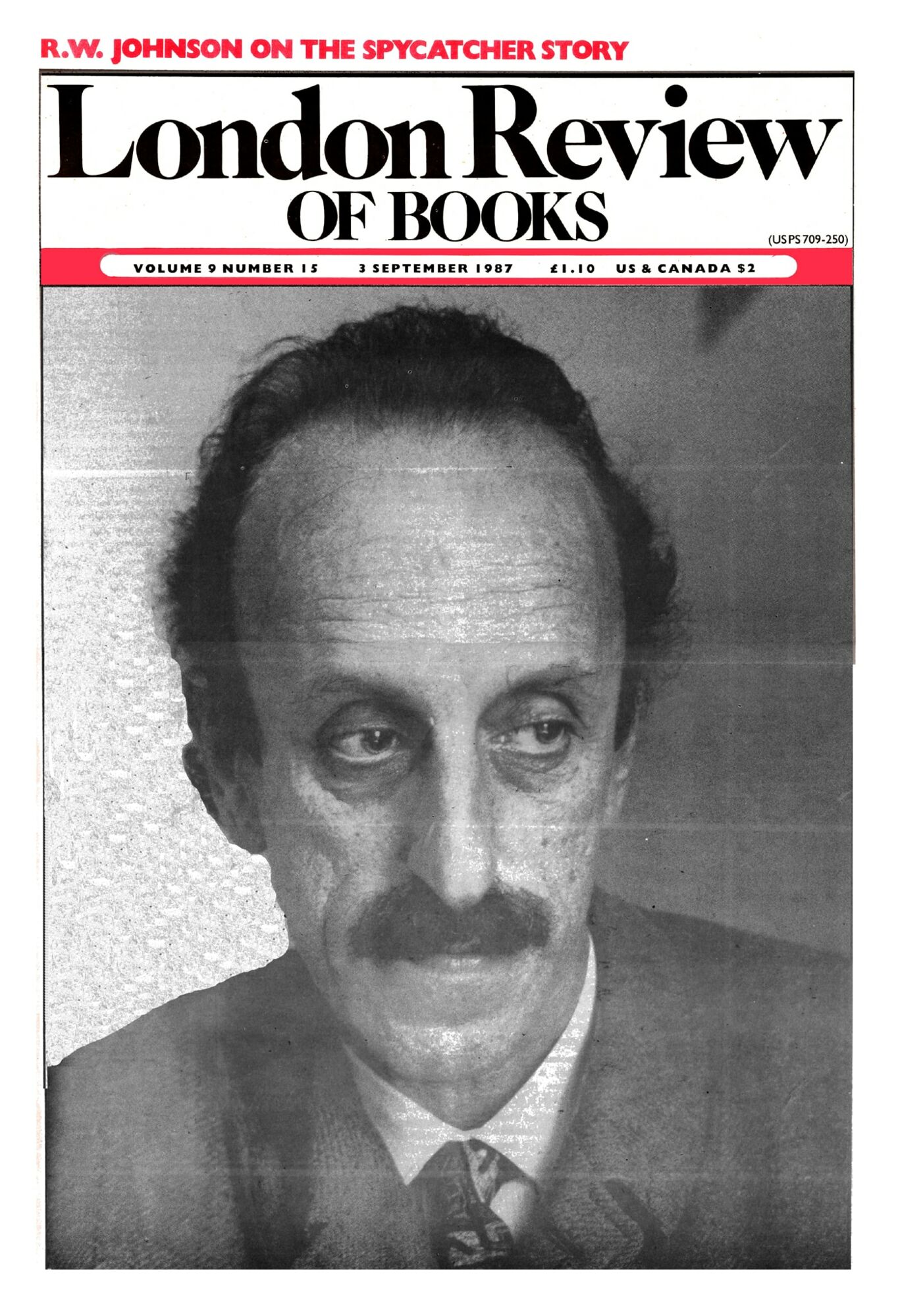
I only need to hear a few bars from Mozart’s G minor Symphony (K. 550) and in a flash Hans is as vivid a presence as he was when he was alive. Not any old bars, mind you: to be precise, bars 125 to 136 of the finale, where in a remarkable unison passage which propels us into the development Mozart exploits (almost) the total resources of the chromatic scale.
Hans thought it to be a presage, a harbinger, of serial organisation, as had Heinrich Jalowetz and Luigi Dallapiccola before him: Hans and I had published an article on Don Giovanni by Dallapiccola in Music Survey in December 1950, which had brought Jalowetz’s observation to our attention. One might argue about the prophetic dimension, but what is indisputable is the extraordinary intensity and compression of the music. It was the kind of explosive moment in music which Hans relished, and about which he always found something interesting to say. I can’t hear those bars now without thinking of him. I hear them, so to speak, through his ears.
I can think of many other such moments which would similarly excite Hans, when his generous moustache would quiver, his eyes – remarkable eyes – glow, and a smile of pleasurable recognition surface on his lips. There was another Mozartian characteristic – entries on (or from) the dominant minor – which gave rise to just such acknowledgment and was one of the tests by which Hans judged, say, a singer’s musicality. I was not at all surprised to find that this was one of the points Hans was to make in his 75th-birthday tribute to Peter Pears, published in 1985. His salute opened with one of those magisterial rebukes, ‘Every musician knows that normally singers are amongst the most unmusicianly, if not indeed unmusical, members of our profession,’ but went on to praise Pears (as Ferrando in Cosi) for something that Hans had always remembered: ‘his deeply moving dominant-minor entries (yes, each of them was different) in the A major duet with Fiordiligi: in my lifetime he has been the only performer with a deep insight into what the dominant minor meant to Mozart.’
I continue to look out for dominant-minor entries in Mozart performances and if they are insufficiently felt or badly executed, then I feel a sense of threefold outrage: on behalf of the composer, Hans and myself. It is a reaction that teaches us something about how closely related was Hans’s analytical thinking to performances and performing – something, of course, of which one is particularly aware in the study of the Haydn quartets which appeared last year.*
At the very start of what seems to me to be the most important of Hans’s books – at least of those published to date – he makes clear that he is addressing primarily the player – i.e. a string and quartet player – who alone can comprehend what, for Hans at any rate, was the ‘secret science’ of the string quartet. It is impossible, he suggests, ‘for any outstanding instrumentalist’ who is not a member of the magic string quartet circle ‘to understand a quartet player’s string quartet in all its intended dimensions; likewise, it is impossible for a composer, however great, to write an intrinsic string quartet if he himself is not a quartet player: the quartets of Brahms, Schumann, Debussy, Ravel, and yes, Bartok are more than adequate evidence.’
The somewhat daunting (and excluding) exclusivity of this approach – and in any case is the proposition true? – might discourage some readers who are not players from grappling with Hans’s text, which would be the greatest pity because the book offers us the most detailed account available not only of Haydn’s quartets but of Hans as incomparable teacher and coach – activities which, after his retirement from the BBC, consumed so much of his energy and brought him untold satisfaction. Here he is, in full flow, on the Adagio of Haydn’s B flat major Quartet, Op. 64, No 3:
In the Adagio, the second violin has to listen to its balance very carefully: it mustn’t forget that its solo bars in the principal section proceed under the first’s held notes, in aural view of which textural relation there is no need whatever to force the dynamics (mezza voce) – the less so since the lower two play a purely accompanimental role too, entirely supportive. They as well as the leading second fiddle won’t, I trust, fall into what one might describe as the all too frequent first-bar trap: the aim of the first bar’s respective phrases is – needless to add by now, one hopes – the second. The antecedent-consequent relationship between the two fiddles is rendered more complex and subtle by the leader not being silent while the second violin speaks, while the second, together with the lower instruments, observes at least partial, respectful silence during the more flowering responses of the first – though carefully considered, the silences don’t cover the actual answers, but the ensuing upbeat phrases, which the three lower instruments should be heard to be glad to leave in peace; it is up to the first violin’s free phrasing thus to convey the lower instruments’ happiness! The silences should not, however, encourage the leader to indulge in unusual liberties; what one hopes are his usual liberties will be quite enough.
Lucky players, lucky pupils! And lucky too even those of us who are not string quartet players or composers. Everybody, in my view, can learn something from, as it were, overhearing Hans think about music and its performance at this exceptional level.
Moreover, as one would expect of a musician for whom interpretation and analysis were virtually indistinguishable, the text continually throws up arresting analytic or historical insights and comments. For example, this on the finale of the C major Quartet, Op. 54, No 2: ‘The work’s most shattering and, if I may so put it, untimely innovation is, of course, the adagio finale, which turns the typical symphonic structure with two allegros upside down, throwing up two adagios instead. History books credit the 19th century with the symphony’s slow final movement, whether it came about by accident (Bruckner’s unfinished Ninth) or design (Tchaikovsky, Mahler). To my inadequate knowledge, not a single historian has noticed that Haydn was responsible for introducing this new symphonic form.’ Or this vintage bit of Kellerian paradox which startles one – performer or not – into a fresh perception of what a composer can get up to and how sophisticated and elaborate both our interpretative and auditory responses have to be. Hans is remarking on a case of ‘violent compression’ in the first movement of Op. 9, No 4, a consequence of which is that ‘transitional feeling flows over, pointedly has to flow over in performance, into the opening stage of the second subject, which therefore must not be allowed ever to settle down despite its well-established relative major key. For by the time it would have settled down (or has done so in the suppressed background), i.e. after the general pause, thematic definition leaves no doubt about the fact that we are approaching the main cadential stage, the end of the exposition: we have to be heard to have played the second subject that never happened.’ Hans’s italics, not mine, and a penetrating, wholly characteristic observation that combines practical instruction and analytic revelation. There was no one who could match Hans in this particular kind of commentary, which shows so well what he could accomplish with words, distrustful of them though he was when they were applied to music.
There are, needless to say, many oddities in the Haydn book – not only the credentials that one should ideally have in order to understand what Hans is writing about, but yet another bizarre hands-off injunction, this time to persuade players not to play, or attempt to play, the F sharp minor Quartet, Op. 50, No 4: ‘Haydn’s only supremely difficult quartet,’ we are told, for which reason Hans has relatively little to say about the work, whose challenging nature, on his own testimony, whets one’s appetite to know more. How was it, or why was it, that the supreme quartet composer seems bafflingly to have lost touch with his mastery of the ‘secret science’ and produced a quartet in which the ‘awkward bits’ preclude the possibility of adequate performance? Here, the conditions imposed by Hans the player seem frustratingly to get in the way of Hans the analyst.
But these are minor qualifications. The book, as Hans himself might have said, is a towering achievement, and fully justifies the prophetic remark to Hans’s teacher made by Franz Schmidt after hearing the youthful Keller participate in the performance – appropriately enough – of Haydn’s C major Quartet, Op. 64, No 1: ‘I can’t tell you what is going to become of this young musician, but one thing I can tell you: the world will know of him.’ And the world did. We come face to face with the prophecy on page 2 of Hans’s Preface and it would be a mistake to interpret it as an advertisement for himself. On the contrary, it is Hans laying his credentials on the line, for our inspection.
My quotations from the Haydn book show what a masterly writer on music Hans was – that is to say, how skilfully he conscripted words in the service of musical analysis. Did anyone use them better, more precisely, more meaningfully? And yet – another paradox – he would, I believe, have cheerfully abandoned words altogether if he could have done so. And indeed, in one area, he did: ‘Wordless Functional Analysis’ ‘burst upon the world’ in 1957. These are the words of Christopher Wintle, in the Memorial Symposium on Keller in Music Analysis, and Wintle shrewdly remarks that ‘it was less the matter than the wordless manner of FA that excited greatest musical interest.’ I must confess to finding myself in difficulties with FA, though I don’t doubt that at least some of them are of my own making. It may well be that I am so hopelessly word-bound that I find myself at sea when these familiar props are knocked away. But there are other considerations: the exclusive concentration of FA on the unity of contrasting themes, for example, which leaves so many of the other parameters of a work untouched and because of its exclusivity endows the one parameter with a primacy that might be open to question. Even more awkward, for me at any rate, is the very musicality of Hans’s wordless analyses, their ingenuity and persuasiveness: these, try as I may, begin to assume the status, almost, of independent compositions, and if not to demand, then at least to evoke, a response that is something different from the reception of Hans’s communication of analytic information.
Two contributors in the Memorial Symposium touch interestingly on this aspect of FA: Susan Bradshaw, who remarks that Hans’s ‘greatest original invention’ may have been ‘his destined compositional outlet’, and Alexander Goehr, who claims that ‘behind the form of his Functional Analysis stood a being who really wanted to communicate with the pitches and rhythms that were the subject of his investigation. Like Bernard Williams, who made philosophy by recomposing Descartes, he, I believe, almost thought you could make music by recomposing Mozart.’ In FA the medium and the message somehow proved to be not quite the same thing. Whatever our conclusions about or reactions to FA, however, we may be grateful that Hans stayed with words, without which we would not have had the Haydn book, the most single-minded of his major texts: the discursiveness of Criticism offers a strong and sometimes exhausting contrast here.† Nor would we have had him on his feet talking. Hans had an extraordinary capacity to marshal his thoughts and then deliver them verbally. As the thoughts materialised, so did the perfect, unhurried sentences which embodied them, a measured pace, neither dragging nor hurried, with never a pause for reflection nor a hesitation (only very occasionally was there the indication of a slight stutter).
Not only was there this enviable and singular clarity of thought and articulation: scarcely less striking was an unusual ability to be simultaneously gregarious and isolated (another paradox). Hans was able to sit among friends and conduct a conversation with them, smoke, swim – and at the same time methodically work at a current review or article or script. And what emerged on paper was quite as orderly and smooth-flowing as if he had been concentrating solely on the notebook in front of him. He was a master of this contrapuntal mode of life.
I got to know Hans well before the world did, as a result of encountering his ‘analytic’ criticism in the late Forties. I was so stimulated by it that I determined to get in touch with him. I had read somewhere, I think it must have been in Music Review, a long notice by Hans, most probably the performance of an opera (Mozart?) at Sadler’s Wells or Covent Garden. I was knocked out by it, by its precision, its confidence and all the very specific points it made, whether adverse or positive.
Gone were all those boring generalities and tedious descriptions, stuffed with modifiers and qualifiers – our Sunday-paper review sections are still littered with them – and in their place, detailed observations on rhythm, pitch, tonality, modulation, dynamics, nuances of expression, which left one in no doubt that here was a critic who knew what he was talking about. And even more amazing, knew the work he was talking about, from the inside outwards, as Hans himself might have said. Moreover, I seem to remember that, lest anyone might think that this critic had not done his homework, there were footnotes in which he laid out his sources. It was an astonishing performance – and there were many others of a like kind – which punched a big hole in the façade of English music criticism as it was practised in the Forties and Fifties. It has never been – or looked – quite the same since.
Very soon after our first meeting, ‘H.K.’ was among the regular reviewers of Music Survey, and in 1949 he contributed a notice of a production of Figaro at Covent Garden which was sub-headed ‘An experiment in concrete criticism’. This incredibly detailed review began, ‘And now, dear reader, open your score, and follow me right through the opera, particularly if you are engaged at Covent Garden,’ and ended, memorably, some three columns later: ‘In sum: The production is not so bad that you cannot enjoy much of it if you shut your eyes.’ More often than not at this time in his life, he would have his head in the score on his knees in the darkened theatre, checking out the performers and performance with the aid of a pocket torch and impervious to the indignation of his neighbours. A narrow, searching beam illuminating the score. There is something in this image that symbolises his early life as a music critic.
The first review I read of Hans’s brought us together. We found that we were living near one another, in South London, and arranged to meet – at a concert, I think at the Central Hall. Our first dialogue was on the phone, not only about where we were to meet, but how we should recognise each other. I was rather bewildered by this part of the conversation, which, on Hans’s part, not only included sensible references to his prominent moustache but, rather more mysteriously, signals about his ‘big’ nose. I must have been rather a naive young man, but it was some time before the penny dropped: this was Hans’s coded way of conveying to a stranger that he was a Jew. It pains me still to think of it, pains me above all to think that Hans should have thought it necessary to give me, in some sense, advance ‘warning’. If I mention it now, I do so because it shows how profoundly conscious he was of his Jewishness – something he was to make me conscious of, for the first time – and how deeply he had been affected by his fearful experiences in Vienna pre-war. What would he have made of President Waldheim’s Austria, I wonder? He would not, alas, have been surprised.
We got on famously at the concert and our next meeting was in Herne Hill, where Hans shared a house with his widowed mother. I had suggested to Hans that he might care, one day, to write a small book on Hans Pfitzner. ‘No,’ said Hans, ‘not Pfitzner, but Franz Schmidt’ – the Schmidt of the prophecy. I had barely heard of him and not a note of his music, and so had no opinion of my own. But now that I am better-informed, it seems to me to have been a revealing choice – very Viennese, traditional and conservative. The paradox of it all was that Hans could be, and I have come to believe was, all those things, and yet at the same time was so plainly sceptical, radical and innovative.
Hans might have scorned my thinking of him as ‘Viennese’: but he could be conspicuously Viennese when there was a part of that culture with which he could wholeheartedly identify himself. I remember very well when that wonderful old Decca set of Die Fledermaus first appeared (1951), with Julius Patzak (one of Hans’s heroes), Hilde Güden, and the rest. The discs were transported to the house next door, where Hans’s half-sister lived with her English doctor husband, and were played over and over again with the entire Keller family as audience – and no one enjoyed every inflection of the performance more than Hans and his mother. I got a sense then of the Vienna in which they had been steeped and which still meant so much to them, despite their brutal ejection.
Johann Strauss, Franz Schmidt, and of course Schoenberg, as powerfully authoritarian and authoritative as he was revolutionary. If one had to choose the 20th-century composer who might provide the perfect match with Hans, then it would have to be Schoenberg. With Stravinsky, it seems to me, that great contrasting pole, he never quite made his peace, despite the admirable and largely admiring work he did on the old master’s later serial pieces.
I can clearly remember a performance of Le Sacre at a Salzburg Festival, after which ‘primitive’ was a word that surfaced rather prominently in Hans’s response. I was to understand that this was criticism delivered at – or from – a very ‘high level’ (one of Hans’s characteristic phrases): but ‘primitive’ was his judgment of the piece. I wonder sometimes if he was not influenced here by Adorno’s somewhat similar views of Stravinsky.
I remember, too, Hans meeting Stravinsky at a Faber party in the old Russell Square offices in December 1958. Eliot was there, and it was probably an occasion that Hans greatly disliked. He didn’t get to speak to Stravinsky until the very end when, on saying goodbye, he half whispered into the astonished composer’s ear, ‘I think you’re a very great genius’ – and departed. I’m sure Hans meant it – and also launched it as a missile against all the smart party small-talk he so much detested. On the other hand, it also struck me as an example of a sometimes unnerving habit of his – of wanting to have it both ways, to hold to certain reservations and discriminations and yet at the same time to appear not to hold to them, or at least to have an exchange that on the face of it would seem to preclude holding any such qualifications.
I was not always quite sure how it was that Hans matched up or reconciled his contrasts. Small wonder that the unity of contrasting themes was one of his musical preoccupations. A more trivial instance of the same kind of thing came about in his disputes with Eric Blom, then music critic of the Observer, about musical matters that it would now be tedious to spell out. The tone of the correspondence was distinctly acrimonious and unflattering. But it did not stop Hans from telling Blom at the end of one of his letters, ‘You must be one of the nicest people I’ve never met’ – a formulation that rooted itself in my memory because it was uniquely Kellerian. But even while I was amused by it, I wondered what compelled Hans to write it? After all, the considerable wrong, without doubt, was on Blom’s side. There was something paradoxical in Hans – that word forces itself on one time and time again when writing about him – something that impelled him to the simultaneous delivery of the mailed fist and the generous embrace.
My Stravinsky recollections raise an issue which was central to Hans’s writing and to our understanding and evaluation of it. I refer to the positions he took up with regard to contemporary music, and especially to European music of the first half of the century. There can be no doubt of Hans’s brilliant work in this field. I am not thinking only of his championing of Schoenberg and Britten – a complementary and paradoxical pair – but of his thinking about what actually constituted ‘composition’ in the second half of the century.
He was the very first, I believe, to point out that the established means of evaluating new music, which had hitherto been able to rely on assumptions about the composer’s technical competence, the precision of his ear, his intent to communicate, could not be applied to music composed according to an entirely different set of rules – or rather without any rules at all, neither technically nor as to what in fact was admissible as ‘music’. Hans was quick to see that as soon as literally everything was possible, a lot of absolute nothingness could acquire a wholly spurious significance. He also cautioned critics, I think again for the first time, in one of his first broadcast talks, made after his return from an International Society for Contemporary Music festival, to be exceptionally wary about falling into the trap of trying to avoid at all costs criticism’s miserable record of judgment in relation to the new music of the past. This guilt, particularly evident in England (where one might concede it proper for critics to have felt guilty), led to judgments of contemporary music which had more to do with the fear of yet again missing the critical boat than with any genuine perceptions about what was on offer. Indeed, very often there was nothing to perceive. He writes about this superbly in Criticism. ‘Impressed ... by the total failure of their forefathers to catch up with new developments and recognise new major talent, not to speak of the genius of a Schoenberg or Britten (or Gershwin, for that matter), the latest generation of music critics, and to some extent of critics of the other arts, has decided to rush into positive evaluation without the slightest understanding – just to be on the safe side. Pseudo-bridges are being built now, cardboard bridges that give themselves the appearance of concrete – but when you step on them, they and you crash into the abyss. The new method of positive incomprehension has even affected the older critics who, paradoxically, are now far more tolerant towards the latest nonsense than they were towards the latest sense twenty years ago.’ It was thus that Hans made a powerful contribution to the forming of essential discriminations about the music by which we were besieged in the Fifties and Sixties – random music, chance music, and the rest, so much of which now is as dead as yesterday’s Daily Telegraph.
One might think that this radical scepticism about many of the manifestations of the ‘new’ music in the Fifties and Sixties reflected Hans’s conservatism, and one would be right – the best side of it, one ought to add. His orthodoxies were founded on the primacy of the ear. This same scepticism led to a famous scandal in 1961, the ‘Piotr Zak’ affair, a jape perpetrated by Hans with the assistance of Susan Bradshaw, when he was employed by the BBC. Hans, very typically, wanted to prove his point about critics falling headlong into the trap which I have mentioned: the sense of a historically-determined duty to be abreast of the times which anaesthetised their ears and prevented them from distinguishing between what was music and what was, in Hans’s view, demonstrably not. So, with his accomplice, Hans darted about a studio in which a fair number of percussion intruments were conveniently housed, and recorded what they were randomly, exuberantly and mischievously ‘creating’ – a bang here, a crash there, crescendi and diminuendi, strokes, rolls and general clatter: this was the time of liberated percussion, when exclusively percussion pieces were in vogue. The concoction was given a convincing title and a pedigree, attributed to Piotr Zak, and put out on the Third Programme as a first broadcast in a concert of contemporary music.
When the hoax was made known, the consequences were more percussive than anything Zak could have imagined. Hans was accused of double-crossing the critics and abusing his position at the BBC. I don’t think he felt the slightest bit guilty on either count. Some day someone ought to research the Zak affair systematically and document the reactions of those who wrote about this significant première in the press the next day. Some were caught out, some wobbled, some were rightly dismissive. Christopher Wintle, in the Memorial Symposium, writes that Zak’s Mobile was ‘not received with much enthusiasm’. On the other hand, Milton Babbitt, who seems to have been offended by the whole enterprise, suggests that the Keller/Bradshaw creation ‘apparently was greeted with mainly enthusiastic reviews’. My own impression was that reviews were, in tone, negative rather than positive. No one, however, realised that it had been a hoax. The whole rumpus proved in the end somewhat inconclusive. In short (as Hans might say), there were too many cards stacked against auditors who in other circumstances might have rumbled what was afoot. The ‘performance’ was put out with the backing and authority of the BBC, its authenticity guaranteed by the billing in the Radio Times, the announcer’s presentation. There was no excuse for those who took the work seriously, but it is difficult to blame those who wrote about the piece as if it had been composed, was ‘real’, however bad and empty. How could it have been otherwise? So strong were the factors conditioning the way listeners heard the piece that it was useless, in my view, as an experiment. But it was a characteristic bit of bravura on Hans’s part and the intention was serious. It might have been deadly if it had been differently circumstanced – as an anonymous wine-tasting, say, with a bottle of Zak introducted among the respectable beverages. But perhaps less fun.
While one may criticise the format of the Zak affair, the position Hans adopted with regard to this particular and modish eruption of non-music seems to me to have been impregnable and valuably corrective. I think his touch was a shade less certain in regard to earlier – and indeed major – manifestations of the ‘new’.
Stravinsky, I have already suggested, was a case in point. His unease about that composer showed up, by the way, in the symposium we jointly edited on Britten in 1952. Stravinsky received short shrift there – something for which William Glock, in a broadcast review, justly took us to task. This at times thinly veiled hostility gave rise to one of Hans’s many bons mots: a devastating (and I now think wrong-headed) dismissal of The Rake’s Progress – the culmination of Stravinsky’s neoclassical period – as the result of ‘a process less allied to composition than to stamp-collecting’.
If I went along with that at the time, it was because my ignorance of Stravinsky equalled Hans’s antipathy. But in later, wiser and more knowledgeable years, I came to comprehend the opera as the masterpiece it is. And when Hans and I were revising our old symposium for a reprint many years later, I shyly suggested (as Hans might have said) that we should take the opportunity to revise our views, of Stravinsky in particular. But he would have none of it. It was not for the Hans Keller of 1971 to criticise the views of the Hans Keller of 1952 who was no longer around to stand up for himself – which rather neatly left on one side the formulation of what those later views might be.
Identical with those of 1952 would be my guess. His important introduction to Milein Cosman’s sketchbook, Stravinsky at Rehearsal, significantly concentrates on the psychological motivation of the composer’s serial ‘conversion’ in works written after 1952, though it does include unusual and unqualified praise of the Symphony of Psalms – ‘a spotless and gigantic masterpiece, where identifications with the past span a wide field’. Just so. But in that case, why not rehabilitate The Rake’s Progress?
There was on occasion an inflexibility in Hans, as if once having committed himself to an opinion, he was stuck with it for ever. The opinions, the ideas, without question, were extraordinarily powerful and arresting, with an influence out of all proportion to their number. Hans, it seems to me, worked his ideas extremely hard. But they were brilliant, fundamental perceptions which he continually re-polished and refined and recapitulated in new contexts, and in their very narrowness was their strength. One may regret that the field was not wider – but it meant that Hans was only writing about what he himself felt he fully understood.
This last point Hans was to make again and again in his writings. Indeed, it was a point he made against other critics, whose adverse criticism he attributed, often rightly, to a lack of basic understanding of what they were reporting on. (I think it was much the same point that Erwin Stein used to make in suggesting that where there was no sympathy there could be no worthwhile criticism.) Hans makes another statement on the subject on the very last page of Criticism: ‘Every single reader, one or two soft-boiled critics apart, will be able to think of at least one distinguished critic who would have deserved a top salary, and a relaxing pension, for remaining silent all his life. Once again, I speak with the corroboration of personal experience: the noblest critical achievements of my life were the moments when I decided to shut up, temporarily or, as in the case of most of the music of Debussy, Delius and Sibelius, for ever. The amount of nonsense I have thus not committed to print, the violence and posthumous torture which has remained unpractised, would have made me a serious rival of the most highly-esteemed members of the profession if all those pseudo-thoughts, those thin rationalisations of incomprehension, had been allowed an outlet.’ A characteristic if somewhat tortuous formulation, but I must confess these days to serious misgivings about the adequacy of it as a response to certain composers. It may well not matter too much, or at all, if one does not understand composer A or composer B, and it will certainly be to everyone’s gain if one refrains from writing about them. Hans lists Debussy among his exclusions (and Alexander Goehr, in the Memorial Symposium, adds Monteverdi, Mussorgsky and Messiaen). But is it good enough, I wonder, when a composer, like Debussy, is so central to the whole history and evolution of 20th-century music, simply to respond, in effect: ‘no understanding: no comment.’ If he were about, I should put it to Hans that there is a handful of composers where one has a positive duty to understand their work and if necessary to write about it, to evaluate it, whatever one’s doubts and shortcomings. The Stravinsky of the early decades of the century, and Debussy – these seem to me to be two blank patches at the very centre of the brilliant lens which Hans brought to bear on the music of our century.
Perhaps, too, there is a suspicion – unworthy? – that bound up with Hans’s self-denying ordinance was a distinct cultural bias. Gallic music, Gallic culture generally, was not his scene. I have referred earlier to his conservatism, and surely part of the abstention from Debussy had its roots in an Austro-German tradition which found it difficult to recognise any other, or at least feel comfortable with it. One shouldn’t hold Hans to things said in front of the TV camera which he might have modified or qualified or edited out if he had been alive when the film was finally assembled. I refer to the Channel 4 obituary, significant stretches of which struck me as being everything that Hans was not: pompous, pretentious, posturing (and occasionally inaccurate). Hans was not a boy wonder who became a prophet or cosmic ombudsman. He was an intensely human human being, often very funny, and on occasion – and like the rest of us – endearingly innocent about himself. This showed up in the film in a memorable flash in which Hans was giving an account of his musical education – an orthodox one, naturally – as a child in Vienna. His mother and family friends made an inspiring contribution: the domestic, chamber-musical experience was undeniably critical to his musical evolution. ‘By the age of ten,’ he concluded, ‘I knew all music.’ All music? It’s not scoring a flippant point if I suggest that that slip of the tongue tells us a good deal about Hans and about the soil from which he sprung.
It was this very innocence that adversaries often misunderstood as arrogance. It enabled him to make those breathtaking claims which, if they fell from other lips, one would react against vehemently. In Hans’s case, the impact certainly made one draw breath – but then one was jolted into thinking.
To this same part of his personality I attribute his claim to have conducted a self-analysis. I don’t mean for a moment to suggest that this was a false claim, but the result of it was in some ways odd. How was it possible that someone as knowing as Hans, and as knowledgeable about others, could from time to time seem to know so little about himself? And yet one also realises that if for Hans there were to be any analysis at all, it would have had to be self-analysis. Can anyone imagine him submitting himself to – for – analysis? I can’t. He was the most independent person I’ve ever met, and I cannot see how anyone so resistant to submission could ever have managed a relationship with an analyst, in which some element of submission is inescapable.
As for Hans’s own strictly psychoanalytical studies, there were a number of published professional pieces which the Memorial Symposium usefully lists. During the Music Survey years Hans talked more than once about projects on which he was collaborating with a psychologist, Margaret Phillips. Did one of them have something to do with prostitution? I remember sitting late at night after a concert in one of those pavement coffee-houses in May-fair that were popular in London in the Fifties and observing that the business conducted next door was of quite another order. The sight of one of the ladies entering the house prompted Hans to tell me something about the investigation he and his colleague had undertaken. I wish I could claim that the lady who triggered off this conversation had proved to be an interviewee! None the less, the vivid memory I have of an occasion which was peculiarly Viennese in its ingredients – a heady mixture of coffee-house, prostitution and psychological probing (Schnitzler, perhaps?) – was gloriously confirmed by at least one of the unpublished essays from this period based on interviews and found among Hans’s papers after his death: ‘Prostitutes wear marriage rings.’
Hans would occasionally clasp his head in his hands and give vent to a half-mocking cry of despair: ‘Oh God!’ The image comes to mind when I think of Hans and football and my inability to say anything about it at all. I feel strongly inclined to shelter behind Hans’s own injunction: shut up when you don’t know what you’re talking about. I can’t, of course, and confess to perceiving a gross disproportion between the skilled attention Hans gave soccer and the skills the game brings into play. Why didn’t Hans grow out of this surely adolescent enthusiasm?
Hans would have much deplored my saying that, so let me make amends by acknowledging what we owe to his not growing out of certain musical enthusiasms which belonged to his youth and stayed with him for ever. There cannot be a single friend of his who was not, very early on, made aware of his belief that the ‘only’ violin concerto – I exaggerate, but not much – was Mendelssohn’s: and so it is unsurprising from one point of view that a completed monograph on the work was discovered among Hans’s papers after his death and awaits publication. Unsurprising, but also mysterious. There is something strange and strangely selfless about Hans bringing these books to completion in manuscript and then abstaining – or so it would appear – from pursuing their publication. Other, more immediate concerns may have intervened – teaching, topical articles and commentaries, his failing health – but even so, how puzzling not to have taken the next step with regard to these major enterprises. It is almost as if he felt that his responsibility was discharged once he had got his thoughts down on paper, and that ours – to attend to the more mundane business of publication – began where his ended. I don’t think anyone could deny that Hans’s ego was a forceful one, but it seemingly did not impose itself in those very areas of ego-assertion peculiar to authors. Can one think of a like case of a writer detaching himself from the business of disseminating his thoughts? There was something inspiringly unworldly about Hans. Perhaps part of this same extraordinary selfless detachment was also to be found in his indifference to possessions, to money (uncashed cheques surfaced among his papers, along with his unpublished manuscripts), to all the trappings and trivialities of status. He cared for none of them.
In other areas Hans could and did assert his ego to uncomfortable effect. He was not, I think, quarrelsome, but there were occasions when he would pick up a topic on which he knew his audience held a different view and hammer away at it to excess. I was sorry that this seemed to have happened on the only occasion Britten and Pears visited him at home, for dinner – I recall that Deryck Cooke was another guest. It would scarcely be worth mentioning here but for the fact that Hans quite often referred to the incident himself (and does so again in Criticism). It appears that Britten and Pears left the dinner party somewhat abruptly. The cause of the trouble, I believe, was Hans’s conviction that Britten was too bland in his social relationships, too conventional, too consistently polite, only rarely spoke his mind, would not open up. Hans had very little patience with social graces and rituals and was determined to break through the mask which he assumed Britten habitually wore. The dispute which developed was not a musical one, but focused on Britten’s strongly held pacifist attitudes and the 1967 Middle East conflict. Nothing came of it, other than Britten and Pears’s hasty exit. Hans took this to confirm his suspicion of Britten’s mannered manners. On Britten’s side, there remained a slightly bruised, even bewildered feeling. It seemed not to occur to Hans that guests whom one had invited to dinner might not expect a drubbing for their views. In any event, outwardly conventional or not, Britten discounted his bruises and came to dedicate his third and last string quartet to Hans, which says perhaps everything that needs to be said about a relationship that was always happiest when embodied in notes rather than words.
The Britten incident indicates that a little bending might have eased an awkward social situation. But to bend was not Hans’s way. And ultimately, the implacable will had a powerful functional role to play (as Hans himself might have said). Did he not decline to bend – to submit – to death, even to the point of resolutely not acknowledging that he was mortally ill? Death might – and did – take him, but he would not surrender. This made for discomfort and unease. But it was an heroic, epic performance on Hans’s part and an entirely characteristic one, though I profoundly wish that he had not had to play it.
I wept when I heard the news of his death. He was so much part of my life, of the way I thought, and think, that I still find it difficult to accept his death. He was by far the most important and original music critic of his day, though he would have disdained the title. I loved him. I shall never forget him.
Send Letters To:
The Editor
London Review of Books,
28 Little Russell Street
London, WC1A 2HN
letters@lrb.co.uk
Please include name, address, and a telephone number.
