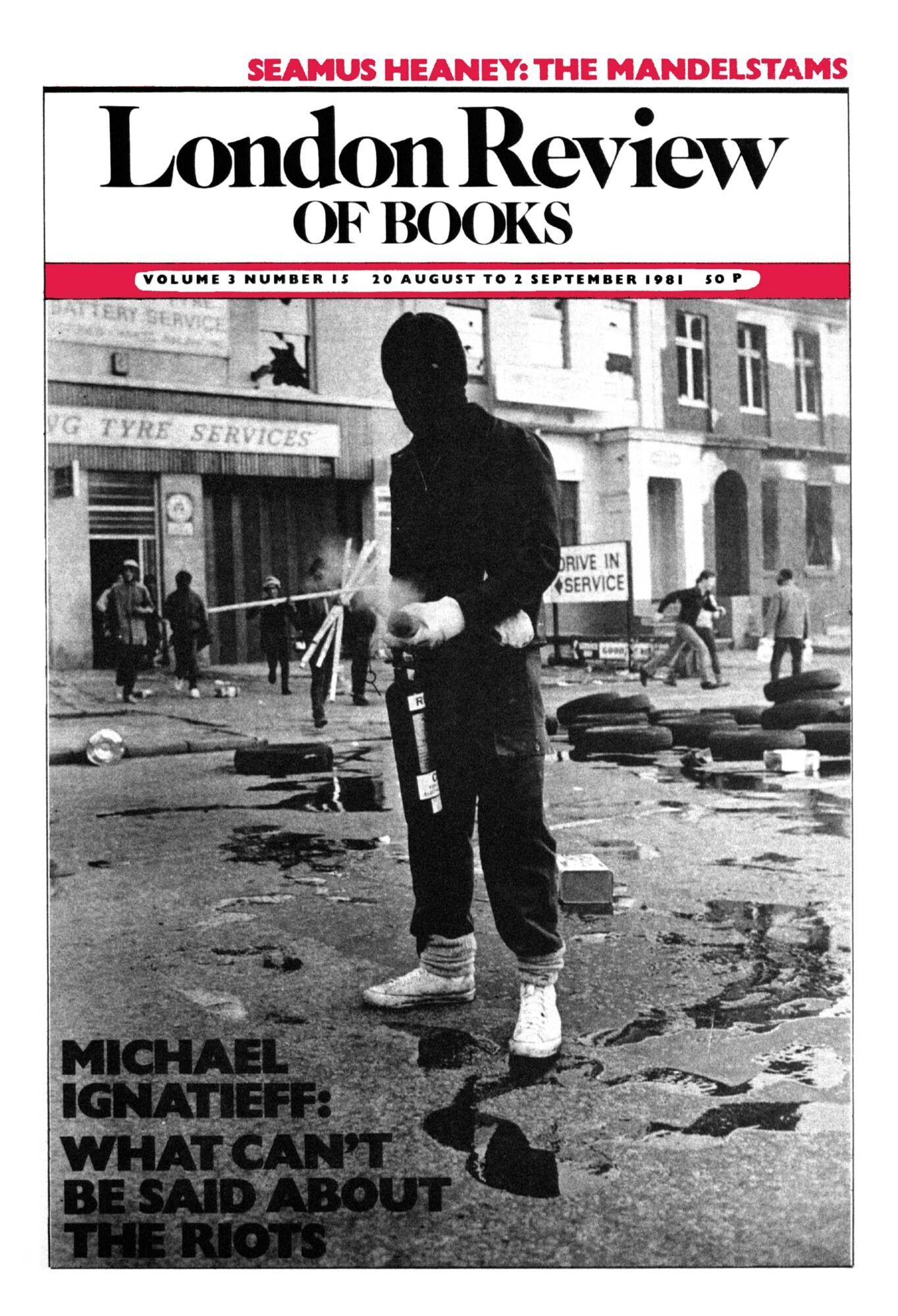
The morning after Toxteth and Moss Side, the Daily Express front page asked its readers ‘HOW MUCH MORE MUST WE TAKE?’ This ‘we’ lends itself to easy caricature. It is ‘Outraged, Tunbridge Wells’ writ large, an army of indignant blue rinse. It is the passive ‘we’ of embattled parents, distributing blame to the ungrateful children with the aggrieved cry ‘What have we done to deserve this?’
In the wake of the riots, every newspaper seems to have its ‘we’. The Daily Mail’s poster, showing that chic woman of a certain age who is ‘Edinburgh every festival, United every season and the Daily Mail every day’, leaves no doubt whose indignant script its editor aspires to write. This chic woman is not so much spoken for as laid claim to, in the hope that real women will associate with the fantasy on offer on the hoardings. She stands for the ‘we’ whom the editor assumes will not guffaw when breakfasting over his 10 July headline, ‘EXTREMISTS’ MASTER PLAN FOR CHAOS’.
The Times leader of 10 July addresses an Englishman who it believes capable of occupying every discursive position at once:
Britain is a multi-racial society with a good deal of racial hatred, yet little is done to enable people to comprehend and combat the evil of racialism. It will not be resisted by preaching integration. That is a fallacy of the Sixties. It is unrealisable, it is questionable if it is desirable and it raises more fear and animosity than it dissipates with its overtones of inter-racial sex, marriage and a coffee-coloured Britain. Tolerance does not require that every Englishman should have a black man for his neighbour or that every Asian should forget his cultural identity. Instead we must acknowledge and understand the existence of social pluralism.
It is not surprising that the Times’s Englishman turns out not to include Asians or blacks. What is curious is the belief that it can be consistent to be against racism and against having black neighbours.
Even though most of the ‘We’s’ for whom the papers presume to speak turn out, on inspection, to be some fraction or other of the white ‘talking classes’, each ‘we’ is an imperialist, asserting its claim to be taken as the universal, the consensual ‘we’. Yet each ‘we’ can only be given an identity by specifying which groups it excludes, and which registers of fear, condescension and concern it employs when speaking of ‘them’. One ‘we’ can be identified by its use of the term ‘hooligan’, another by its penchant for the euphemism ‘New Commonwealth immigrant’. Discourse which employs code-words like these cannot be described as a collective attempt to see and understand, but rather as the rhetorical display of pre-given certainties. No wonder, then, that the discourse on riot has a ritualised familiarity to it.
The riots are the sort of social occasion which sets off intense competition among politicians and journalists to commandeer consensus. There are rewards for those who succeed in defining and then speaking for the largest ‘we’. At Westminster, a scattering of rhetorical gambits at the outset of the riots has been followed by convergence, as each side fights for the right to speak in the name of the narrow centre.
At a time when British politics are more sharply polarised than they have been for a generation, the two major parties are speaking a surprisingly similar language about the riots. In the adjournment debate on ‘Civil Disturbances’, MPs as far apart as Joan Lestor and Michael Heseltine agreed that the speeches had transcended party politics. Of course there were exceptions. No Tory MP joined Stuart Holland and John Fraser in their criticism of the Police in Brixton, and no Labour MP supported Winston Churchill’s call for an end to immigration. Between these poles, however, there was agreement that the British Police should not arm themselves like the French CRS, that ‘tough talk’ about law and order would not solve the problems of the inner cities and that money thrown at the right targets would make some difference. Even Michael Heseltine did not argue that the inner cities needed less money, but rather that they needed more spent on capital-investment projects and less on public-sector wage claims.
This relative convergence of opinion may break apart again if Michael Heseltine or his busload of City gents fail to find sufficient sovereigns to spare from their pots of gold. The temporary consensus against arming the Police with water cannons, CS gas and rubber bullets may not survive another episode in Toxteth or Brixton. Yet while this curious lull in the storm of party invective holds, it is worth examining how it has become possible, even temporarily. The explanation most flattering to MPs would be that in an hour of crisis they had risen above party. It would be more true to say that debate has converged because all sides of the House, but especially the Labour side, are sharply constrained by the rules of responsible discourse. Labour spokesmen have gone as far as they dare in blaming the riots on Tory policy: to go further is to risk seeming to make political capital out of what is understood as a national tragedy. Their own record in office on inner-city problems is hardly brilliant. They also risk seeming to justify riot: but this constraint is more confining than it need be. There is no reason why criticism of a government’s failure should exonerate individuals of their criminal responsibility. Those convicted in court will pay for what they have done. To explain and to criticise is not to justify. If Mrs Thatcher can make it seem so, she will have won the battle to set the terms of public debate.
The second rule for responsible comment is that all sides of the House are required to give support to the Police. This is a rule which Labour speakers have honoured more in the breach than in the observance, but breaking it can be made to have consequences, as Michael Foot discovered when he declined to offer immediate bipartisan support for water cannons, CS gas and rubber bullets. The Prime Minister straightaway insisted that he was being less than loyal to the hard-pressed boys on ‘the front line’. Military metaphor helps in enforcing the rule.
On this issue, it seems to have been the Prime Minister, not the chief constables, who has made support for water cannons etc the discursive test of support for the Police. The constables themselves seem aware that policing the crisis will be more efficient if they remain custodians of the British police tradition. There are ironies in this tradition, not the least of which is that the Police have also made themselves the guardians of the very traditions of British liberty which were marshalled against their coming in 1829. This triumph of ideology and practice may have its costs. It’s quite possible that the French and the Americans have more to criticise in their Police, but they are also less constrained, by tradition and ideology, in making responsible criticism. Our taboos have their uses – in this case, forcing the impetuous to weigh the cost in police paranoia of injudicious wisdom after the event – but they can also inhibit full debate on what the Police themselves describe as a major breakdown in police-community relations.
Faced with this rule, Roy Hattersley has skirted the issue of policing with concerned but imprecise condemnations of bad housing, fiscal neglect and unemployment. This is an economistic language which speaks of riot as the inevitable explosion, the moment when the spark hit the tinder. Tories like Ian Lloyd enjoy demolishing this inevitabilism, citing the example of wretched but peaceable Glasgow as proof that Labour’s correlation between poverty and looting is ‘seditious sociological claptrap’. The correlation may not be claptrap, but it offers no purchase on those nuances of differential response to equivalent conditions which the Tory rhetoric of hooliganism does actually address, in insisting that it is criminal motive not conditions which triggers riot.
Historical analogy with the 18th-century food riots, examined by E.P. Thompson, suggests that explanation should look beyond conditions to the specific legitimising notion or incident which gives reason to riot. In Toxteth, for example, it was not just any arrest which started the trouble but the arrest of the son of a Jamaican car-worker, Leroy Cooper, who was already seeking civil damages against the Chief Constable of Merseyside for the alleged harassment of his other son. Such incidents do not ‘justify’ riot, but they do invite us to consider the violence which follows neither as an inevitable response to conditions, nor as the ‘mindless’ suivisme of hooliganism, but as the chosen behaviour of individuals who at least deserve to be deemed responsible for what they have done. The Tory language of hooliganism and the Labour language of conditions deny them even that.
The third rule of responsible comment in the House is to minimise the racial ‘element’ in the disturbances, by taking cold comfort in the fact that blacks and whites rioted together, and by uniting in the comforting ritual of banning Enoch Powell from the confines of respectable discourse. The banishment of Powell allowed the House the comfort of believing that ‘we are all multiracialists now.’ Yet the real divisions on race reappeared surreptitiously in linguistic usage, some MPs speaking of ‘blacks and Asians’, others of ‘immigrants’ and others of ‘New Commonwealth’. Each usage corresponds to a distinct politics of race.
These rules served to cool antagonisms, to create a useful temporary image of political statesmanship and bipartisanship in the House. At a time of real social tension, such rules have their uses in the short run, but their effect on creative thought and open debate is likely to be the same, in the long run, as the current rule of discourse, only recently breached, which forbade discussion of withdrawal in party debate on the future of Northern Ireland.
The most curious feature of the discourse on riot, both inside and outside the Commons, has been how people of opposite political persuasions have been able to find common ground in nostalgia for the solidarities of the old inner-city working-class community. The most grandiloquent expressions of this nostalgia have come from those identified with the Left: Jeremy Seabrook’s interpretation of looting as ‘the loss of morality in these poor, proud, stoical working communities’ (Guardian, 20 July), or Erin Pizzey’s invocation of the lost days, forty years ago, when there was family discipline in the working classes (Sunday Times, 12 July). It is not merely that these elegies sit oddly with Seabrook’s own savagely unsentimental recollections of growing up working-class in Northampton, or with Erin Pizzey’s special acquaintance with wife-battering among the working class. It is also that these Labour populists find themselves in company with Rhodes Boyson, Timothy Raison and others who read the riots as the failure of post-war society to find disciplines to replace those lost to the working class by consumerism, unionism and permissiveness. One would have expected William Whitelaw’s proposal to make parents responsible for their children’s fines to strike a chord with the shires, but not with Labour populism. In the ‘Civil Disturbances’ debate, patriarchal nostalgia knew no party. Both parties elegised the old back-to-backs, and blamed the looting on homes where children returned, in the words of one MP, ‘to find a 50p piece from mother and a message telling them to get a bag of chips’. Some Labour MPs wanted no part of this thinly-veiled rush to single out working mothers, single-parent families and fathers on overtime, but even those who would not swallow the patriarchal registers of the discourse on the decay of working-class community did share the belief that something had cut the heart out of the old popular solidarities.
If community has been destroyed (and nostalgia plays havoc with social description), Labour and Tory spokesmen seemed to agree that it was the urban-development bulldozers of the Sixties which did for it. The riots occurred in places both blighted by the collapse of industry and vandalised by the arrogant good intentions of planners, city councillors, architects and builders. Jim Lester observed that the riots in Nottingham’s Hyson Green began, not in the back-to-backs, but in a new housing complex fondly known by its inhabitants as Alcatraz.
What has sobered the debate on solutions is the realisation that when there was money to ‘throw at the problem’ it went to the wrong people for the wrong purposes. The question now is not only how to find the money to buy back a form of community thrown away by money spent in the past, but who is to spend it: the councillors and planners, the enterprise-zone entrepreneurs, or the neighbourhood leadership itself. When the debate reaches that issue, the convergence of opinion of the last few weeks is certain to disappear, and politics as usual will resume. The neighbourhoods are unlikely to be well-served if the language of solutions divides into the rhetoric of ‘enterprise zones’, on the one hand, and ‘municipal socialism’, on the other. That set of choices can only be enlarged if the leadership of the communities can find the voice to insist that they are the ones to decide where the money should go.
One wants to believe that not only the community leaders, but the real protagonists of the drama – the 16 and 17-year-olds in the billiard halls and on the street corners – will be given the right to speak for their needs. But such a torrent of respectable opinion, such a clamour of ‘we’s’, has descended upon them, that they have been talked into silence. They have been spoken for and spoken to so many times, by so many knowing voices, that when the time comes for them to speak, they may not even bother. They may choose, once again, to act. What they need to know is that they will be heard when they speak, and not only when they act.
Send Letters To:
The Editor
London Review of Books,
28 Little Russell Street
London, WC1A 2HN
letters@lrb.co.uk
Please include name, address, and a telephone number.
